Strong March Job Growth Gives Fed Room to Focus on Inflation
The U.S. economy added 178,000 jobs in March, blowing past Wall Street's forecast of 59,000 and giving the Fed cover to keep rates steady while battling above-target inflation.

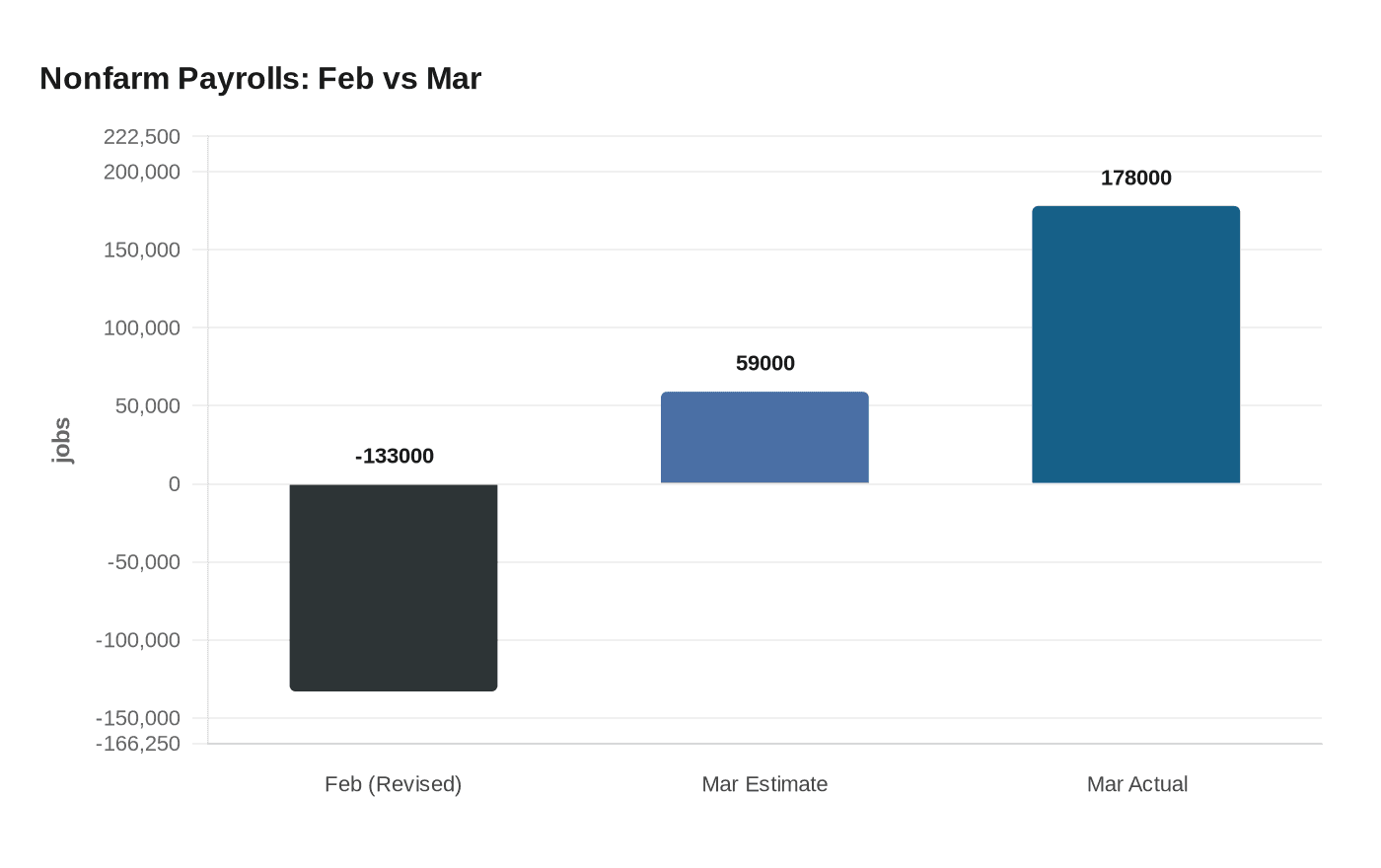
The U.S. economy added 178,000 nonfarm payroll jobs in March, the Bureau of Labor Statistics reported Friday, easily surpassing the Dow Jones consensus estimate of 59,000 and reversing the revised loss of 133,000 jobs in February. The unemployment rate ticked down a tenth of a point to 4.3%, though economists noted the decline owed more to a shrinking labor force than to genuine employment gains, with the labor force participation rate slipping to 61.9% from 62%.
Health care carried the bulk of the expansion, contributing 76,000 of the month's total. Federal government employment, by contrast, fell another 18,000 in March, extending a contraction that has now erased 355,000 federal jobs, or 11.8%, since the sector's peak in October 2024. Financial activities shed 15,000 positions, with finance and insurance alone accounting for 16,000 of those losses.
Wage growth cooled modestly. Average hourly earnings for private nonfarm employees rose nine cents, or 0.2%, to $37.38, pulling the annual pace down to 3.5% from 3.8% the prior month. The average workweek edged down 0.1 hour to 34.2 hours.

The report lands against a backdrop of persistent inflation well above the Federal Reserve's 2% target and surging energy prices. Futures markets responded to the data by pricing in virtually no probability of any movement at the Fed's April 28-29 Federal Open Market Committee meeting.
"The bottom line is March was somewhat encouraging, but it's been a rocky year for the labor market with almost no hiring since last April," said Heather Long, chief economist at Navy Federal Credit Union. "The March data will keep the Federal Reserve on hold, but no one is declaring victory yet. It's likely to be a tough spring for job seekers."
The context behind that three-month average, roughly 68,000 jobs per month, matters for understanding Fed calculus. The St. Louis Federal Reserve estimated recently that payroll growth of as little as 15,000 could keep the unemployment rate steady, meaning March's headline number, while encouraging relative to expectations, still reflects a labor market that has substantially downshifted from its post-pandemic pace.
The number of long-term unemployed, those out of work for 27 weeks or more, held at 1.8 million in March but has risen by 322,000 over the past year, a sign that the costs of the slowdown are accumulating beneath the surface even as monthly headlines improve. For policymakers watching both sides of the Fed's dual mandate, March's report offered just enough stability to stay the course on rates without triggering any urgency to act.
Sources:
Know something we missed? Have a correction or additional information?
Submit a Tip