Studies warn AI reliance may erode doctors’ and engineers’ skills
AI is speeding up doctors and coders, but early studies suggest it may also be leaving them less able to work without it.

The sharpest warning from AI’s rise is no longer about machines replacing jobs. It is about workers getting faster while losing the skills that make them good at the work in the first place.
Nature flagged that risk on June 18, saying early studies are raising concerns that reliance on AI systems may be degrading the abilities of physicians and software engineers. The danger is most acute in fields built on judgment, pattern recognition and repeated practice, where a tool that does too much can leave the human operator less prepared when the tool disappears.

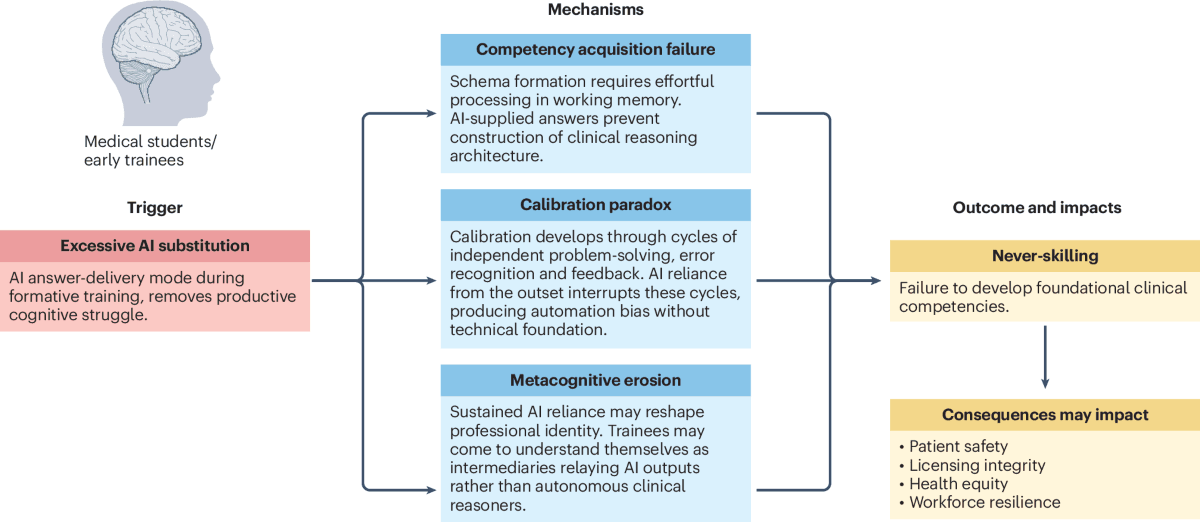
Medicine is already showing the tradeoff. In Pakistan, a randomized controlled study involving 58 physicians found that large language model assistance improved diagnostic reasoning performance on six clinical vignettes by 27.5 percent. That helps explain the appeal of these systems in hospitals and medical imaging. But it also sharpens the concern raised by Nature Medicine, which argued in June that physicians in the AI era should be treated as context engineers, with AI governed around the data, patient and workflow rather than substituted for judgment. A separate Nature Medicine perspective asked whether trainees who rely on AI will fail to develop foundational independent clinical reasoning.
The institutional worry is broader than any single doctor’s performance. BMJ Quality & Safety warned in May that clinical deskilling can create organizational risk because teams may not notice skill erosion until care processes become dependent on AI. A 2026 JAMA Network Open Viewpoint also cautioned that overreliance can lead to both deskilling and mis-skilling, with the biggest risk falling on medical students, residents and fellows who have not yet built expertise.
Software development is now facing a similar reckoning. An April 2026 arXiv study on skill formation found that novice workers who rely heavily on AI to finish unfamiliar software tasks may compromise their own skill acquisition. A separate longitudinal study of professional software engineers using AI coding assistants began with 158 eligible respondents, followed 101 at follow-up and kept 95 in the matched cohort; 82 percent said they spent less time writing code after adopting the tools. Another industrial study in telecommunications and FinTech found that AI’s productivity effects depend on task complexity, coding skill, domain knowledge and integration quality.

The broader pattern is not limited to medicine or programming. A 2026 arXiv study found that AI assistance improved immediate performance on arithmetic and reading tasks, but people did worse once access to the tool was removed. That is the central policy question now facing schools, offices and professions built on judgment: how to use AI as a support system without turning competence into a hidden casualty.
This article was produced by Prism’s automated news system from verified source data, official records, and press releases, then run through automated quality and moderation checks before publishing. The system is built and supervised by the people who set the standards it runs under. Read our full AI policy.
Know something we missed? Have a correction or additional information?
Submit a Tip