Study finds vaping after quitting smoking may not cut lung-cancer risk
Among 4.5 million former Korean smokers, those who vaped after quitting had higher lung-cancer risk than people who stayed off nicotine entirely.

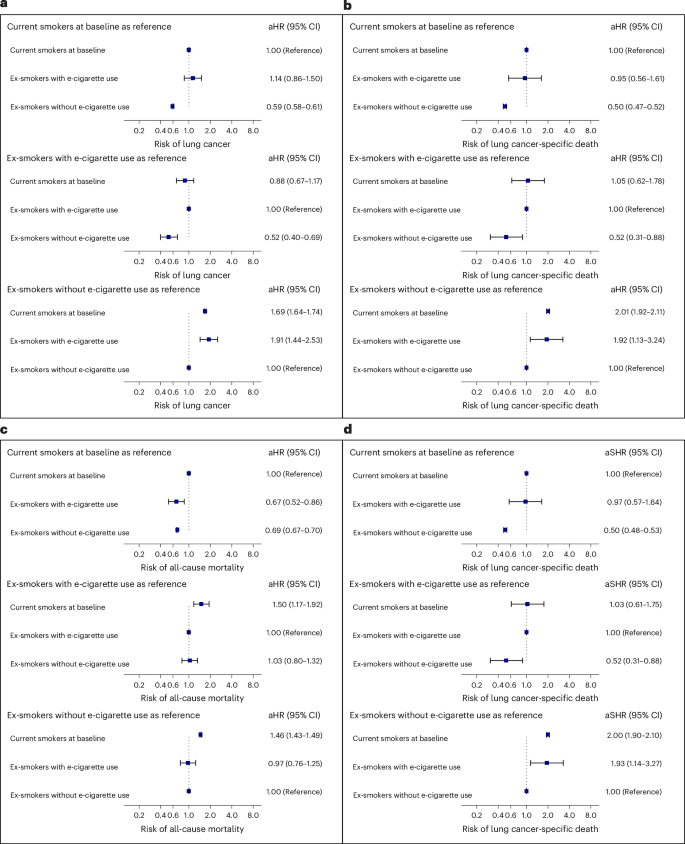
Vaping after quitting cigarettes may not deliver the sharp lung-cancer risk drop many smokers expect. In a nationwide South Korean study of 4,524,895 adults with a smoking history, people who quit smoking but then used e-cigarettes had higher lung-cancer incidence and higher lung-cancer deaths than those who quit without vaping.
The paper, titled Electronic cigarette use after smoking cessation and lung cancer risk, was published June 8 in Nature Medicine by Yeon Wook Kim, Eung Joo Park and Choon-Taek Lee. Nature’s news coverage on June 14 highlighted the same central finding: lung-cancer risk was higher in people who took up electronic cigarettes after quitting than in those who stopped smoking completely.
Researchers drew on the Korean National Health Screening Program and prior records from 2012 to 2014, then followed participants through December 2023. Daily e-cigarette use at baseline defined post-cessation use. Over 24,182,543 person-years of observation, the study recorded 35,887 lung cancers and 12,807 lung-cancer-specific deaths, giving the analysis enough scale to detect even modest differences in risk.
The finding matters because it pushes back on a common public assumption that switching from tobacco to vaping should produce a steep drop in cancer danger. The study does not say vaping is the same as smoking, but it does suggest that using e-cigarettes after quitting may blunt some of the health gains that come from complete cessation. The authors concluded that e-cigarette use after smoking cessation may attenuate the benefits of full smoking cessation for lung-cancer prevention.
That nuance carries weight for clinicians and public-health officials trying to message risk honestly. Tobacco use remains the leading cause of preventable disease and death in the United States, yet e-cigarettes still occupy a contested place in cessation advice. Nature has previously published arguments that nicotine e-cigarettes can help some people quit smoking, alongside more recent clinical guidance stressing that there are no safe tobacco products and that regulation should be pragmatic and evidence-based.

The Korean setting gives the study extra policy relevance. South Korea’s National Lung Cancer Screening Program launched in 2019 for adults ages 54 to 74 with a heavy smoking history, reflecting how central smoking-related cancer prevention remains. With a nationwide single-payer screening dataset behind the new paper, the evidence is unusually broad, and it challenges anyone treating vaping as a clean handoff from cigarettes to safety.
This article was produced by Prism’s automated news system from verified source data, official records, and press releases, then run through automated quality and moderation checks before publishing. The system is built and supervised by the people who set the standards it runs under. Read our full AI policy.
Did this article answer your question?