Super Meat Boy Remains One of Indie Gaming's Most Beloved Brutal Platformers
Fifteen years after release, Super Meat Boy's razor-sharp 2D platforming and instant-respawn design still define what it means to make dying feel fun.
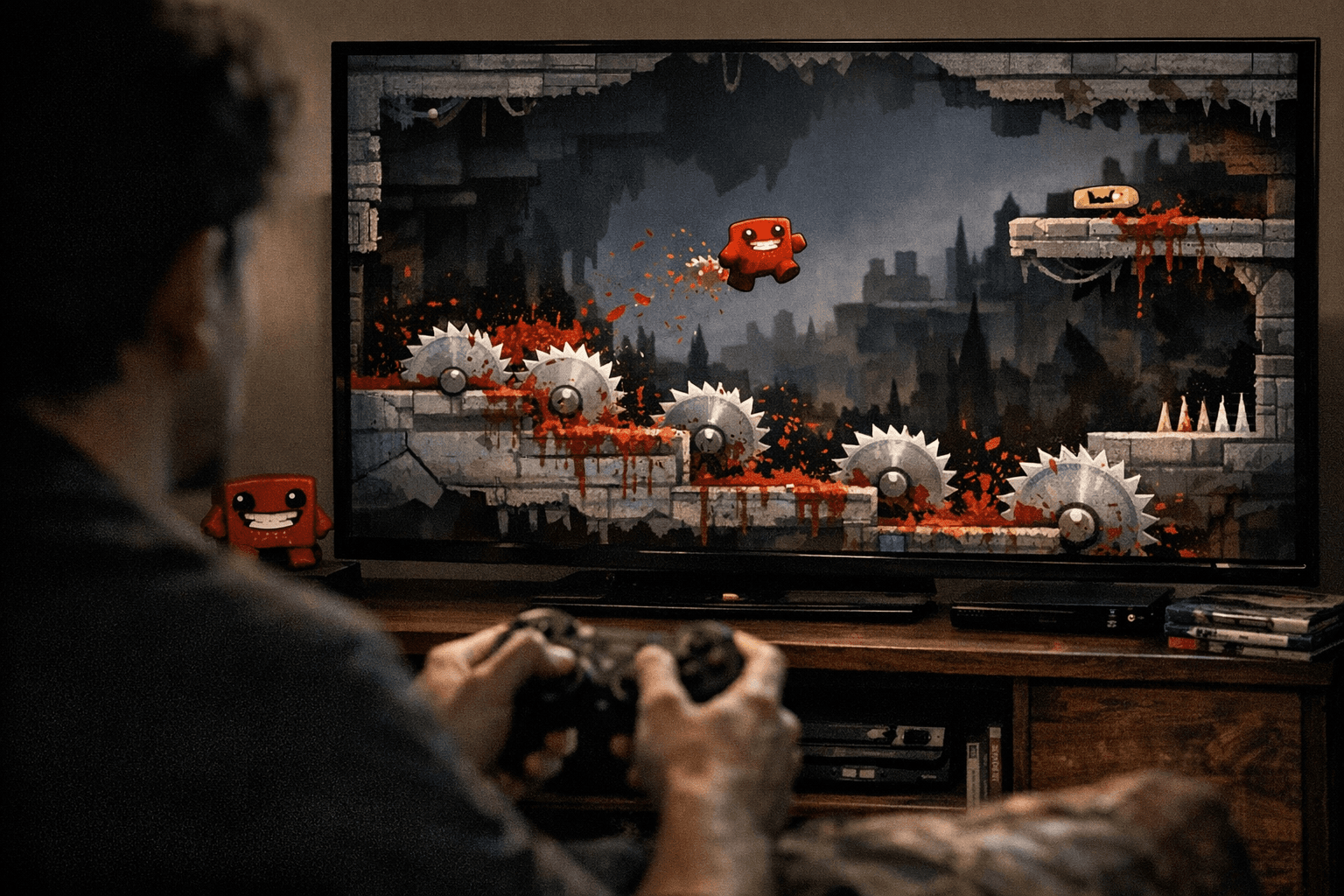
Fifteen years on, Super Meat Boy sits in a category with very few companions: games so mechanically pure that players return to them not despite the difficulty, but because of it. Released on October 20, 2010, on Xbox Live Arcade and then on Steam the following month, the game from two-person studio Team Meat transformed a grotesque little Flash experiment into one of the defining artifacts of the indie game era. Understanding why it endures means understanding exactly what it asks of you, and what it gives back.
From Newgrounds to Cultural Touchstone
Super Meat Boy traces its lineage to 2008, when designer Edmund McMillen and programmer Jonathan McEntee built a Flash game called Meat Boy for Newgrounds. The character was originally named Meat Ninja before being renamed to avoid confusion with another Newgrounds title, The Ninja from N. After three months of development, that Flash game found a devoted audience, and McMillen began imagining something larger.
He found his collaborator in Tommy Refenes, a programmer he had also met through the Newgrounds community. Together they founded Team Meat, and together they spent roughly two years building the expanded, commercial version. Microsoft initially projected low sales for the game, citing its 2D format as a liability. That skepticism proved spectacularly wrong. The game sold over 400,000 copies worldwide in its first months and crossed 1 million sales by 2012. It was the fourth-highest-rated PC game of 2010 and collected more than 15 Game of the Year awards.
The Premise is Simple. The Execution is Not.
In Super Meat Boy, you control Meat Boy, a red, cube-shaped character who is, literally, a skinless blob of muscle. His girlfriend, Bandage Girl, has been kidnapped by the villainous Dr. Fetus, and your job is to navigate more than 300 hazardous levels to rescue her. The story is delivered with absurdist humor, but the gameplay is entirely serious: fine control, split-second timing, and precise jumps through environments packed with buzz saws, spike pits, pools of needles, salt flats, and crumbling cave systems. The worlds range from haunted hospitals to salt factories to Hell itself.
What separates Super Meat Boy from games that merely describe themselves as hard is the quality of its controls. Meat Boy can run, jump, and wall-slide with a responsiveness that makes every failure feel earned rather than arbitrary. When you die, which will happen hundreds of times, you restart immediately with no loading screen and no long death animation. The level resets in an instant and you are back at the beginning. This near-instant respawn is the game's masterstroke: it converts frustration into momentum.
The Die-Retry-Learn Loop
The "die-retry-learn" loop that Super Meat Boy perfected is not accidental. It emerges from the intersection of two deliberate design choices: levels are extremely short, typically lasting between five and thirty seconds for a successful run, and failure carries almost no penalty beyond the time lost. The result is that each attempt functions like a single repetition in a training drill. You absorb the layout, you identify where you failed, and you try again with a slightly better mental map of the obstacles ahead.
The game reinforces this loop with a clever replay feature. After completing a level, the game simultaneously plays back every single one of your failed attempts alongside your successful run, showing a swarm of Meat Boys all dying at various points while one makes it through. It is simultaneously humbling and hilarious, and it makes the victory feel genuinely earned.
Earning an A+ grade by completing a level within a specific time threshold unlocks the Dark World version of that stage: a harder, often visually distinct variant of the same level with new hazards and tighter demands. Dark World levels are not required to complete the game, but they exist for players who find the standard levels insufficiently punishing.
Warp Zones and the Love Letter to Indie Gaming
Hidden throughout Super Meat Boy's levels are portals called Warp Zones. Finding and entering one transports you to a bonus stage that operates under different rules. Some Warp Zones apply the art style of older video games and restrict you to three lives, a stark contrast to the standard game's unlimited respawns. Others are themed around other indie games entirely, functioning as short crossover tributes built into the architecture of the game itself.
This indie camaraderie extends to the game's roster of unlockable playable characters. Completing specific Warp Zones or collecting enough hidden bandage items unlocks characters from other independent games, each with unique abilities. Commander Video from the Bit.Trip series can momentarily float in midair. Tim from Jonathan Blow's Braid brings his own movement properties. Alien Hominid, the Headcrab, Spelunky's spelunker, and even Steve from Minecraft all appear as playable alternatives. At a moment in gaming history when indie developers were forming a genuine community and mutual support network, Super Meat Boy made that solidarity tangible and playable.
Soundtrack as Architecture
The original Super Meat Boy soundtrack, composed by Danny Baranowsky, matches the game's energy with precision. Each world carries its own sonic identity, shifting from industrial grind to eerie ambience to frenetic electronic propulsion depending on the setting. The music does not just accompany the action; it amplifies the psychological state the game is trying to create, which is somewhere between focused intensity and controlled panic. Baranowsky's score became one of the most discussed elements of the game's release and remains a reference point for how video game music can function as an emotional accelerant rather than mere background texture.
Why It Remains Relevant
Super Meat Boy helped establish that independent studios could build games that competed with major studio releases on quality without compromising on creative risk. Team Meat had no external investment: their cost was time, not capital, and that freedom allowed them to build something idiosyncratic and uncompromising. The game's influence can be traced directly to titles like Celeste, Hollow Knight, and The End Is Nigh, all of which adopted Super Meat Boy's philosophy of punishing precision combined with forgiving respawn mechanics.
The game also seeded the speedrunning culture that has grown enormously since 2010. Its short, self-contained levels, tight physics, and A+ grading system make it a natural fit for time-attack play, and it remains actively run in the speedrunning community. The precision required to shave seconds off a level's completion time is exactly the same precision the game teaches through normal play, making the transition from casual player to speedrunner feel like a natural progression rather than a genre shift.
Super Meat Boy proved that a game built around dying repeatedly could be not just tolerable but genuinely joyful. That achievement, more than the sales figures or the awards, is why it still matters.
This article was produced by Prism’s automated news system from verified source data, official records, and press releases, then run through automated quality and moderation checks before publishing. The system is built and supervised by the people who set the standards it runs under. Read our full AI policy.
Did this article answer your question?