Sistine Chapel's Secret Nighttime Crew Keeps Michelangelo's Masterpiece Alive
A Vatican nighttime crew battles tourist sweat coating Michelangelo's frescoes in white salt, working 5:30 p.m. to midnight to preserve the 500-year-old ceiling.
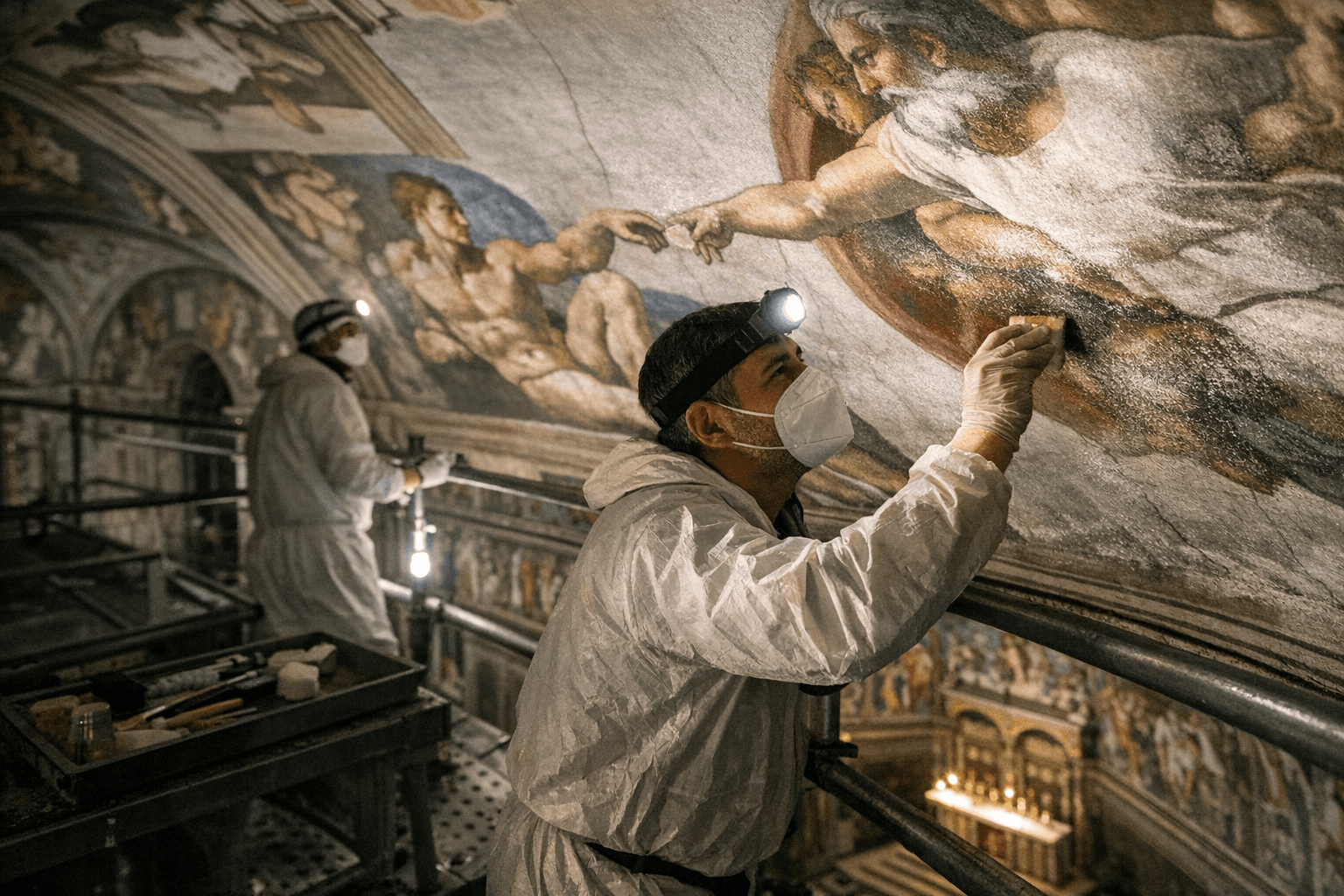
The Sistine Chapel's most important visitors arrive at 5:30 p.m., long after the paying public has gone home. Every January and February, Vatican conservators work from dusk to midnight, scaling heights of up to 20 meters on a crane-like platform nicknamed the "Spider," a Multiful SMX 250 self-propelled tracked machine, to tend to one of the most consequential painted surfaces in human history.
"Although we do it every year, the power of the experience never dims," said Vatican Museums conservator Vittoria Cimino.
The approximately one-month annual routine involves restorers knocking on plaster to detect detachment, checking for paint flaking, and removing contaminants while they remain soluble. The work is never truly finished. The chapel's 12,000-square-foot ceiling, where Michelangelo rendered scenes from the Book of Genesis between 1508 and 1512 under commission from Pope Julius II, faces an adversary that grows more powerful each decade: the visiting public.
The chapel now draws 5 to 6 million visitors annually, with as many as 25,000 passing through on a single day. The human body is itself a conservation threat. Former chief restorer Francesca Persegati described the physics bluntly: "Our bodies are made of water so when we visit the Sistine Chapel, we bring in humidity and heat, everyone heats the environment like an 80-watt bulb." Lactic acid from visitors' sweat evaporates, rises, and condenses on cooler plaster surfaces, reacting with calcium carbonate to form calcium lactate, a white salt that accumulates as a film over the frescoes. Carbon dioxide and bacteria compound the problem over time.
Keeping that chemistry in check requires constant surveillance. An array of 30 hidden sensors monitors temperature, air circulation, and visitor numbers around the clock. The chapel's climate must remain precisely calibrated: temperature between 22 and 24 degrees Celsius, humidity between 55 and 60 percent. High-tech air purifiers were installed in 2014, and LED lighting, which emits no UV rays capable of fading pigments, has since replaced older systems.
By early 2026, the accumulation had become severe enough to warrant what Vatican Museums officials called an "extraordinary maintenance" intervention, the most significant work in roughly 30 years. Scaffolding went up in February targeting The Last Judgment, Michelangelo's monumental altar wall fresco depicting 391 figures across nearly 2,000 square feet, painted between 1536 and 1541. Current Head Restorer Paolo Violini cited a "widespread whitish film" of calcium lactate that had diminished the chiaroscuro contrasts and original colors. Curator Fabrizio Biferali noted that the altar wall runs colder than the others, producing more condensation and a heavier buildup. Barbara Jatta, director of the Vatican Museums, framed the expected results simply: "People are going to be able to see Michelangelo's magical, marvellous colours again." A team of 10 to 12 conservators worked from scaffolding covered with a canvas reproduction of the fresco so visitors could still view an approximation while work proceeded, with completion targeted for Holy Week in early April 2026. Daily visitor capacity was capped at 24,000, and new climate control systems for the upper and lower galleries are planned before the end of 2026.
The central irony is not lost on conservators. The landmark 1980–1994 restoration, led by chief restorer Gianluigi Colalucci and sponsored by Japan's Nippon Television, stunned the art world when it stripped centuries of grime, soot, and animal glues to reveal brilliant ultramarine blues and vermilion reds. Visitor numbers subsequently climbed from roughly 1.5 million annually to over 5 million by 2011. The restoration's success created the preservation crisis that now demands a nighttime crew, 30 sensors, and a "Spider" machine running until midnight each winter.
Conservation here has never been a modern invention. In 1625, a restorer named Simone Lagi cleaned Michelangelo's ceiling by rubbing it with linen cloths and bread. The tools have changed. The urgency has not.
This article was produced by Prism’s automated news system from verified source data, official records, and press releases, then run through automated quality and moderation checks before publishing. The system is built and supervised by the people who set the standards it runs under. Read our full AI policy.
Did this article answer your question?