Dutch Scientists Unveil Dinosaur DNA Handbag to Showcase Lab-Grown Leather
A teal handbag stitched from reconstructed T. rex collagen debuted in Amsterdam, carrying a reported auction estimate of over half a million dollars.

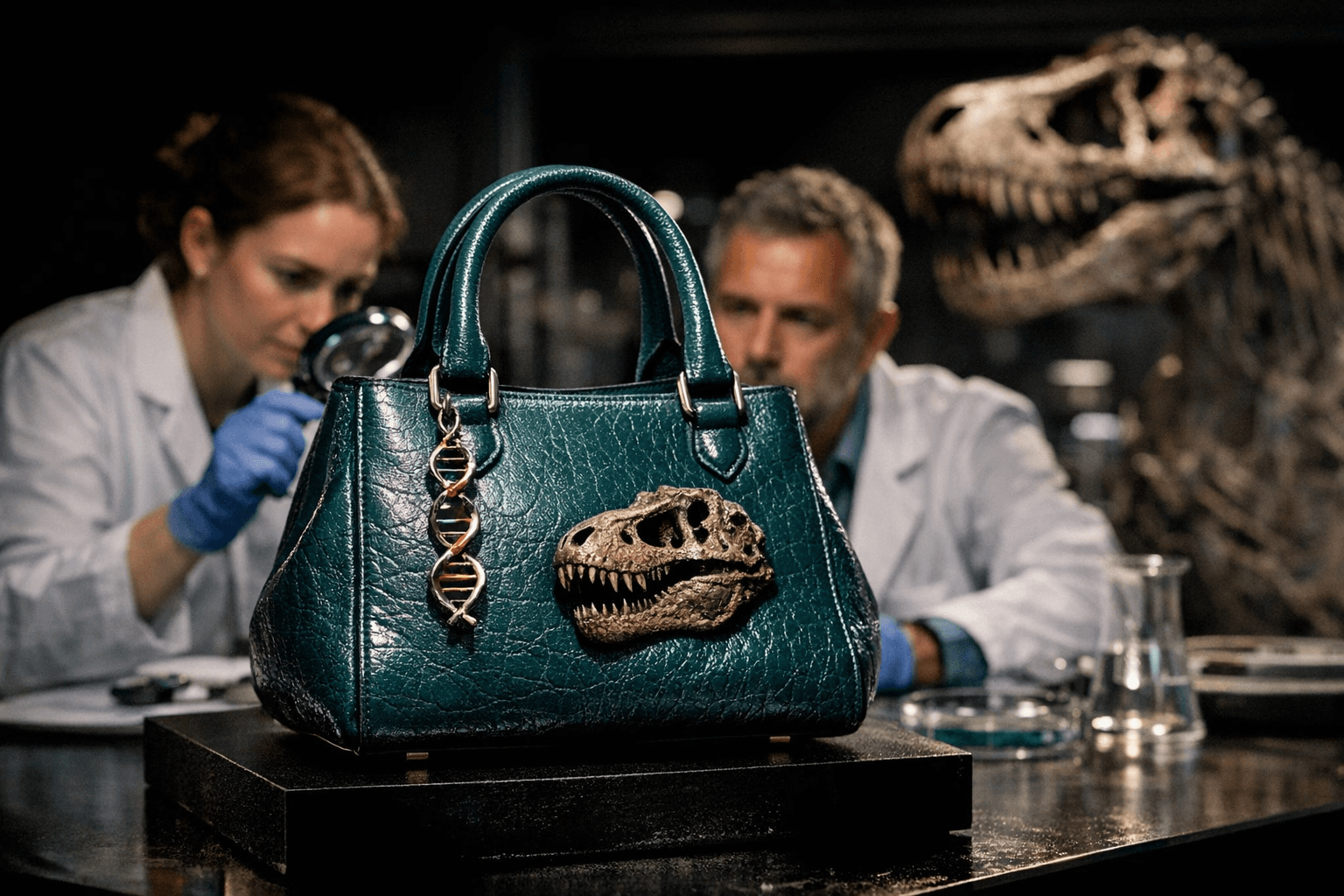
A handbag engineered from collagen sequences extracted out of Tyrannosaurus rex fossils debuted at Amsterdam's Art Zoo Museum on April 2, displaying what its creators call the world's first product made from lab-grown T. rex leather, a material they argue could reshape the future of luxury fashion.
The teal-colored bag, adorned with sterling silver and black diamonds and designed by fashion house Enfin Levé, was placed on a rock inside a glass enclosure beneath a life-sized T. rex replica. It will remain on display until May 11, at which point it heads to auction with a reported starting price exceeding half a million dollars. A single 10-by-15-centimeter swatch of the material is estimated to be worth between €10,000 and €20,000.
Three companies jointly developed the project: creative agency VML, a subsidiary of WPP; genomic engineering firm The Organoid Company; and Lab-Grown Leather Ltd., a subsidiary of BSF Enterprise. Their process began with fossilized collagen fragments isolated from T. rex specimens recovered in the United States. Scientists reconstructed the missing segments of that genetic sequence to form a complete collagen blueprint, then inserted the synthesized DNA into cells from an undisclosed carrier animal to grow the leather-like material. None of the three companies identified which animal's cells served as the biological host.
Che Connon, CEO of Lab-Grown Leather Ltd., framed the project as more than an environmental alternative. "It's not just about a green alternative to leather, it's a technological upgrade," Connon said, adding that the T. rex origin gave the material extra "oomph." The Organoid Company and VML previously partnered in 2023 to produce a giant meatball grown from woolly mammoth DNA combined with sheep cells.
Outside scientists pushed back sharply on the project's scientific framing. Melanie During, a Dutch vertebrate paleontologist at Vrije Universiteit Amsterdam, said collagen survives in dinosaur bones only as fragmented traces, making it impossible to recreate authentic T. rex skin or leather. Thomas Holtz Jr. of the University of Maryland was more blunt: "We have NO preserved tyrannosaurid DNA, so there are no T. rex genes." Several researchers also challenged the label "T. rex leather" on the grounds that cells from another animal are required at every stage of production.
The companies behind the bag acknowledged that the material is not a literal replication of dinosaur hide, but argued the ancient collagen sequences remain central to the final product's identity. Their stated goal is to make T. rex leather available to luxury brands in the coming years, beginning with high-end accessories before expanding into sectors such as automotive manufacturing.
The project lands as the luxury industry is already weighing cultivated biomaterials. Hermès has experimented with mushroom leather, and a growing number of startups are offering low-impact alternatives to animal hides. Whether T. rex leather can graduate from museum spectacle to viable commercial product will depend as much on resolving the scientific credibility questions as on what the auction gavel eventually decides it is worth.
This article was produced by Prism’s automated news system from verified source data, official records, and press releases, then run through automated quality and moderation checks before publishing. The system is built and supervised by the people who set the standards it runs under. Read our full AI policy.
Did this article answer your question?