Supreme Court Birthright Citizenship Battle Raises Questions About Newborns' Legal Status
An immigrant's daughter will argue before the Supreme Court on April 1 to defend a right her own birth secured, as justices prepare to rule on birthright citizenship for the first time in over a century.
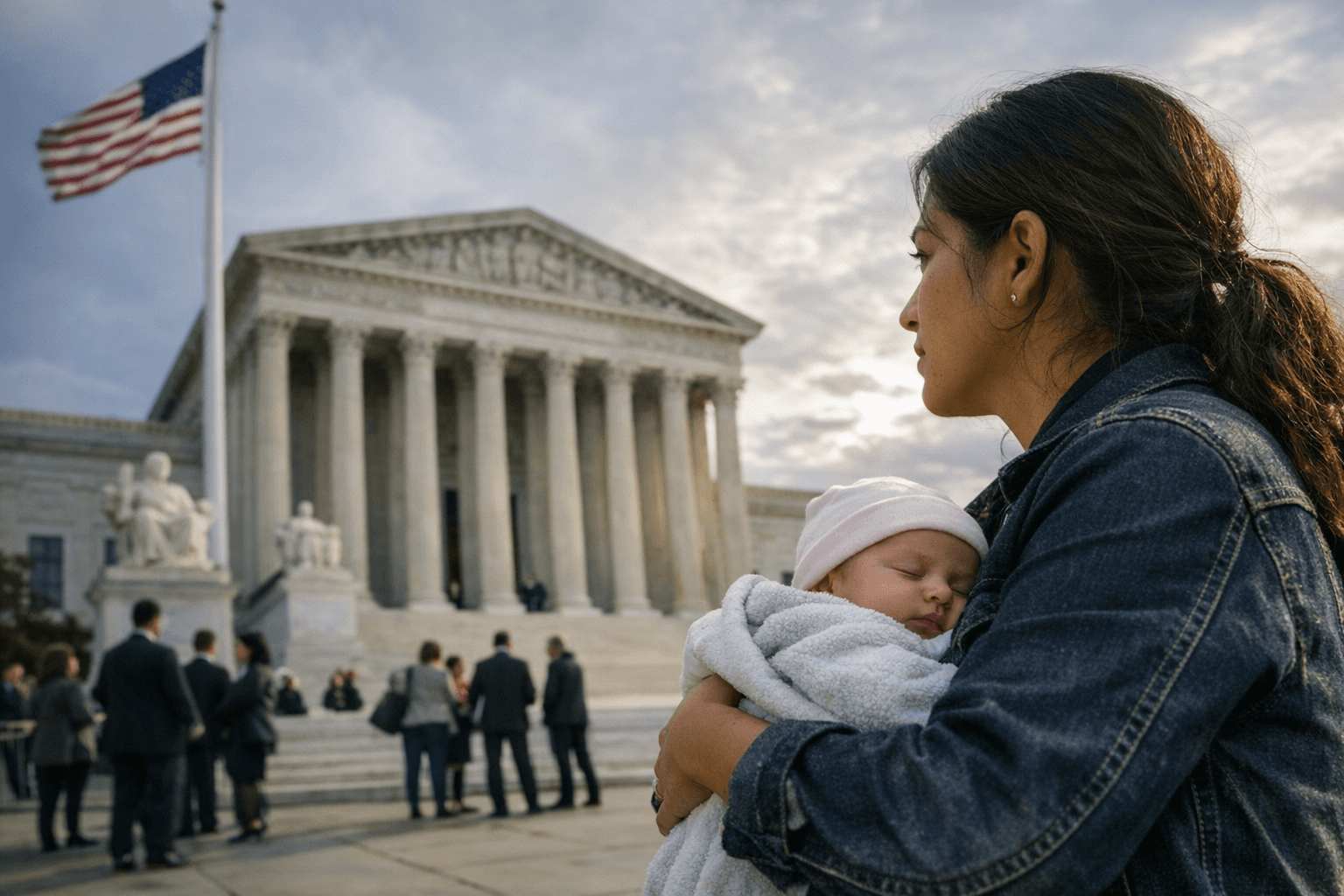
Cecillia Wang spent more than two decades as an ACLU lawyer before she became the face of the most consequential immigration case in a generation. The ACLU's national legal director is also a birthright citizen herself, the daughter of immigrants, and on April 1 she will stand before the Supreme Court to argue that President Trump cannot unilaterally rewrite the constitutional guarantee that made her an American.
The case, Trump v. Barbara, centers on Trump's Executive Order 14160, signed on his first day back in office on January 20, 2025. The order sought to deny automatic citizenship to children born in the United States whose mothers were undocumented or on temporary visas and whose fathers were neither citizens nor lawful permanent residents. Federal courts blocked it almost immediately. Four district courts and two appeals courts have ruled the order unconstitutional, citing the 14th Amendment, which has guaranteed citizenship to virtually all people born on American soil since 1868, and a landmark 1898 Supreme Court precedent, United States v. Wong Kim Ark.
But the practical questions that a ruling in the administration's favor would unleash are proving as thorny as the constitutional ones. Justice Brett Kavanaugh pressed U.S. Solicitor General D. John Sauer on exactly this point during earlier proceedings, demanding to know whether hospitals would have to change how they process newborns, whether state governments would need new procedures, and how federal officials would determine citizenship if a birth certificate no longer sufficed. Sauer's response, that "federal officials will have to figure that out essentially," did little to resolve the uncertainty. Most of those same questions remain unanswered today.
Under current law, a birth certificate alone is generally enough to prove citizenship. If the executive order were upheld, the American Bar Association has warned in an amicus brief that the change would reverberate far beyond immigration law, destabilizing access to civil litigation, public benefits, healthcare, and government identification. Parents of every newborn, including U.S. citizens, could be required to document their own immigration status at the hospital before their child qualifies for a Social Security number, a process that for decades has been part of routine hospital birth registration.
Consider what that would mean in practice. A Texas woman on a valid work visa gives birth in Houston. Under the old system, her baby is automatically a citizen; a Social Security card follows weeks later. Under Trump's order, the baby's citizenship depends on both parents' legal status, triggering a review process whose mechanics the administration has yet to fully define. The New York attorney general's coalition of states has argued the chaos would strip citizenship from hundreds of thousands of newborns each year, leaving families in legal limbo and children exposed to potential statelessness.
The administration has anchored part of its legal argument in Elk v. Wilkins, an 1884 Supreme Court ruling that denied birthright citizenship to a Native American man, John Elk, who had left his tribe and sought to assimilate into broader American society. The court ruled that Native Americans, owing allegiance to their tribes, were not "subject to the jurisdiction" of the United States within the meaning of the 14th Amendment. Trump's lawyers have applied the same "subject to the jurisdiction" language to children of undocumented immigrants and visa holders. Experts on Native American law have called that reliance on Elk legally and rhetorically misplaced, noting that tribal sovereignty, not immigration status, was the issue in that 19th-century dispute.
Wang, who has argued for "over 150 years" of settled constitutional tradition, told reporters the courts have unanimously rejected Trump's position. A ruling on the merits is expected before early July 2026. Whatever the justices decide, it will be the first time since 1898 that the Supreme Court has directly confronted whether a president can redefine who is born American.
This article was produced by Prism’s automated news system from verified source data, official records, and press releases, then run through automated quality and moderation checks before publishing. The system is built and supervised by the people who set the standards it runs under. Read our full AI policy.
Did this article answer your question?

