Supreme Court Justices Signal Skepticism Toward Trump Birthright Citizenship Order
Six justices, including Trump appointees, challenged the administration's birthright citizenship arguments as Trump made history as the first sitting president to attend Supreme Court oral arguments.
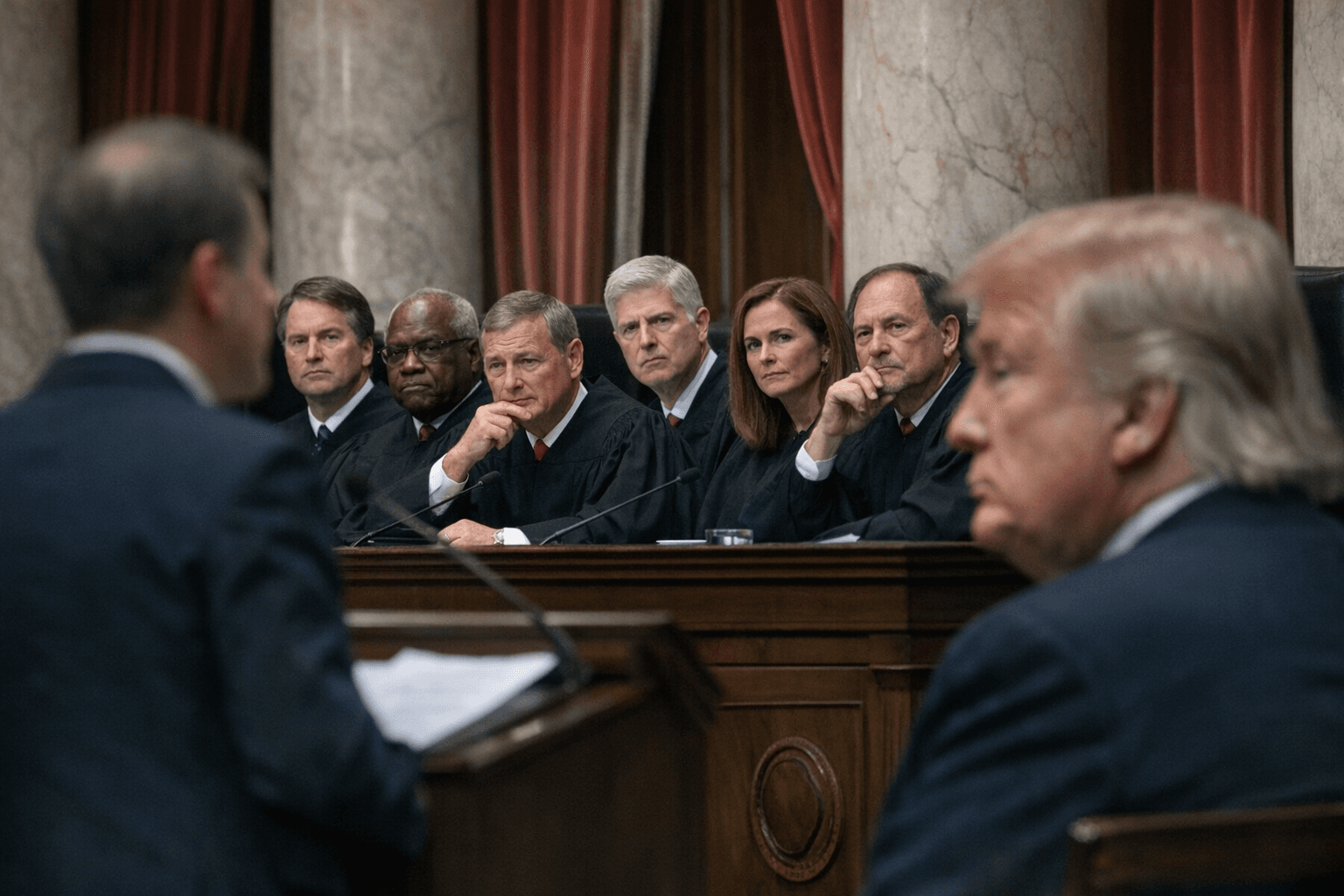
In a courtroom moment with no precedent in American history, President Donald Trump sat inside the Supreme Court for roughly 90 minutes on Tuesday as a majority of justices, including several he appointed, cast serious doubt on his executive order seeking to restrict birthright citizenship. The oral arguments in Trump v. Barbara represented the most direct constitutional confrontation over the 14th Amendment in more than a century.
Trump signed the order on January 20, 2025, his first day back in office. It would limit birthright citizenship to children born in the United States who have at least one parent who is a U.S. citizen or lawful permanent resident, effectively stripping citizenship from children born to undocumented immigrants or parents on temporary visas. Solicitor General D. John Sauer argued the administration's case before a bench that showed little patience for his legal framework.
Chief Justice John Roberts delivered one of the sharpest rebukes of the session. When Sauer argued that 8 billion people are now "one plane ride away" from having a child become a U.S. citizen, Roberts cut back: "Well, it's a new world. It's the same Constitution." Roberts also pressed Sauer on why narrow historical exceptions, such as children of foreign ambassadors or enemies during a hostile invasion, could logically be extended to cover, as Roberts put it, "a whole class of illegal aliens."
Justice Neil Gorsuch zeroed in on a contradiction in the administration's own legal theory. Under the government's domicile test, Gorsuch noted, illegal entry status would have been irrelevant in 1868 when the 14th Amendment was ratified, because someone who showed up and established domicile was doing so lawfully under the laws of the time. Justice Elena Kagan was more blunt, telling Sauer he was relying on "pretty obscure sources" against what she described as the clear text of the amendment. Justice Amy Coney Barrett called part of Sauer's argument "puzzling," particularly his explanation for why the amendment's framers did not tie citizenship to bloodline rather than birthplace. Justice Brett Kavanaugh dismissed Sauer's comparisons to citizenship laws in other countries as having no "relevance as a legal, interpretive matter."
The constitutional foundation the administration is challenging has stood since 1898. In United States v. Wong Kim Ark, the Supreme Court ruled 6-2 that Wong Kim Ark, born in San Francisco to Chinese immigrant parents, was a U.S. citizen under the 14th Amendment. That precedent has governed birthright citizenship for over 125 years.
Arguing against the administration was Cecillia Wang of the ACLU, who is herself a product of the very citizenship rule at stake. Wang was born in Oregon to parents from Taiwan who were in the United States on student visas. She told the justices: "Ask any American what our citizenship rule is, and they'll tell you, everyone born here is a citizen alike." The strongest skeptical questioning of Wang came from Justice Samuel Alito, who pressed her on the original intent of the 14th Amendment's "subject to the jurisdiction thereof" clause.
Trump departed the courtroom shortly after Wang began her presentation and subsequently posted on Truth Social calling the United States "STUPID" for having birthright citizenship. His attendance was confirmed in advance by White House press secretary Karoline Leavitt.
The stakes of the case are substantial. Pew Research Center data shows approximately 250,000 babies were born in the U.S. to unauthorized immigrant parents in 2016, representing roughly 6 percent of all births that year. The Center for Immigration Studies estimates that figure remained between 225,000 and 250,000 in 2023, down from a peak of approximately 330,000 in 2009.
The administration has faced legal obstacles since the order's signing. The ACLU filed its lawsuit on January 20, 2025, the same day Trump signed the order. The first preliminary injunction blocking the order was issued on February 5, 2025, with a second following from a New Hampshire federal judge on February 10. The Fourth Circuit denied the government's attempt to narrow the injunction on February 28, 2025. Last June, the Supreme Court ruled 6-3 in Trump v. CASA to restrict district courts' ability to issue nationwide injunctions but explicitly left the birthright citizenship question unresolved.
Conservative attorney John Eastman, who submitted an amicus brief supporting the administration's position, attended Tuesday's arguments and credited Sauer with making "sophisticated highbrow arguments across the board," while acknowledging he could not predict the outcome "one way or the other for sure." That uncertainty notwithstanding, the weight of Tuesday's questioning suggested the Court's majority is not persuaded that a 128-year-old precedent should yield to an executive order.
This article was produced by Prism’s automated news system from verified source data, official records, and press releases, then run through automated quality and moderation checks before publishing. The system is built and supervised by the people who set the standards it runs under. Read our full AI policy.
Did this article answer your question?

