Supreme Court Justices Weigh Domiciles and Foundlings in Citizenship Case
Trump's own Supreme Court appointees grilled his solicitor general over "domicile" and foundlings as the court weighed a landmark birthright citizenship case.
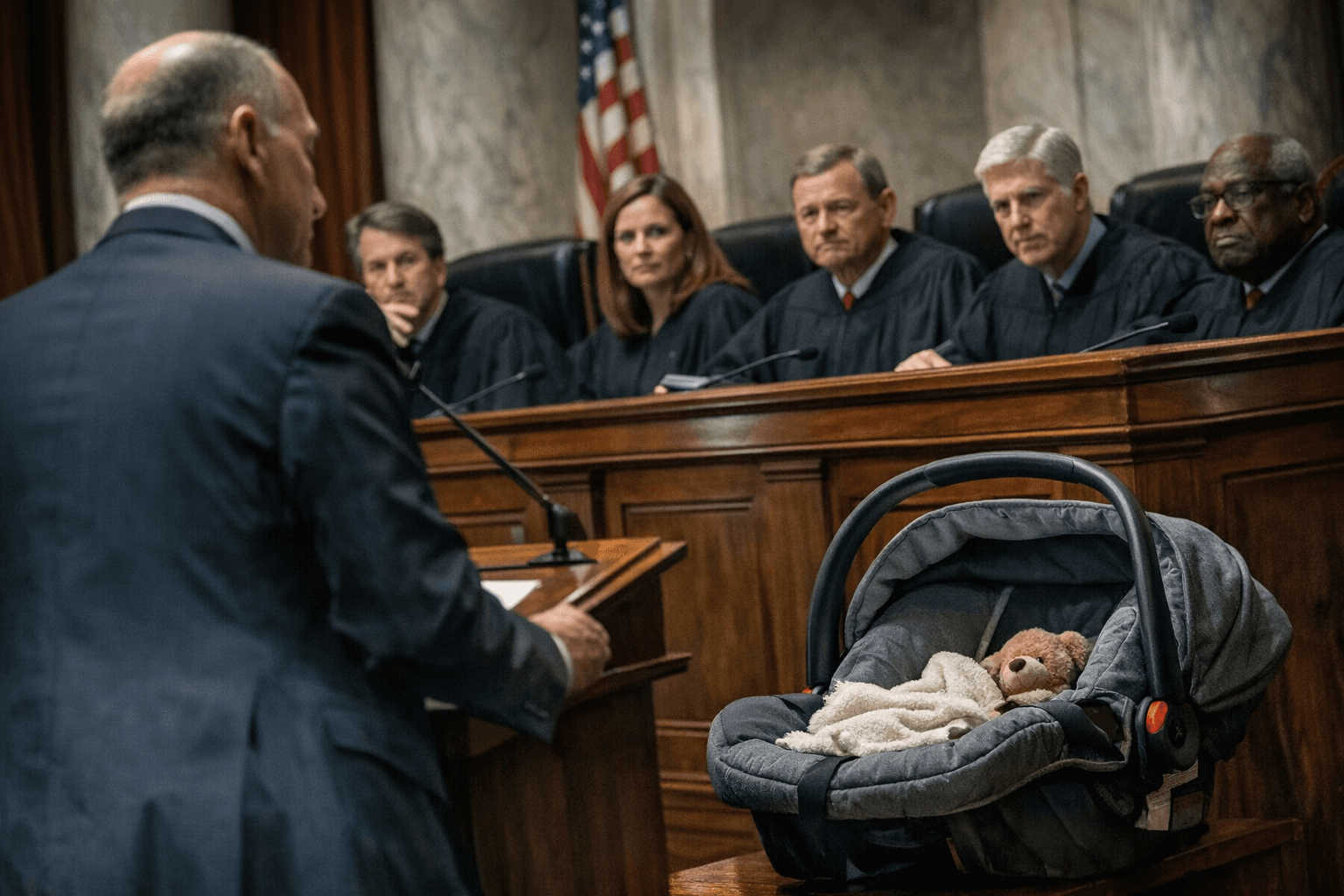
A majority of Supreme Court justices expressed deep skepticism Wednesday toward the Trump administration's attempt to limit birthright citizenship, with the court's conservative wing repeatedly challenging Solicitor General D. John Sauer over his central legal arguments, including the meaning of "domicile" and what would happen to children of unknown parentage.
Sauer opened by arguing that the 14th Amendment's citizenship guarantee applies only to children born in the United States whose parents are "domiciled" here, meaning those with permanent legal residence. That framing drew immediate pushback from across the ideological spectrum. Chief Justice John Roberts pointed out that the landmark 1898 Wong Kim Ark ruling uses the word "domicile" roughly 20 times, pressing Sauer on whether that history actually bolstered the government's position rather than settled it.
Justice Amy Coney Barrett, a Trump appointee, pressed Sauer on the practical consequences of his theory. When Sauer was attempting to explain how the administration's framework would handle "foundlings," children of unknown parentage with no parents whose immigration status could be assessed, Barrett cut him off: "Yeah, yeah, yeah, what about the Constitution?" She separately noted the government's argument had "very little to do with the text of the Fourteenth Amendment."
Justice Neil Gorsuch, another Trump appointee, pursued the domicile logic to an uncomfortable endpoint for the solicitor general, asking whether Native Americans would qualify as birthright citizens under the administration's test. Sauer acknowledged they would not under a strict reading of the historical congressional debates, a concession that illustrated what several justices characterized as the sweeping and unpredictable reach of a ruling in the government's favor.
Justice Brett Kavanaugh zeroed in on a textual inconsistency, noting that the Civil Rights Act of 1866 used the phrase "not subject to any foreign power" to define citizenship eligibility, while the 14th Amendment, ratified two years later, deliberately omitted that language. When Sauer argued the intent was identical, Kavanaugh pressed back: "Why didn't they say the same thing?"
When Sauer invoked the prevalence of "birth tourism" and argued that global travel has transformed the stakes of birthright citizenship, Roberts deflated the point cleanly. "It's a new world," Roberts said, echoing Sauer's framing. "It's the same Constitution."
Cecillia Wang, national legal director of the American Civil Liberties Union, argued on behalf of the challengers that the Constitution's meaning was already settled. Wang maintained that the Wong Kim Ark decision affirmed a broad principle of birthright citizenship and that Sauer was reading a narrow exception into the ruling's specific facts rather than its holding.
Justice Elena Kagan was less measured, accusing the administration of relying on "pretty obscure sources" to construct its historical argument.
President Trump attended the arguments for roughly 90 minutes, the first sitting president to be present for a Supreme Court oral argument. He departed after Sauer completed his presentation and before Wang took the podium. A decision is expected before the end of June.
This article was produced by Prism’s automated news system from verified source data, official records, and press releases, then run through automated quality and moderation checks before publishing. The system is built and supervised by the people who set the standards it runs under. Read our full AI policy.
Did this article answer your question?

