Supreme Court refuses AI art appeal, human-authorship copyright rule stays
The Supreme Court declined to hear Stephen Thaler's appeal, leaving the Copyright Office's human-authorship test and lower-court denials intact with immediate effect.
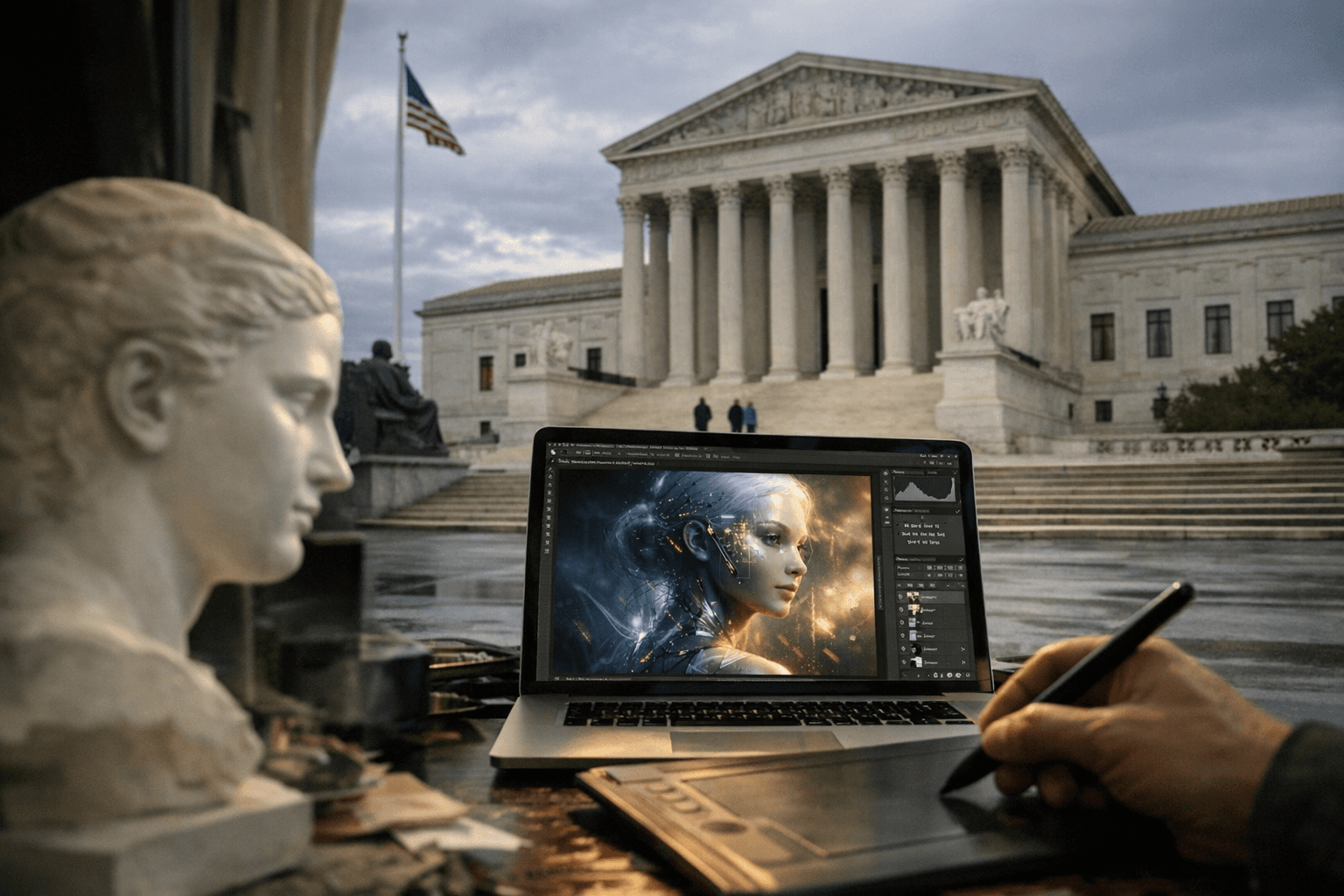
The U.S. Supreme Court declined to take up an appeal on March 2, 2026, that sought copyright protection for artwork generated autonomously by an artificial intelligence system, leaving in place lower-court rulings and the U.S. Copyright Office position that creative works must have human authorship to qualify for copyright.
The appellant, Stephen Thaler, a computer scientist from Missouri, has pursued multiple attempts to secure intellectual property rights for outputs of his AI systems, including earlier applications to the U.S. Patent and Trademark Office that were rejected on similar grounds. A lower court had denied copyright for the visual artwork at the center of the appeal; the Supreme Court's denial of certiorari means that decision, and the Copyright Office's human-authorship test, remain the governing standard for now.
Thaler's legal team warned that the timing of the Supreme Court's refusal carries costs for creators and the creative sector. Thaler's lawyers said "even if it later overturns the Copyright Office's test in another case, it will be too late," and added the decision "will have negatively impacted the creative industry during 'critically important years.'"
The decision does not create a new Supreme Court precedent; instead it preserves the patchwork of lower-court holdings and administrative practice that currently governs whether AI outputs can be registered for copyright. The court could choose to address a related dispute in the future, leaving the possibility of a definitive national rule open.
The ruling comes amid parallel, high-stakes litigation over large-scale training of generative models. Anthropic agreed to pay authors $1.5 billion to settle a class action alleging copyright infringement, a deal that a federal court is scheduled to consider for approval imminently. Plaintiffs' counsel at Lieff Cabraser described proposed distribution terms that would pay approximately $3,000 per class work for titles included on the settlement list and said the class will include owners of copyrights in books Anthropic downloaded from Library Genesis or Pirate Library Mirror that were registered within five years of initial publication and prior to Anthropic's download. The firm said the final class size is still being finalized.
Those parallel developments underscore a striking tension in current law. In a June ruling, U.S. District Judge William H. Alsup agreed with Anthropic's defense, stating the company's use of plaintiffs' books to train its AI model was acceptable. Ziniti summarized the legal impact succinctly: "regardless of the settlement, the judge's ruling effectively means that at least in Northern California, AI companies now have the legal right to train their large language models on copyrighted works, as long as they obtain copies of those works legally."
The practical effect is a bifurcated landscape: the human-authorship requirement controls whether AI-created works can receive copyright protection, while district-court rulings and settlement agreements are shaping what training practices courts will tolerate in particular jurisdictions. Creators, publishers and AI companies are left to navigate competing doctrinal signals while several major cases and settlement approvals remain unresolved.
For now, the Copyright Office's human-authorship test stands as the default for registration and enforcement, and the Supreme Court's refusal to hear Thaler's appeal preserves that status quo pending further litigation or administrative change.
Know something we missed? Have a correction or additional information?
Submit a Tip