Supreme Court ruling spurs Southwide rollback of Black voting districts
A Supreme Court ruling has opened the door to dismantling Black-majority districts across the South, reshaping who gets represented and who gets power.

How one ruling changed the rules
The fight over Black political power in the South has moved from the courtroom to the map room. After the Supreme Court’s 6-3 decision in Louisiana v. Callais on April 29, 2026, states gained far more room to redraw congressional lines in ways that weaken districts where Black voters can elect candidates of their choice.
Civil-rights lawyers say the ruling sharply curtailed Section 2 of the Voting Rights Act, the central protection used for decades to challenge racial vote dilution. That change matters because Section 2, strengthened by the 1982 amendments and interpreted through Thornburg v. Gingles in 1986, became the legal foundation for majority-Black districts across the South.
Louisiana moves first
Louisiana lawmakers acted quickly. On May 29, 2026, they passed a new congressional map that dismantles the state’s 6th District, the seat held by Democrat Cleo Fields after he was elected in 2024. The old district had connected Black communities stretching from Shreveport to Baton Rouge, reflecting a court-ordered redistricting plan that had restored Black voting power after years of litigation.
The new map leaves Louisiana with only one majority-Black district, and that district runs through parts of New Orleans and Baton Rouge. Advocates say the change does more than alter lines on a page. It breaks apart a political coalition that had finally allowed Black voters in multiple regions of the state to help decide who represents them in Congress.
That is the mechanism at the center of the dispute. When a district is drawn to unite Black communities, those voters can often elect a candidate responsive to their needs. When the district is split apart, those same voters are dispersed into larger, whiter, or more heavily Republican constituencies, making it much harder to translate population into power.
What gets lost when a district disappears
The impact reaches beyond one seat or one lawmaker. A district like the former 6th in Louisiana can shape who gets a hearing on hospital access, maternal health, flood recovery, school funding, labor protections, and federal disaster aid. When that district is dismantled, the communities it linked together do not vanish, but their ability to speak with one political voice weakens.
That is why civil-rights groups argue the Supreme Court’s ruling is not just about partisan advantage. The NAACP Legal Defense Fund and the Brennan Center for Justice both described Callais as a major blow to Section 2, warning that it threatens the political power of Black communities. The Brennan Center has also said that successful Section 2 enforcement in Alabama, Georgia, and Louisiana led to new majority-Black districts for the 2024 election, which helped increase turnout among Black registered voters where those districts were created.
In other words, the map itself affects participation. When voters see that their communities are fairly represented, they are more likely to vote, organize, and demand accountability. When the map is rewritten to dilute that power, the damage is political and practical.
Alabama shows the ruling’s reach
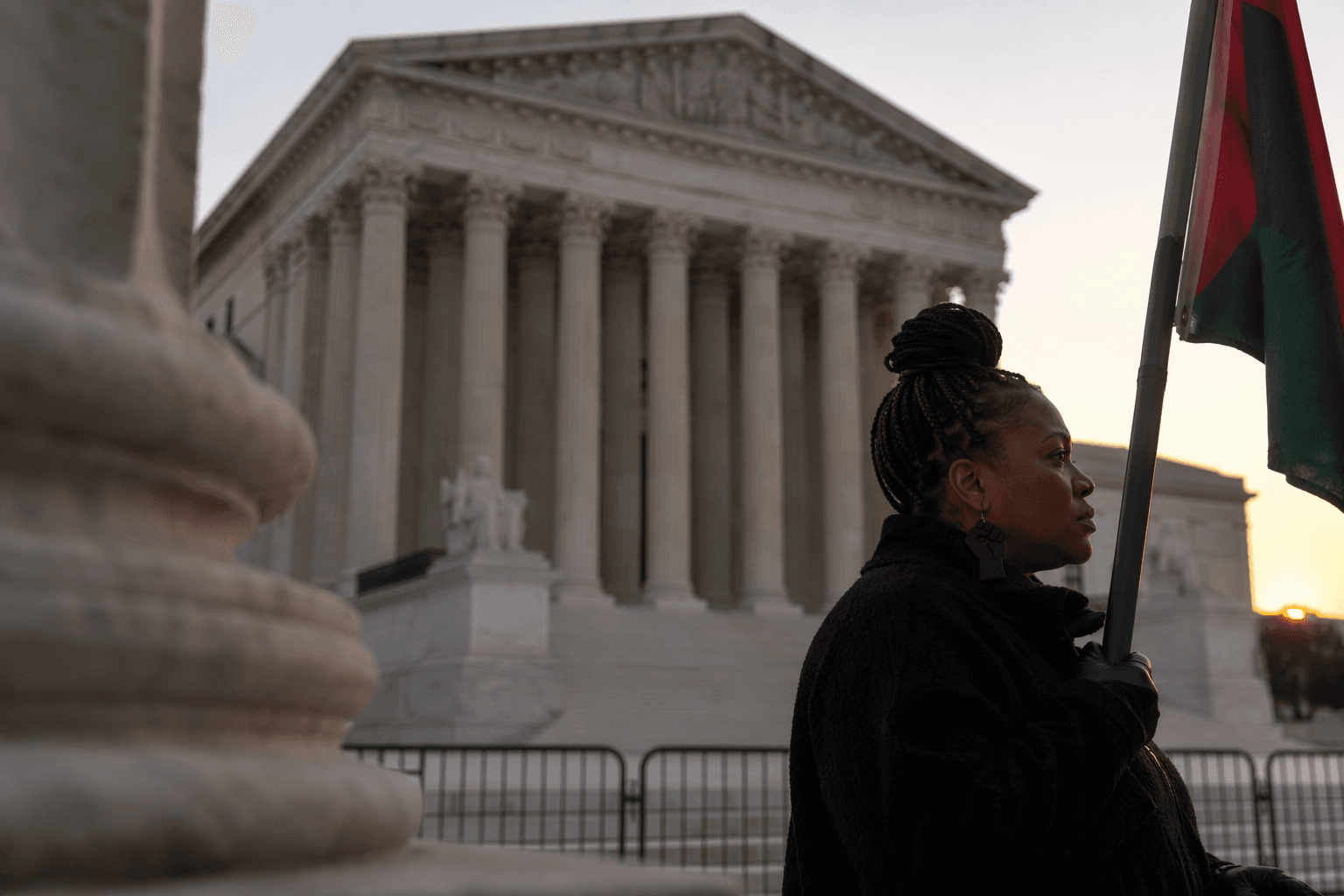
The Louisiana case did not stand alone for long. On June 2, 2026, the Supreme Court allowed Alabama to use a congressional map that eliminates one of its two districts where Black voters made up a majority or near-majority. That came despite a lower-court finding that the plan intentionally discriminated against Black people.
The Alabama decision shows how quickly the Court’s new posture is being translated into statewide action. Even where a lower court has already found discrimination, the current Supreme Court is willing to let a challenged map stay in place while elections move forward. For Black voters, that means representation can be stripped away before the legal fight is fully resolved.
It also gives state officials a roadmap. If a legislature can defend a map by arguing that Section 2 is narrower now, or that race-conscious districting is constitutionally suspect, then a district that once survived court review can become vulnerable almost overnight.
A regional chain reaction
The consequences are likely to spread well beyond Louisiana and Alabama. Civil-rights advocates say Republican officials across the South are already discussing special sessions to redraw maps before the midterms. That makes the ruling a template, not a one-off.
The South is central to this fight because it contains the country’s largest Black populations, including Louisiana, Mississippi, Alabama, Georgia, and South Carolina. That is where majority-Black districts matter most, and where changes to congressional lines can most dramatically alter who gets represented in Washington, D.C.
Black Southern Democrats told POLITICO in May 2026 that “the entire South is on fire,” a blunt warning that the fight is not confined to Congress. Minority-majority districts in state legislatures are also at risk, which could affect everything from school policy to Medicaid expansion to local public health priorities.
The Court’s shift and the dissent’s warning
The procedural path in Louisiana v. Callais underscores how much changed before the final ruling landed. The Supreme Court first heard arguments in March 2025, then ordered reargument in November 2025, before issuing its final decision on April 29, 2026.
Justice Elena Kagan’s dissent, joined by Justices Sonia Sotomayor and Ketanji Brown Jackson, said the majority’s approach “threatens a half-century’s worth of gains in voting equality.” That warning captures the broader fear among voting-rights advocates: that the Court is not merely narrowing one statute, but reinterpreting the rules in a way that makes it much easier to unwind hard-won gains in Black representation.
Justice Samuel Alito wrote the majority opinion, which the Brennan Center said held that the configuration of Louisiana’s second Black-majority district was an unconstitutional racial gerrymander. That framing matters because it shifts the legal burden. Instead of requiring states to create or preserve districts where minority voters can elect candidates of choice, it gives states more room to argue that race-conscious districts themselves are illegitimate.
Why the map fight is a democracy fight
This rollback is about more than seat counts. It changes which communities can build coalitions, which candidates have a realistic path to office, and which policies are likely to be prioritized once lawmakers are elected. If Black-majority districts keep disappearing, the South’s congressional delegation will become less reflective of the populations it serves.
That is why the ruling in Callais has such wide consequences. It does not just redraw one district in Louisiana or preserve one map in Alabama. It redefines the limits of voting-rights protection at a moment when Black voters across the South are being told, in effect, that the legal tools built to protect their representation may no longer work the way they once did.
This article was produced by Prism’s automated news system from verified source data, official records, and press releases, then run through automated quality and moderation checks before publishing. The system is built and supervised by the people who set the standards it runs under. Read our full AI policy.
Know something we missed? Have a correction or additional information?
Submit a Tip