Supreme Court Takes Up Challenge to Colorado's Conversion Therapy Ban
The Supreme Court signaled skepticism toward Colorado's 2019 conversion therapy ban, a posture that could undermine similar laws in more than 20 states.
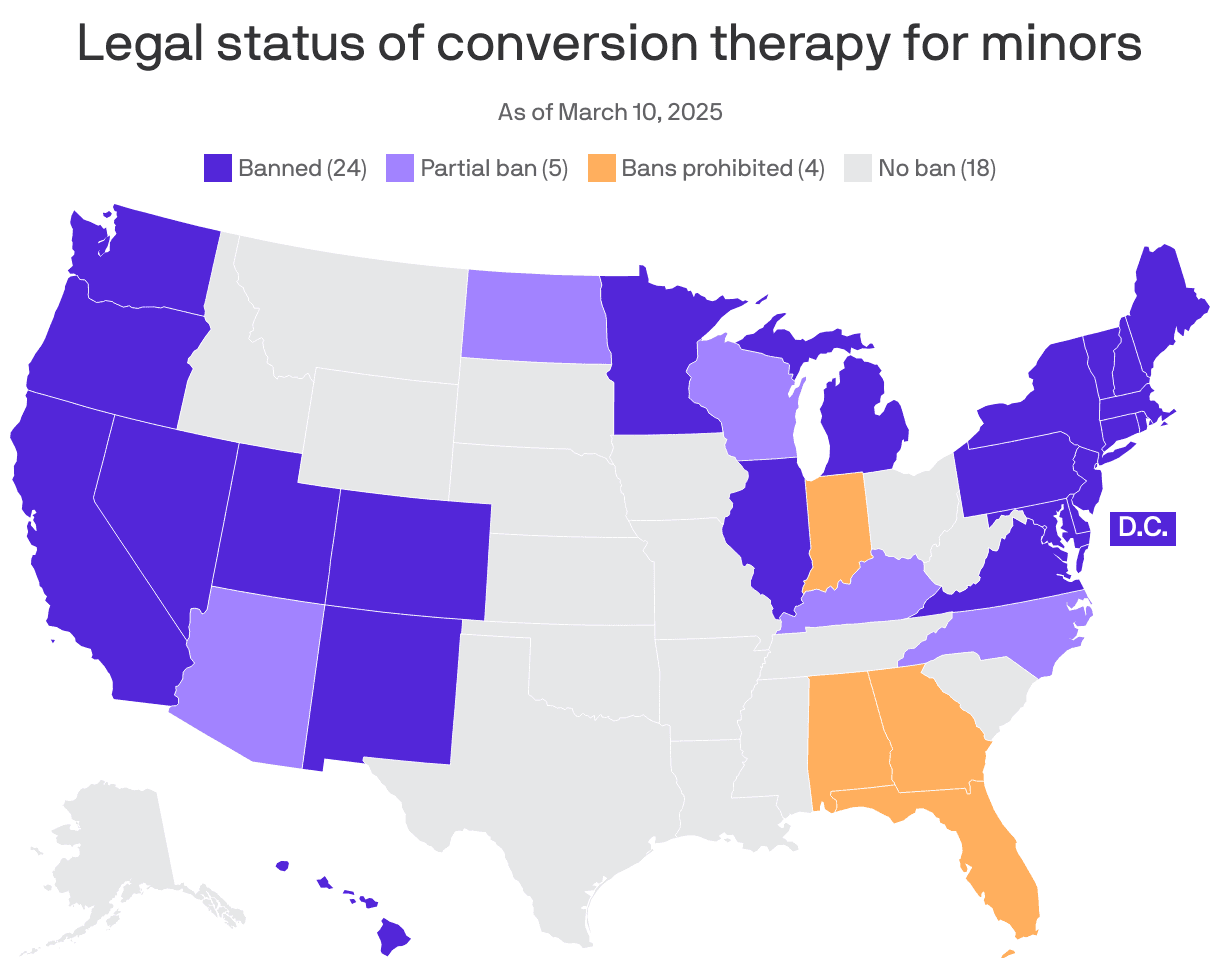
The Supreme Court heard oral arguments in a First Amendment challenge to Colorado's 2019 ban on conversion therapy for minors, with the Court's 6-3 conservative majority signaling deep skepticism of the state's position. A ruling against Colorado could place similar prohibitions in more than 20 states in constitutional jeopardy and force a fundamental rethinking of how far licensing boards can reach into what licensed mental health professionals say to their clients.
The Colorado Minor Conversion Therapy Law bars licensed therapists from attempting to "change behaviors or gender expressions" or "eliminate or reduce" same-sex attraction in minors, with violations carrying up to a $5,000 fine and potential loss of license. Crucially, the law does not restrict religious groups, faith-based ministries, or family members from having the same conversations it forbids for licensed professionals. That exemption sits at the heart of the constitutional argument: by drawing the restriction along the line of professional licensure rather than the practice itself, critics contend Colorado constructed what functions as a content-based restriction on speech, not a regulation of medical conduct.
The 10th Circuit Court of Appeals rejected that view, upholding the law as a legitimate regulation of "professional conduct" that only incidentally restricted speech and did not constitute viewpoint discrimination. The justices' questioning during oral argument suggested they were not as certain.
The case was brought by Kaley Chiles, a licensed professional counselor and Christian therapist based in Colorado Springs, through Alliance Defending Freedom, the conservative Christian legal group the Southern Poverty Law Center has classified as a hate group. ADF filed the challenge in September 2022 after the Colorado law survived at the federal district court level. The Colorado case is the third recent legal challenge on gay and transgender rights to reach the Supreme Court from ADF clients in that state; the organization's lawyers cited the Court's 2018 ruling in favor of Colorado baker Jack Phillips some 30 times in their principal brief.
Chiles argued the prohibition cuts off counseling that patients voluntarily request. "Struggling kids benefit from access to voluntary counseling, conversations that help them as they seek wholeness and gaining peace with their bodies," she said. "They deserve better than Colorado's one-size-fits-all approach."

Colorado Attorney General Weiser defended the law as protection for a vulnerable population. "We know that young kids right now are hurting," Weiser said. "One of the ways we protect young people is we let them have autonomy about who they are." The district court had acknowledged the harmful impact of conversion therapy on minors, and major American mental health and medical organizations have widely discredited the practice for decades.
The stakes reach well beyond Colorado's licensing regime. During argument, attorneys pressed the connection between Colorado's professional-conduct rationale and the Court's recent ruling upholding Tennessee's ban on certain medical treatments for transgender teens, raising the question of whether that same theory could be used to restrict gender-affirming talk therapy and related treatments. "We think that's a strong reason to support our position," Mooppan argued, invoking the Tennessee precedent. The exchange illustrated the doctrine's double-edged quality: a decision that reshapes how courts evaluate professional-speech restrictions could destabilize a wide range of state healthcare regulations far beyond any single ban.
A decision is expected before the end of the current term. For the more than 20 states whose conversion therapy prohibitions rest on the same professional-conduct framework the 10th Circuit endorsed, the Court's skepticism at oral argument suggests those laws may not survive intact.
Know something we missed? Have a correction or additional information?
Submit a Tip