Supreme Court Takes Up Trump's Bid to End Birthright Citizenship
The Supreme Court heard arguments today in Trump v. Barbara, with Trump becoming the first sitting president on record to attend oral arguments at the nation's highest court.
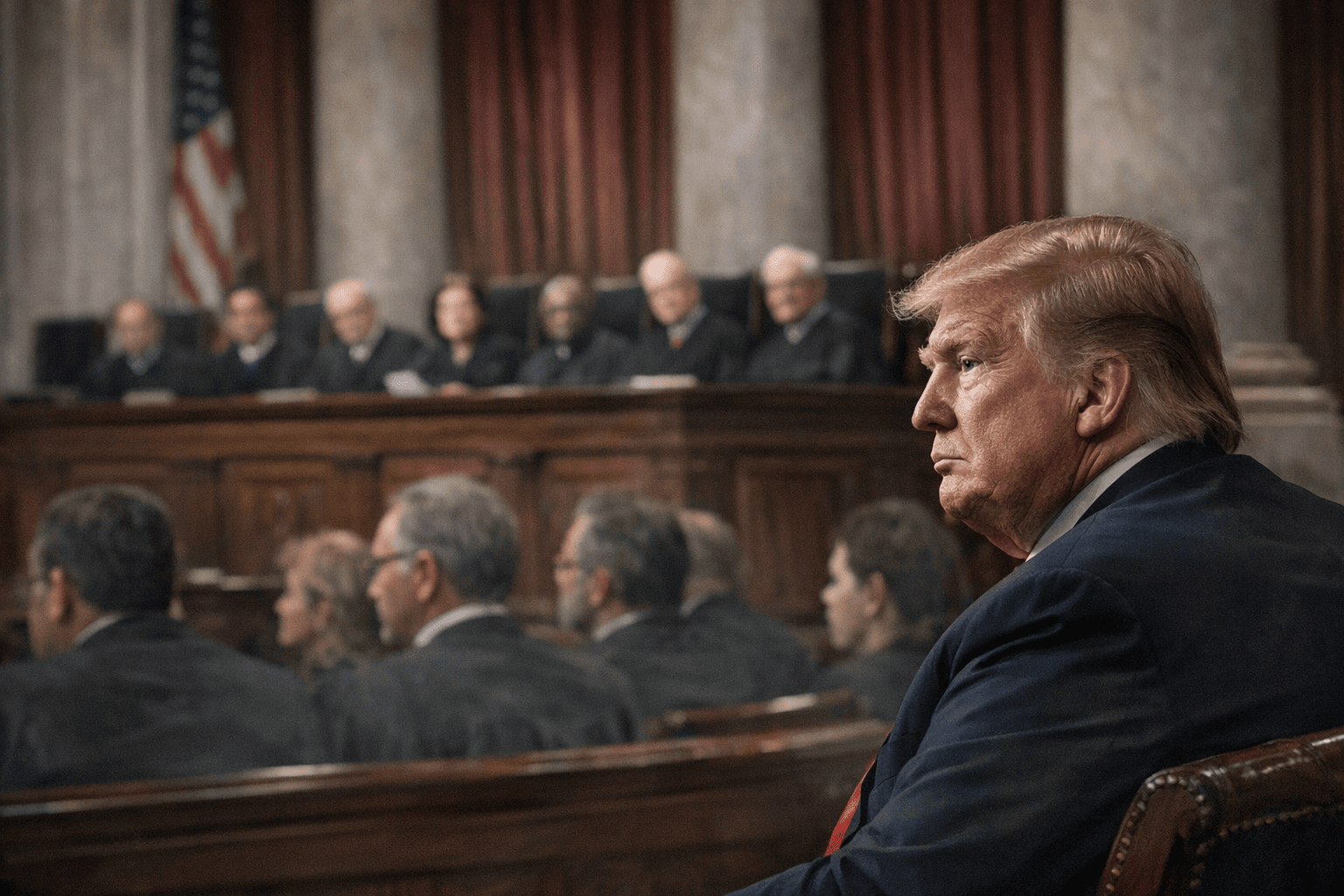
The Supreme Court took up one of the most consequential constitutional disputes in a generation on Wednesday as it heard oral arguments in Trump v. Barbara, a direct challenge to President Donald Trump's executive order seeking to end birthright citizenship. Trump made history by attending the proceedings in person, becoming the first sitting president on record to observe oral arguments at the nation's highest court. Both the Supreme Court and the Supreme Court Historical Society have said there is no official record of any sitting president attending oral arguments. Trump told reporters in the Oval Office on Tuesday, "I'm going. Because I have listened to this argument for so long," and White House press secretary Karoline Leavitt confirmed his attendance.
At the center of the case is Executive Order 14160, which Trump signed on January 20, 2025, the first day of his second term. The order denies citizenship to children born in the United States to a mother who is in the country unlawfully and whose father is neither a citizen nor a lawful permanent resident, and to children born to mothers with temporary legal immigration status whose fathers also lack citizenship or permanent residency. The administration's argument rests on a reinterpretation of the 14th Amendment's Citizenship Clause, ratified in 1868, which reads: "All persons born or naturalized in the United States, and subject to the jurisdiction thereof, are citizens of the United States."
The human stakes are substantial. An amicus brief filed by 141 law professors estimates that more than 255,000 babies born in the United States each year would be denied citizenship under the order. Research from the Migration Policy Institute and Pennsylvania State University's Population Research Institute arrives at a similar figure, exceeding a quarter million annually. A separate lawsuit filed by 18 states, the District of Columbia, and the city and county of San Francisco puts the number above 150,000 children per year. Without citizenship, some of those children could be rendered stateless, belonging to no country.
Every federal court to have considered the executive order has blocked it from taking effect. Following the Supreme Court's June 27, 2025 ruling in Trump v. CASA, which restricted the scope of nationwide injunctions but did not address the constitutionality of the citizenship order, U.S. District Judge Joseph Laplante issued a class-wide preliminary injunction on July 10, 2025, barring enforcement against babies born after February 20, 2025. The lead plaintiff in that case, known only as Barbara, is a Honduran national whose full identity is withheld for safety reasons.
The administration's position runs directly against the Supreme Court's own 1898 ruling in United States v. Wong Kim Ark, in which the Court held 6-2 that a child born in San Francisco to Chinese immigrant parents was a U.S. citizen by birth. That precedent has stood uncontested for more than 125 years. The 14th Amendment itself was ratified in 1868 specifically to repudiate the Supreme Court's 1857 Dred Scott v. Sandford decision, which had declared that persons of African descent could not be citizens. The Trump administration also cites Elk v. Wilkins, an 1884 ruling, to argue the Citizenship Clause does not extend to children born to parents without permanent allegiance to the United States.
Cody Wofsy, deputy director of the ACLU's Immigrants' Rights Project, called the executive order "deeply illegal, unconstitutional and morally wrong." Challengers' legal briefs describe the administration's position as demanding "nothing less than a remaking of our nation's constitutional foundations." Justice Sonia Sotomayor, joined by the court's two other liberal justices, had already dissented from the Court's June 2025 ruling limiting injunctions.
The United States is one of approximately 33 countries that maintain unconditional birthright citizenship, a group that includes Canada, Mexico, Brazil, and Argentina. Most of Europe, Asia, and the Middle East use jus sanguinis, granting citizenship through parentage rather than place of birth. A ruling for Trump would mark the first fundamental departure from the jus soli model the country has maintained since 1868. The Court is expected to issue its decision by the end of June or early July 2026.
Sources:
Know something we missed? Have a correction or additional information?
Submit a Tip