Supreme Court Weighs Border Policy That Would Block Asylum Seekers
The Supreme Court heard arguments Tuesday in Noem v. Al Otro Lado, a case that could restore a policy letting border agents block asylum seekers on Mexican soil before they reach U.S. territory.
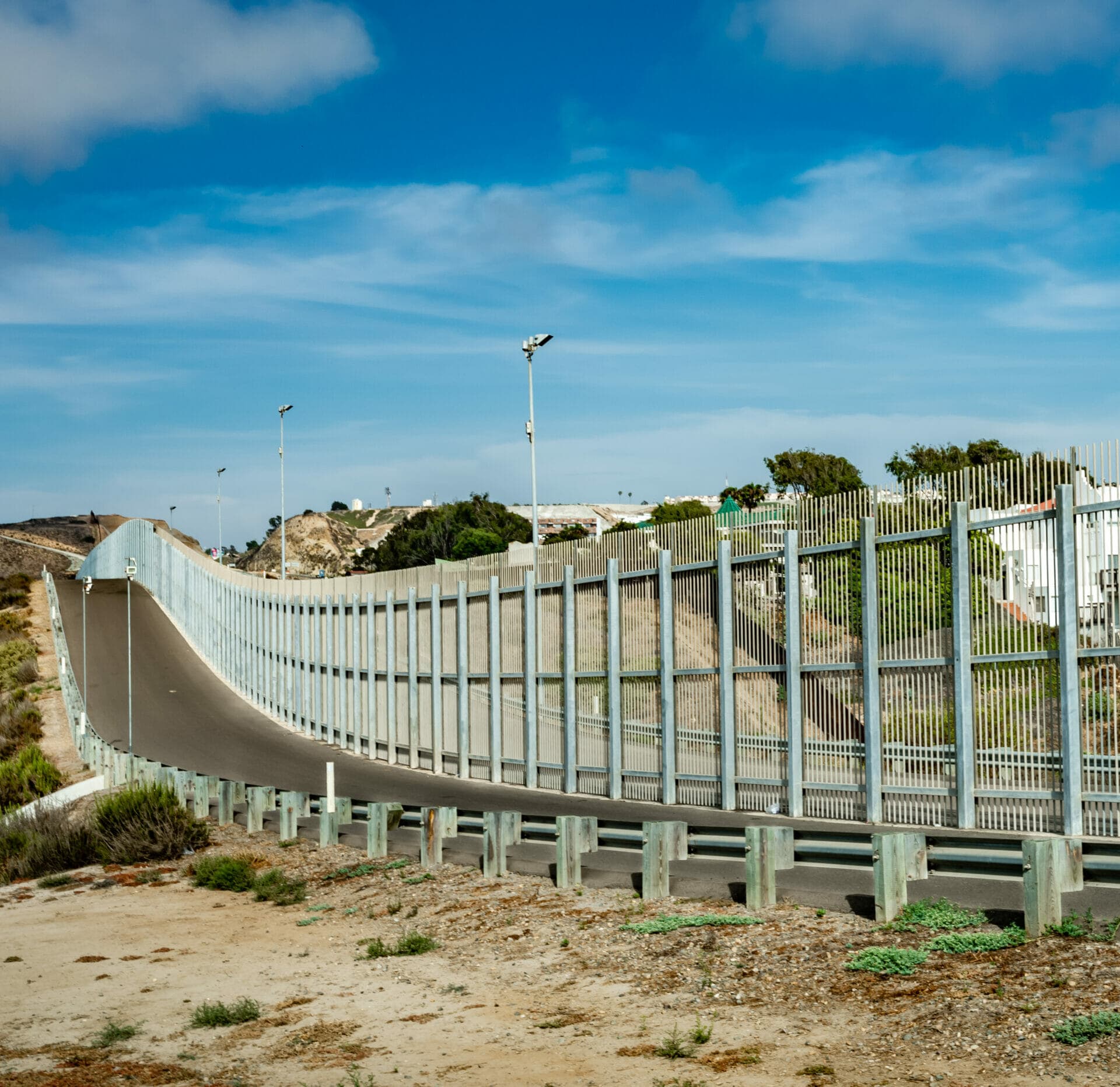
Border agents positioned on the Mexican side of the U.S.-Mexico line turned away asylum seekers under a federal "metering" policy. On Tuesday, the Supreme Court heard arguments over whether that practice was lawful — and whether the government can revive it.
The policy at the center of *Noem v. Al Otro Lado* is no longer in place, but the Trump administration calls it a "critical tool for addressing" surges in immigrants at the border. The government calls the practice "metering," and under it, border officers physically blocked people from seeking asylum at ports of entry along the southern border, turning them back to Mexico.
The question before the justices is relatively straightforward: Is a migrant who is stopped by federal agents on the Mexican side of the border covered under the law that requires officials to begin passing them through the asylum process? Under federal law, the government must process a migrant who presents at a port of entry and is fleeing political, racial or religious persecution in their home country.
Solicitor General D. John Sauer argued that "in ordinary English, a person 'arrives in' a country only when he comes within its borders," adding that a person stopped in Mexico does not arrive in the United States. Sauer also contended that "administrations of both major parties have opposed the lower court decision, which deprives the Executive Branch of a critical tool for addressing border surges and preventing overcrowding at ports of entry."
An immigrant rights group and more than a dozen individuals challenging the policy countered with an unequivocal "yes," arguing that Congress's use of the present tense in the statute shows that lawmakers wanted its mandates to apply to those "attempting to step over the border" — and that if Congress wanted the law to cover only noncitizens who had already arrived, it would have said so.
The policy was rolled out under President Barack Obama, formalized by Trump, and rescinded in 2021 under President Joe Biden, but the Justice Department has continued to defend it in court over the years. The Trump administration told the Supreme Court it likely would resume the use of metering "as soon as changed border conditions warranted that step," without providing specifics.
Georgetown Law professor and CNN Supreme Court analyst Steve Vladeck questioned why the Court agreed to hear the case at all, saying: "The Supreme Court isn't supposed to decide hypothetical questions, which is why it's weird that it agreed to take up this appeal in the first place." The current administration's decision to keep pressing the case in court underscores its desire to preserve the policy as a backup avenue to stem the flow of migrants as other restrictive measures face challenges elsewhere.

Tuesday's arguments arrived against a backdrop of sweeping immigration litigation. The Supreme Court unanimously ruled in *Urias-Orellana v. Bondi* that federal appeals courts must defer to immigration judges when reviewing asylum decisions, bolstering the executive branch's authority in immigration cases; Justice Ketanji Brown Jackson, a Biden appointee, wrote that immigration laws require federal courts to use a "substantial-evidence standard" when reviewing whether an asylum seeker could face persecution if deported. Jackson wrote that the agency's determination "is generally 'conclusive unless any reasonable adjudicator would be compelled to conclude to the contrary.'"
That ruling compounded a pattern stretching back years. In the first Trump term, the Court issued an unsigned, one-paragraph per curiam order on September 11, 2019, staying a nationwide injunction that had blocked enforcement of the administration's "asylum-transit" rule — a regulation that denied asylum eligibility to any migrant who traveled through a third country en route to the United States without first seeking protection there. The stay allowed immediate enforcement despite lower courts having found the policy likely violated federal immigration law and administrative procedural requirements. Justice Sonia Sotomayor filed a brief dissent.
The shadow docket activity that enabled that 2019 order reflected a sharp break from historical norms. In the first three years of the Trump administration, the Solicitor General filed at least 20 applications for emergency stays of lower court rulings, including 10 in a single term. Across the entire 16 years of the Bush and Obama administrations combined, only 8 such applications were filed.
The Supreme Court has backed Trump in several immigration-related rulings issued on an emergency basis since his return to the presidency, including allowing him to deport migrants to countries other than their own and to revoke temporary legal status for hundreds of thousands of Venezuelan migrants. Meanwhile, district courts have cut in the other direction: Judge James Boasberg extended a temporary restraining order blocking the administration from using the Alien Enemies Act to deport alleged Venezuelan members of the Tren de Aragua gang through April 12, and the government asked the Supreme Court to vacate that order and grant an immediate administrative stay.
A ruling in *Noem v. Al Otro Lado* is expected later this term and would determine whether the executive branch may station agents at an invisible jurisdictional line and deny asylum processing to migrants who have not yet set foot on American soil.
Know something we missed? Have a correction or additional information?
Submit a Tip