Supreme Court Weighs Quebec's Religious Symbols Ban and Notwithstanding Clause
Quebec's 2019 ban on religious symbols for public workers is before the Supreme Court this week, with provinces split over whether the notwithstanding clause gives governments unlimited power to override Charter rights.
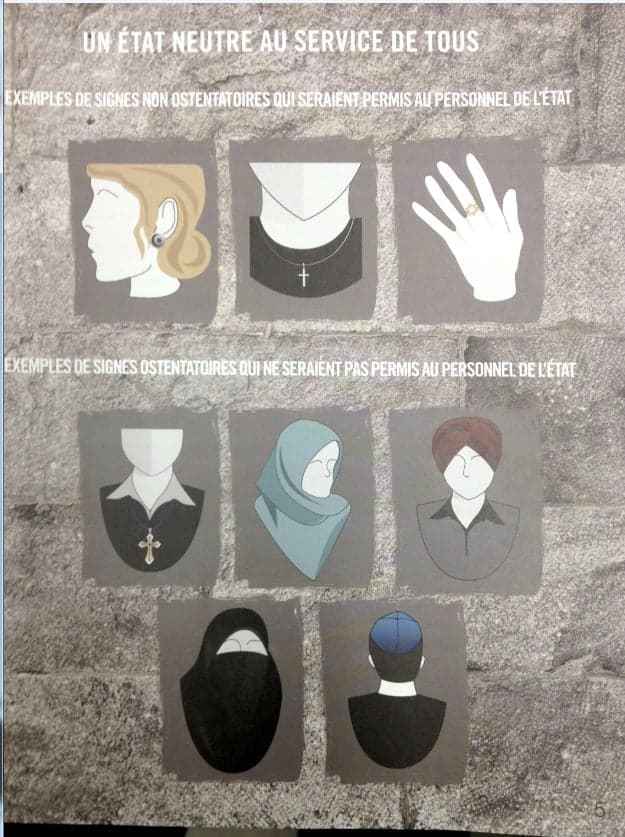
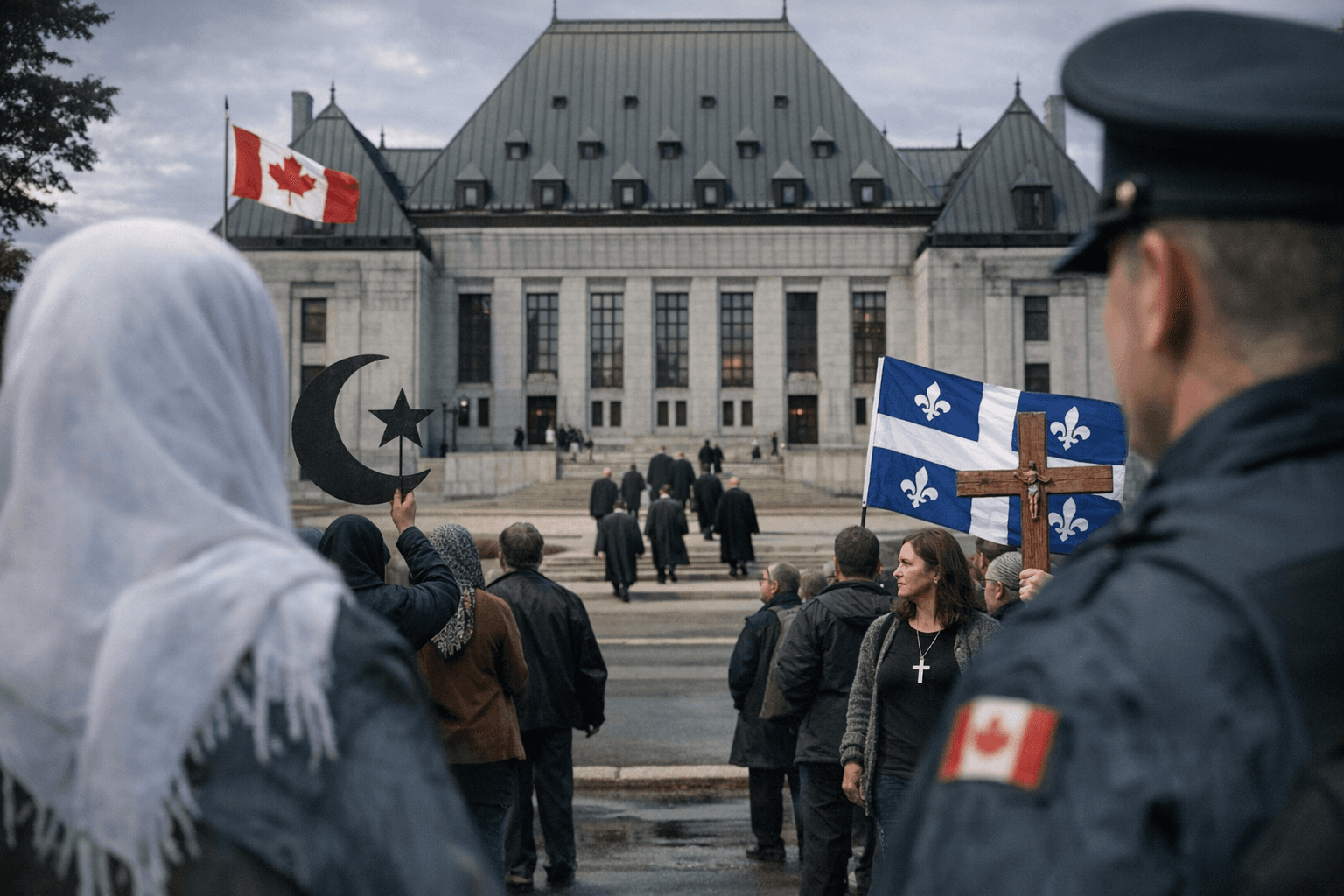
Four days of hearings at the Supreme Court of Canada opened Monday on the legality of Bill 21, Quebec's religious symbols ban for public sector employees in positions of authority. The stakes extend far beyond Quebec: legal experts say whatever the eventual ruling, it will have a profound effect on constitutional law in Canada.
The case stems from a law passed in June 2019 by the Quebec government led by François Legault, which bans certain public-sector workers, including teachers, police officers and judges, from wearing religious symbols on the job in the name of state neutrality. The practical consequences are immediate and personal. As constitutional lawyer Nader R. Hasan of Stockwoods LLP has noted, Bill 21 means that in Quebec, a Muslim woman who wears a hijab cannot be a lawyer, a Jewish man who wears a kippah cannot be a teacher, and a Sikh man or woman who wears a turban cannot work in the public service.
At the centre of the legal debate is Section 33 of the Canadian Charter of Rights and Freedoms, the notwithstanding clause. Legault's Coalition Avenir Québec government pre-emptively invoked the notwithstanding clause to shield the law from most court challenges over fundamental rights violations, a move critics call constitutionally reckless. That decision allowed the legislature to use Section 33 to suspend certain rights without having to justify its actions, which experts like Joel Bakan, a professor at the University of British Columbia's Allard School of Law, have called a "blank cheque" approach.
Patrick Taillon, a professor at Université Laval specializing in constitutional law, said the heart of the matter is the challengers' request that the Supreme Court overturn the interpretation of Section 33 that it established in 1988 in the Ford decision. The Ford decision allowed the legislature to use Section 33 to suspend certain rights without having to justify its actions. The Supreme Court has asked all parties to provide arguments based on Section 1 and to explain why the limits would or would not be "reasonable." Quebec has refused to do so, relying on the Ford decision, which does not require it to provide any justification.
That refusal defined day two of the hearings. Isabelle Brunet, the lawyer representing Quebec, told the court on Tuesday that the province does not have to justify its use of the notwithstanding clause, since it effectively shields the law from court scrutiny. Brunet also said the courts should not be used to meddle in a Quebec political debate, saying they should not become "an instrument enabling those who oppose certain legislative measures to evade them."
By Wednesday, arguments revealed a sharp divide between provinces on the role of courts in interpreting the notwithstanding clause. The federal government, along with Manitoba and British Columbia, argued that even when the clause is invoked pre-emptively, courts should still have the right to issue non-binding judgments as to whether a law violates the Charter. Quebec, along with Alberta and Ontario, vigorously opposed that idea. Ontario Attorney General Doug Downey told the court: "Ontario's position is that once Section 33 has been invoked, courts should not provide opinions on whether the law would have been constitutional if that invocation had not been made."
The broader pattern alarms those who believe the clause is being weaponized. Frédéric Bérard, arguing on behalf of a federation of Quebec teachers' unions, noted that the clause has been invoked nine times by provincial governments in the past 24 months alone. In recent years, provinces including Ontario, Alberta and Saskatchewan have invoked the notwithstanding clause to pass legislation stopping teacher strikes and setting new guardrails for gender-affirming care, among other issues.
There is only one limit to the clause: it sunsets, and therefore must be renewed every five years. The Quebec government has already renewed Bill 21 for another five-year period in 2024.
Hasan has argued the court should impose a harder constitutional floor: any government invoking Section 33 should be required to prove in court that the rights-overriding law has been passed for a proper purpose, rooted in Canadian constitutional values and principles, and that the law is rationally connected to that proper purpose. In his framing, "legislatures should have the ability to use the notwithstanding clause, but not with impunity. There must be limits."
The cultural roots of the dispute run deep. Quebec's law is formally known as the Act respecting the laicity of the state, setting out the principles of secularism in the province. The concept of laïcité has been a longstanding core tenet since the Quiet Revolution, which pushed back against the power and influence of the Catholic Church in Quebec society during the 1960s and 1970s. One thing that is unprecedented in this case, according to Emmett Macfarlane, a political science professor at the University of Waterloo who specializes in constitutional law, is that no qualified lawyer in the country disputes that Bill 21 is unconstitutional. There is agreement that it plainly violates religious freedom and equality rights, and only continues to operate by virtue of the notwithstanding clause.
Whatever the justices decide, the ruling will redraw the constitutional map. Both the Quebec Superior Court and the Quebec Court of Appeal ruled that, because of the notwithstanding clause, they could not rule on the law's constitutional validity. The Supreme Court's answer to whether that deference must continue, for this law and every one that follows, will define the limits of rights protection in Canada for a generation.
This article was produced by Prism’s automated news system from verified source data, official records, and press releases, then run through automated quality and moderation checks before publishing. The system is built and supervised by the people who set the standards it runs under. Read our full AI policy.
Did this article answer your question?

