Supreme Court Weighs Whether States Can Count Late-Arriving Mail-In Ballots
Justice Elena Kagan challenged the RNC's lawyers on federal preemption as the Supreme Court heard two hours of arguments in Watson v. RNC, a case that could strip ballot grace periods from 14 states before the 2026 midterms.

The U.S. Supreme Court heard oral arguments Monday in Watson v. Republican National Committee, which will determine whether states will still be allowed to count mail ballots that were sent on or before Election Day but arrive after it. The case turns on a deceptively simple question: does the word "election" in federal statutes passed in the 1800s mean the day voters mark their ballots, or the day officials receive them?
Before the court is Mississippi's law, which allows mail ballots received up to five days after the election to be counted as long as they were postmarked by Election Day. In 2024, the RNC and the state GOP, as well as Mississippi's Libertarian Party, filed lawsuits challenging the state's ballot-receipt deadline. A federal judge sided with the state, but the Fifth Circuit Court of Appeals ruled for the plaintiffs, prompting Mississippi to appeal to the Supreme Court. The Supreme Court agreed in November 2025 to take up the case.
Across roughly two hours of arguments, the justices asked sharp questions of lawyers for both the Republican National Committee, which is challenging the grace periods, and Mississippi officials, who are defending the law. U.S. Solicitor General D. John Sauer argued on behalf of the Trump administration, contending that Mississippi's law and similar statutes in other states could erode voter confidence in election results. Chief Justice John Roberts and Justice Amy Coney Barrett each asked questions indicating they were concerned about how a decision invalidating the deadlines for late-arriving ballots could affect election rules for early voting.
Justice Elena Kagan pressed Sauer and former U.S. Solicitor General Paul Clement, who argued on behalf of the RNC, on how far a ruling against Mississippi could reach. "Once we go down this road, once we say that these statutes that don't say anything actually have some significant preemptive effect, where are we going to end up?" Kagan asked Solicitor General D. John Sauer. Conservative Justices Samuel Alito and Clarence Thomas, by contrast, appeared skeptical of state laws that permit counting ballots arriving after Election Day.
Lawyers for the RNC urged the court to uphold the Fifth Circuit decision that invalidated Mississippi's law, arguing that the election ends when the ballot box is closed, not when voters make their selection. The term "election," Clement argued, refers to the public process of selecting candidates for federal office. "Finality should take place on Election Day," he told the justices.
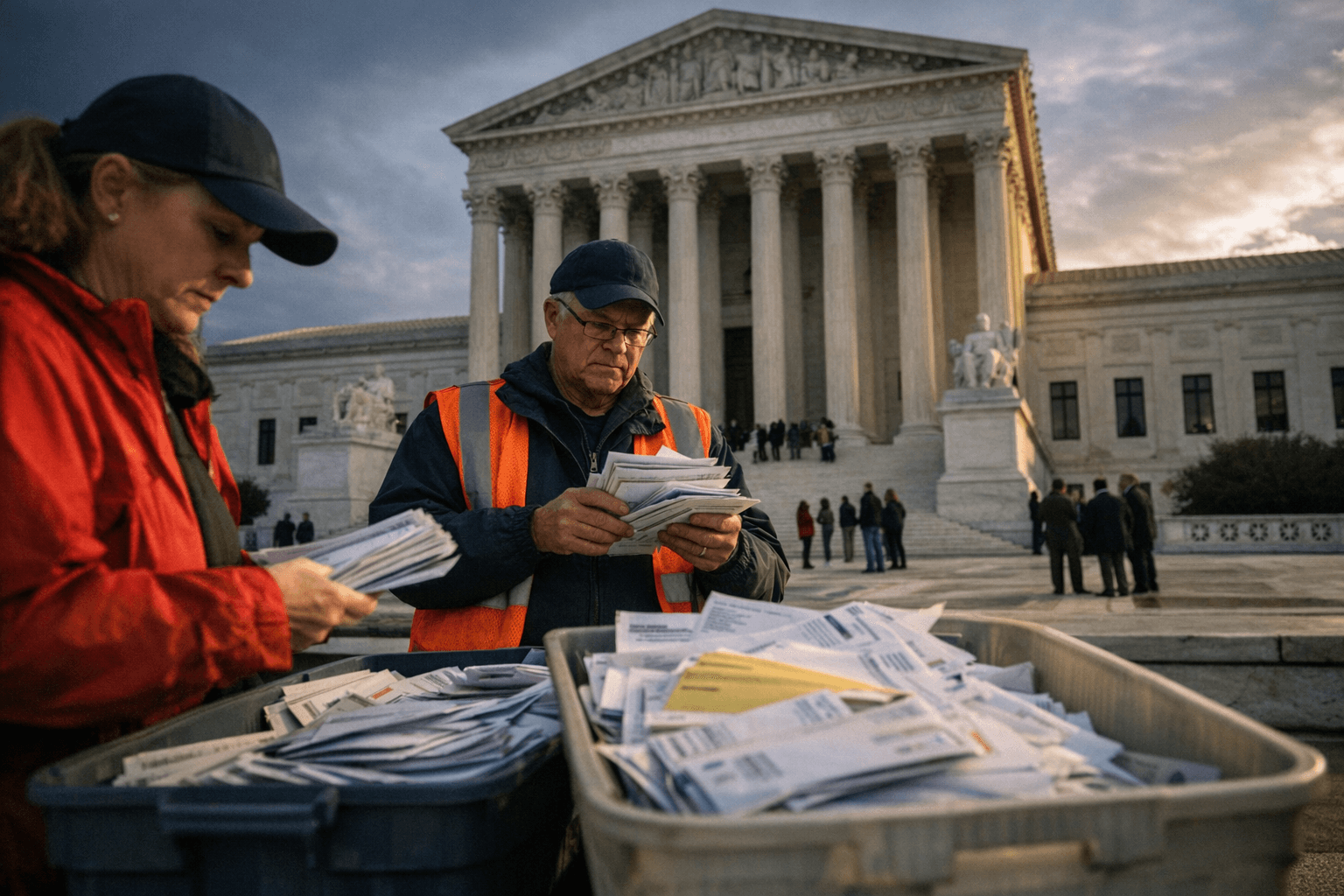
The stakes extend well beyond Mississippi. Watson and others defending the grace periods have warned that if the Supreme Court adopts the Fifth Circuit's rule, it could jeopardize the laws of the 29 states that accept some ballots after Election Day, including from military and overseas voters. There are nearly 4 million servicemembers and U.S. citizens living abroad who rely on mail ballots to vote, according to a coalition of groups representing troops, military families and overseas voters. State and big-city election officials filed a written brief warning that forcing states to change their practices just a few months before an election risks "confusion and disenfranchisement," particularly in jurisdictions that have operated under relaxed deadlines for years.
Justice Sonia Sotomayor pointed out during the oral arguments that late-arriving military ballots helped push Republican George W. Bush over the line in a prior presidential race, underscoring that the ruling's impact would not fall neatly along partisan lines. Questions from Justice Amy Coney Barrett, who is often a key swing vote, were harder to interpret than those from her conservative colleagues.
Mississippi's five-day grace period was passed nearly unanimously by the state's Republican-controlled legislature in 2020, explicitly to protect voters from unpredictable mail delays. President Donald Trump has framed the broader issue as a matter of election integrity, and in March signed the Executive Order Preserving and Protecting the Integrity of American Elections, which aimed to ban the counting of ballots received after Election Day.
The court's ruling could put thousands of mail ballots that arrive after Election Day at risk of rejection for the midterm elections. A decision in Watson v. Republican National Committee will determine whether federal law requires not only that voters cast their ballots by Election Day, but also that election officials receive the ballots by then. If the justices agree that it does, laws in more than a dozen states could be upended. A ruling is expected by late June, in time to set the rules for how ballots are counted in the November 2026 congressional elections.
This article was produced by Prism’s automated news system from verified source data, official records, and press releases, then run through automated quality and moderation checks before publishing. The system is built and supervised by the people who set the standards it runs under. Read our full AI policy.
Did this article answer your question?

