Surprise Swiss Chalet Hidden Within a Popular Isle of Man Glen
A Victorian glen built in the 1860s harbours an unexpected Swiss chalet with a story of fires, reinvention, and a new life as a showcase for Manx produce.
Tucked into the wooded western flank of the Isle of Man, four miles from Peel, Glen Helen is exactly the kind of place you visit for waterfalls, ancient trees, and a quiet walk beside a river. A Swiss chalet is the last thing most people expect to find here. Yet one has stood, burned, been rebuilt, and burned again at this spot for well over a century, and in 2026 it has opened its doors once more, this time as a dedicated showcase for local food and craft producers.
A glen built by ambition
Glen Helen was not a happy accident of nature, though it looks like one. The glen was created in the 1860s by a consortium of Manx businessmen interested in arboriculture. They laid its paths, carried out extensive planting of trees and ornamental shrubs, constructed river bridges, and opened the place to the public in 1867. The site was formerly known as Glen Rhenass, and the attractive name Glen Helen was likely taken from Greek myth to reflect the beauty of the location, though local tradition holds it was named after a daughter of the glen's early owner, Mr. John A. Marsden, a brush manufacturer from Seaview, Liscard, Cheshire, who also owned Liskeard Castle near Liverpool.
The Victorian development paid off. Today a variety of mature and impressive trees including sequoia, thuja, spruces, Douglas fir, oak, sycamore and beech can be seen. Paths traverse the glen along the rivers Neb and Blaber. Three-quarters of a mile into the glen is the dramatic Rhenass Waterfall. The glen covers 67 acres and is one of the best known glens on the Island, on the western side, on the famous TT Course.
That TT connection is no incidental detail. Glen Helen is known for the sweeping left-bend and uphill exit towards Creg Willey's Hill on the Snaefell Mountain Course used for the Isle of Man TT Races. The same road that carries motorcycles at racing speeds past its entrance also makes it an accessible stop for visitors arriving by car or coach, and a large car park sits at the entrance to the glen.
The chalet that shouldn't be here
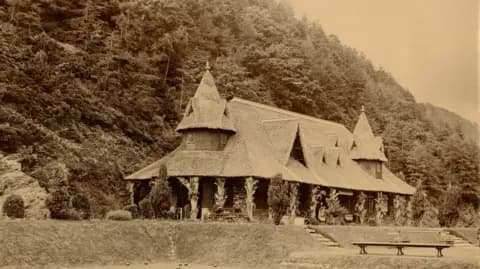
The Swiss Chalet at Glen Helen is a genuine architectural curiosity. The Swiss Chalet has a thatched roof and virgin cork supports to the veranda. It was designed by James Cowle, a Douglas architect and builder, who also designed Douglas Railway Station, the Rolls Office and the prison. The choice of a Central European alpine style for a Manx glen was unusual even by Victorian resort standards, and it inspired at least one remarkable piece of local mythology. The Robinson connection might be behind a story that the Swiss Cottage Chalet was originally erected by the Mormons with lower rooms designed for baptising converts, as stated in Dearden and Russell's "A Postcard tour of the I.O.M." Whether or not there is any truth in that tale, the chalet became a defining feature of the glen, drawing visitors who came to walk, eat, and take in the scenery around the falls.
In 1958 the Forestry, Mines and Lands Board purchased Glen Helen and Pleasure Grounds for £4,300. It was the eighth glen to be purchased for the Manx nation and included the Swiss Chalet restaurant, playground and buildings.
A history of fire
The chalet's story is inseparable from fire. The Swiss Chalet, which preceded the restaurant we see today, was burnt down in 1983. The Peel, Kirk Michael and Castletown fire brigades all turned out to fight the blaze at 6.45am on Monday 3rd January 1983. Little remained of the thatched structure, and what was left was so unstable that it had to be leveled. The glen was temporarily closed. It had destroyed a landmark that had already stood for over a century.
The rebuild, however, earned its own recognition. The replacement built in 1984 has a convincing Swiss chalet appearance and won an award for being a fitting replacement for the building that had been lost. For the next three decades it continued operating as a restaurant, becoming the Swiss House under the Mowat family after a six-month renovation and interior makeover that opened on Valentine's Day 2012, before returning to the Swiss Chalet name in subsequent years.
Then, in June 2020, history repeated itself. Forty firefighters tackled a devastating blaze at the Swiss Chalet in June 2020, which left the building a charred wreck that faced likely demolition. The fire broke out just after 1am, waking the building's occupants, who all escaped without injury. Crews from Peel, Kirk Michael and Douglas spent six hours bringing it under control. The building, owned by the Department of Environment, Food and Agriculture, had already closed as a restaurant the year before; the fire left it empty, damaged, and uncertain of any future.
A new chapter: farm shop and Manx produce
Six years on from that blaze, the Swiss Chalet has been transformed once more. Matt Harrison, managing director of the Isle of Man Farm Shop Company Ltd, has taken it on under a 20-year lease from DEFA. The planning committee voted unanimously to approve a change of use. The building reopened on Good Friday as a farm shop and deli takeaway, and the vision is deliberately rooted in the Island's own larder.
The Isle of Man Farm Shop Company brings together a wide range of Manx food, drink and craft producers all under one roof. The shop includes a full butchery counter offering meat from Tates Butchers, Lee Mayers Butchers, and Loaghtan producers Jenny Shepherd and Rawdon Hayne of Ballacosnahan Farm. Fresh seafood, including queenies, features alongside local eggs, honey, and vegetables. Beyond food, the shop carries Manx clothing, jewellery, ceramics, knitwear, books, and artwork, making it as much a cultural destination as a place to pick up groceries.
The location is a natural fit. Glen Helen already attracts coach parties, walkers, families with children visiting the play park, and TT spectators who know the bend by name. The chalet sits at the heart of all that foot traffic, with a 67-acre national glen on its doorstep and one of the island's most photographed waterfalls less than a mile up the path. What was once at risk of demolition after two fires and years of vacancy now serves as both a working shop and a statement about what the Isle of Man can produce and celebrate on its own terms.
This article was produced by Prism’s automated news system from verified source data, official records, and press releases, then run through automated quality and moderation checks before publishing. The system is built and supervised by the people who set the standards it runs under. Read our full AI policy.
Did this article answer your question?