Survivors of Iran Attack Dispute Pentagon Account, Say Unit Was Left Exposed
Soldiers from the 103rd Sustainment Command say their Port Shuaiba worksite had no overhead cover when Iran's drone struck, killing six on March 1.
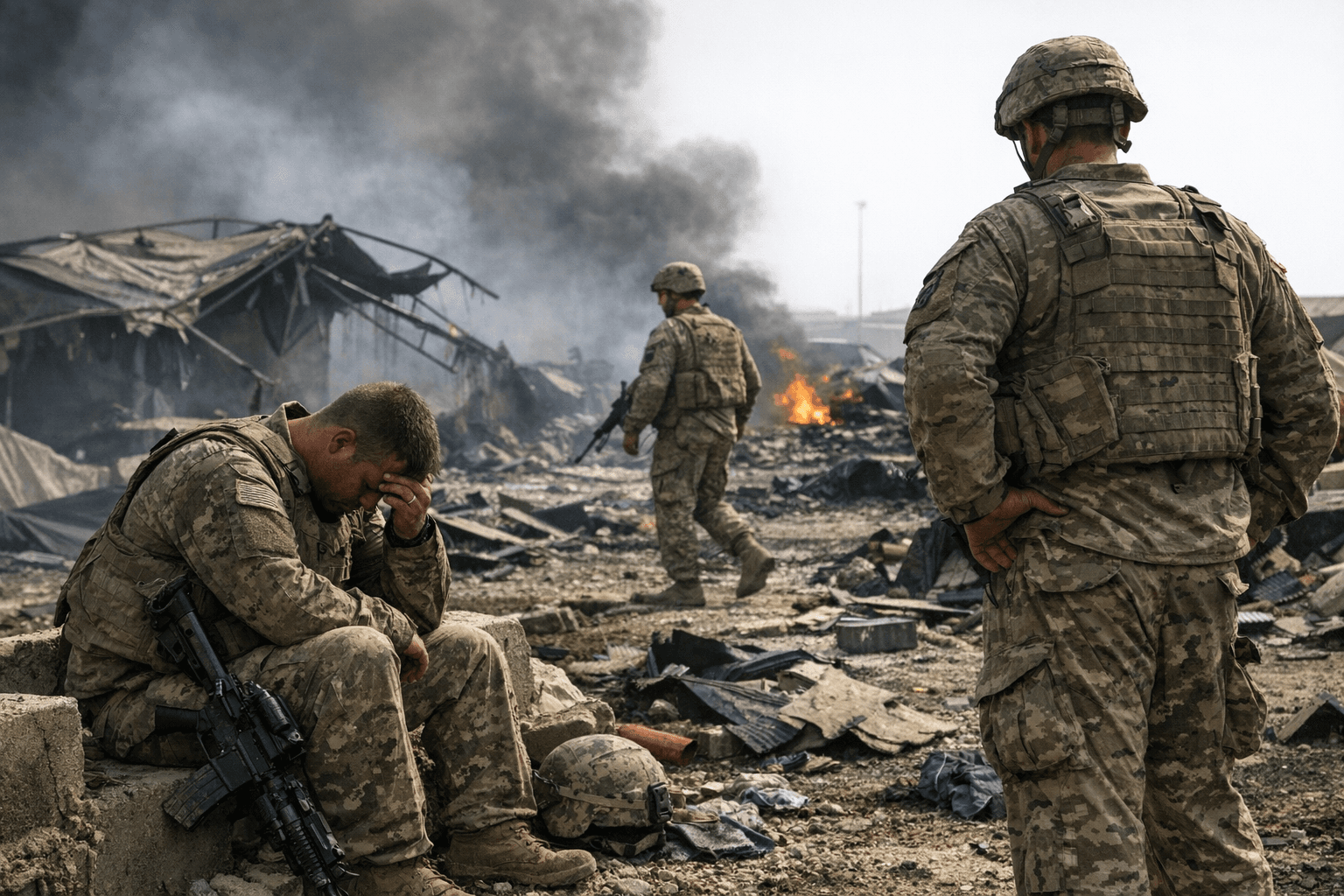
Around 9:15 a.m. on March 1, an all-clear sounded at the Port of Shuaiba, south of Kuwait City. Officers from the Army's 103rd Sustainment Command removed their helmets and returned to their desks inside a wood and tin workspace, roughly the width of three trailers. They had just taken cover in a cement bunker as a ballistic missile flew overhead. About 30 minutes later, an Iranian Shahed drone struck the center of their worksite.
Six soldiers were killed in what became the deadliest attack on U.S. forces since 2021. More than 20 others were wounded, and more than 35 were injured severely enough to require evacuation to medical facilities in the United States or Germany. Now, survivors of that strike are directly contradicting the Pentagon's official account of what happened and why.
Defense Secretary Pete Hegseth, speaking at a March 2 press briefing, described the strike as the work of a "squirter" that "happened to hit a tactical operations center that was fortified." Soldiers who lived through the attack say that characterization is false. "Painting a picture that 'one squeaked through' is a falsehood," one injured member of the 103rd Sustainment Command said. "I want people to know the unit was unprepared to provide any defense for itself. It was not a fortified position."
The soldiers, who spoke on the condition of anonymity due to rigid military media restrictions, described an operations center protected by little more than thin vertical blast barricades, designed to deflect mortar and rocket blasts but offering no cover from aerial attacks. "From a bunker standpoint, that's about as weak as one gets," one soldier said.
The exposure was not incidental. About one week before the launch of Operation Epic Fury, most American soldiers and airmen stationed in Kuwait were relocated to Jordan and Saudi Arabia, moved deliberately out of Iranian missile range. Leadership told some to pack for 30 days. The directive was phrased simply: "Get off the X." But for several dozen members of the 103rd, orders sent them in the opposite direction, to Port Shuaiba. One soldier said there was intelligence indicating the facility was on a list of possible Iranian targets. "We moved closer to Iran, to a deeply unsafe area that was a known target," that soldier said. "I don't think there was a good reason ever articulated."
The crew of about 60 troops had already sheltered from one incoming missile that morning before the all-clear sounded. When the drone detonated, the scale of injury was immediate and overwhelming. "It was chaos," one survivor said. "There was no single line of patients to triage. You're on one side of the fire or you're on the other side of the fire." Survivors described head wounds, heavy bleeding, perforated eardrums, and shrapnel injuries across the body.
Assistant Secretary of Defense Sean Parnell pushed back, stating that "every possible measure has been taken to safeguard our troops at every level" and that the facility had been "fortified with 6-foot walls." House Intelligence Committee Chairman Rick Crawford, an Army veteran from Arkansas, also faced pointed questions about the discrepancy.
For some who survived, the dispute over language carries weight beyond semantics. "It's not my intent to diminish morale or to disparage the Army or the Department of War more holistically, but I do think that telling the truth is important and we're not going to learn from these mistakes if we pretend these mistakes didn't happen," one soldier said. Asked directly whether the attack was preventable, the answer was unambiguous: "In my opinion, absolutely, yes.
This article was produced by Prism’s automated news system from verified source data, official records, and press releases, then run through automated quality and moderation checks before publishing. The system is built and supervised by the people who set the standards it runs under. Read our full AI policy.
Did this article answer your question?

