Suspicious Oil and Prediction Market Trades Surge Ahead of Key Conflict Moments
The White House issued an internal warning to staff after roughly $500 million in oil futures were traded in a single minute before Trump's Iran strike announcement.
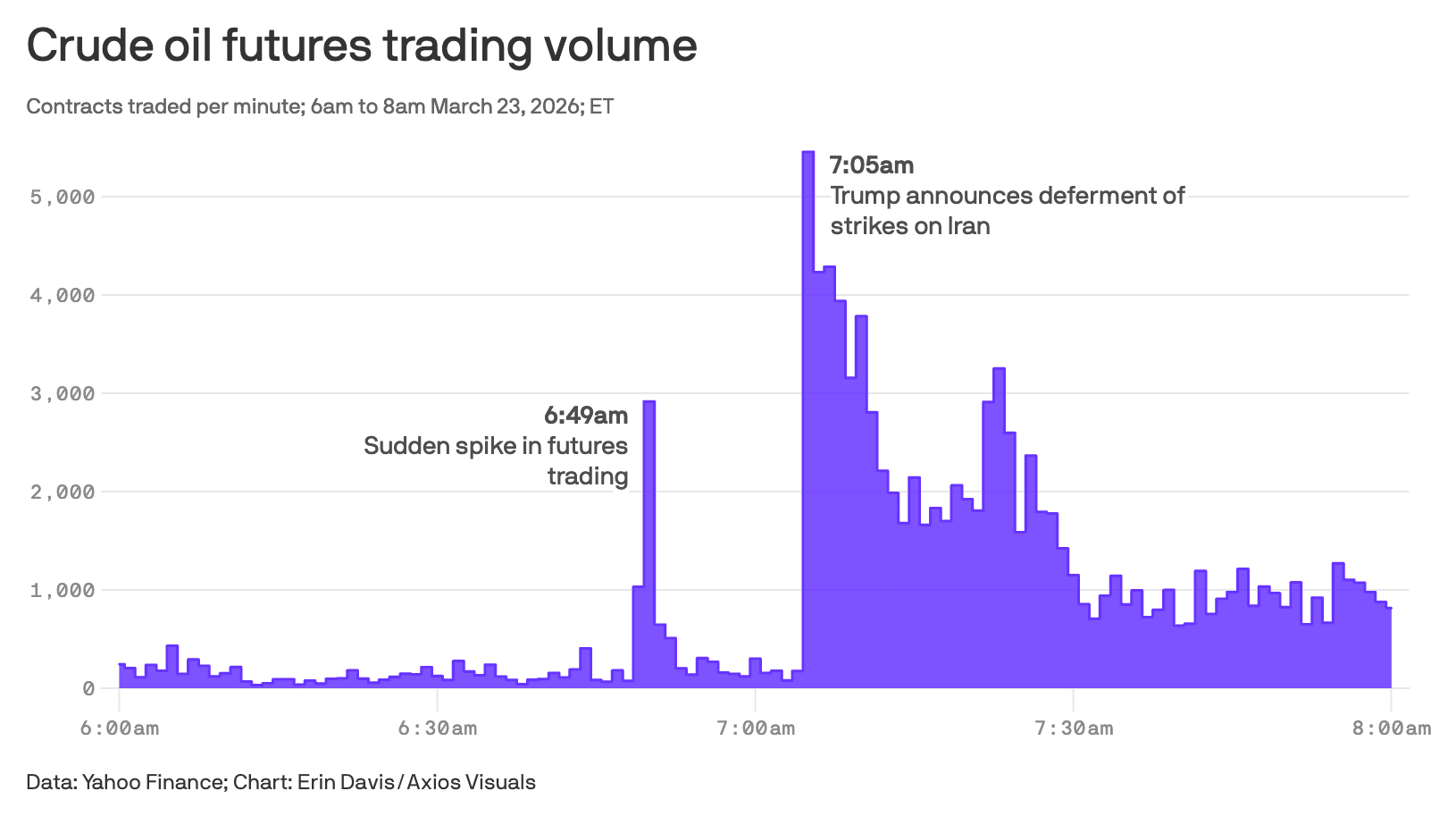
A single 60-second window between 6:49 and 6:50 a.m. on March 22 tells a damning story. In those 60 seconds, roughly 6,200 Brent and West Texas Intermediate crude oil futures contracts changed hands, representing approximately $500 million in bets placed just before President Trump announced a five-day pause in strikes against Iran. The trades preceded Trump's Truth Social post by roughly 15 minutes, and oil prices responded exactly as a well-positioned trader would have hoped.
The White House, recognizing the reputational exposure, sent an internal staff-wide email warning employees against using confidential government information to place trades on financial markets and prediction market platforms. White House spokesperson Kush Desai stated plainly that "The White House does not tolerate any administration official illegally profiteering off of insider knowledge," though the directive itself acknowledged the behavior as a live concern rather than a resolved one.
The oil futures episode was not an isolated incident. On Polymarket, the offshore prediction market platform, a trader operating under the account name "Magamyman" collected nearly $600,000 by correctly timing bets on the February U.S. and Israeli strikes on Iran. A separate Polymarket user accumulated $967,000 across numerous Iran-related contracts, with a win rate exceeding 93 percent on bets valued above $10,000, a statistical performance that market analysts described as implausible without some form of advance knowledge. On Polymarket alone, more than half a billion dollars in war-related contracts were traded as the conflict began in February.
Rep. Ritchie Torres, a New York Democrat and member of the House Financial Services Committee, wrote to the heads of both the Securities and Exchange Commission and the Commodity Futures Trading Commission demanding a formal investigation. "There's something suspicious about the sheer speed, scale and structure of the trade," Torres said. "The facts are so glaringly obvious neither the SEC nor the CFTC can afford to ignore them." He warned that the episode "may be the largest case of insider trading in history." It was the second such alarm Torres raised in recent months; in January he had flagged suspicious Polymarket activity preceding the ouster of Venezuelan President Nicolás Maduro.
The oversight gap is structural. The CFTC is the primary body responsible for policing futures markets and prediction platforms like Polymarket and Kalshi, but since Trump returned to office in 2025, the agency dropped its effort to block Kalshi from offering political event contracts and closed its investigation into Polymarket. That regulatory retreat left enforcement largely to the platforms themselves. Polymarket updated its terms of service to explicitly prohibit trading on "stolen confidential information" or on events a user could influence. Kalshi announced it would bar politicians from trading on their own campaigns and preemptively blocked anyone in college or professional sports from wagering on games they play or administer. Critics characterized both moves as efforts to preempt tougher government oversight rather than genuine deterrents.
State governments began filling the vacuum. California Gov. Gavin Newsom banned state appointees with insider knowledge from participating in prediction markets. Washington State sued Kalshi directly, alleging it was facilitating "illegal gambling." More than a dozen other states have moved to regulate the platforms.
Nobel laureate Paul Krugman framed the pattern in the starkest possible terms, calling the behavior treason. Marko Kolanovic, former head of quantitative strategy at JPMorgan, warned that the manipulation was a "net negative for markets" and urged investors to stop relying on official government statements and instead focus on physical realities, specifically whether oil was actually flowing through the Strait of Hormuz. Brent crude has risen approximately 37 percent since the conflict began on February 28, trading near $100 a barrel, a price level that enriches whoever correctly anticipated each escalation and each pause.
The White House memo arrived the day before the question before Congress became unavoidable: if the regulatory body designed to investigate this kind of trading has been effectively stood down, and the platforms writing their own rules have every financial incentive to stay in business, who exactly is left to enforce the law?
This article was produced by Prism’s automated news system from verified source data, official records, and press releases, then run through automated quality and moderation checks before publishing. The system is built and supervised by the people who set the standards it runs under. Read our full AI policy.
Did this article answer your question?