Target unveils AI-powered turnaround plan, tech chief says AI won't replace workers
Target committed $1 billion in new capital and $1 billion in operations, plus 30 stores and AI-driven app rewrites, as tech chief Prat Vemana said AI will free employee time, not replace workers.
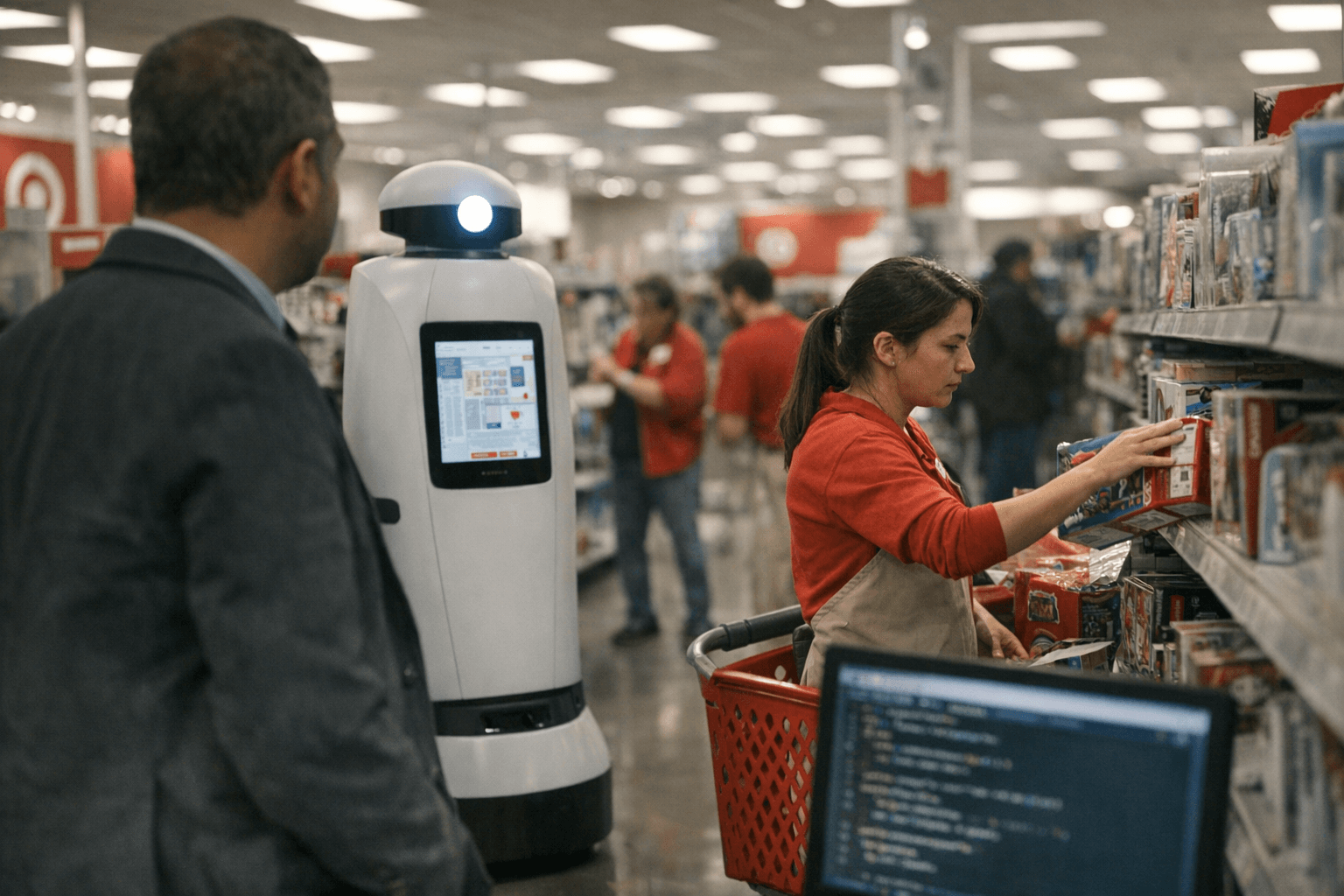
Target rolled out a multibillion-dollar turnaround that pairs $1 billion in additional capital and $1 billion in new operational commitments with an aggressive store and assortment plan, company leaders said at the Minneapolis headquarters presentation. New CEO Michael Fiddelke, who officially started in February, spent the morning outlining 30 new stores, 130 remodels and plans to overhaul as much as 75 percent of assortment in certain categories after the retailer logged its 13th consecutive quarter of weak sales while competitors Walmart and Costco gained market share.
Central to the pivot is what Target’s tech chief, Prat Vemana, described as a suite of new AI tools that the company is deploying to speed work and spot trends across merchandising, product and store operations. Vemana led demonstrations showing generative-AI projects and framed the arrival of the technology as timely: "Generative AI couldn't have come along at a better time for Target," he said, adding, "I couldn't have asked for a better time for AI to show up, because now we have a need. We have a bold agenda ahead of us."
Vemana emphasized AI as a productivity lever rather than a headcount play, saying, "We really care about human touch — that's what matters," and, "Anything that gives time back to the team, they give back to the guest, and guest is happy." The company has not released workforce impact numbers in conjunction with the plan; executives presented AI as a way to free employees for guest-facing tasks and to accelerate internal processes.
Part of that acceleration was illustrated by the app rewrite Vemana described. He said the company "rewrote the entire app already — what would have taken years and years — in, like, 18 months," crediting "AI coding companions" for making the task much faster. The overhaul responded to generative-AI needs, he said, because the way generative models handle information required a complete codebase rewrite. Vemana also pointed to product-facing features such as the Target app’s list scanning feature and promised "blisteringly fast product releases" as part of the turnaround cadence.
Target is also experimenting with external integrations that reflect wider retail trends. The company is among the first retailers to offer multi-item baskets through ChatGPT and is one of Google’s partners in developing the open commerce protocol on Gemini, moves that position Target to participate in agentic shopping tools that "grabbed headlines last fall," according to executives.
Leadership framed the spending and technology push as necessary to meet urgent competitive pressure and to change how products reach guests. The centerpiece commitments — $1 billion in capital, $1 billion in operations, 30 stores, 130 remodels and sweeping assortment work — signal a measurable bet on AI-accelerated product development and store investment, with Vemana arguing those tools will return time to team members and preserve "human touch" in stores and online. The company’s next test will be translating faster tech cycles and partnerships into sales growth after more than a year of weak results.
Know something we missed? Have a correction or additional information?
Submit a Tip

%3Amax_bytes(150000)%3Astrip_icc()%2F8-k.asp-final-08e181198e5a47aaafdb796be8ef4efa.png&w=1920&q=75)