Tax Debt and Tax Liens Are Different, and Confusion Can Cost You
Tax debt is what you owe; a tax lien is what the government can enforce against everything you own. Confusing them delays action that could prevent assets seized or a home sale blocked.
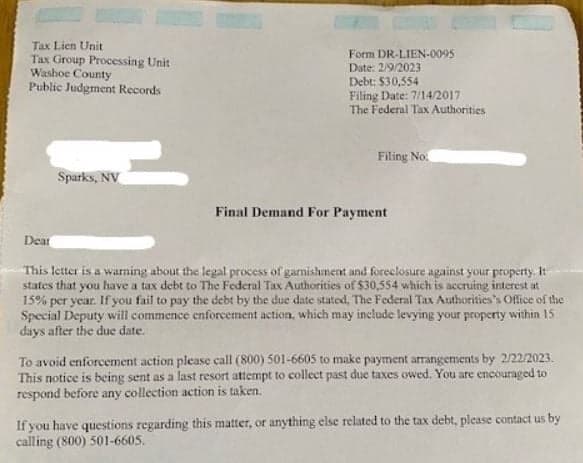
The moment the IRS files a Notice of Federal Tax Lien against you, it enters the public record at your local recording office. From that point, selling your home, refinancing your mortgage, or applying for a business loan all run directly into a government claim that must be satisfied first. That is the concrete cost of confusing tax debt, what you owe, with a tax lien, what the government can legally enforce against everything you own.
What Tax Debt Actually Is
Tax debt is the starting point: an outstanding unpaid obligation owed to a taxing authority, whether federal, state, or local. It becomes the trigger for everything that follows. Until the IRS assesses that debt and sends you a formal bill, no lien exists. Once it does and you ignore it, the legal machinery accelerates quickly.
Lien, Levy, and Certificate: Three Terms That Mean Very Different Things
The IRS draws a precise line between its two primary enforcement tools. "A levy is a legal seizure of your property to satisfy a tax debt," the agency states. "A lien is a legal claim against your property to secure payment of your tax debt, while a levy actually takes the property to satisfy the tax debt."
A lien reserves the government's place in line. A levy physically takes what you own: bank accounts, wages, real estate, vehicles. The distinction is not academic. A lien can linger for years, quietly blocking financial transactions. A levy is immediate and concrete.
Then there is the tax lien certificate, a third concept that trips up even attentive readers. "A tax lien is a claim a government makes on the property when taxes are delinquent," according to Proplogix, a property-data firm. A tax lien certificate, by contrast, is a claim a private purchaser holds on the interest and fees from those overdue taxes. One is a government enforcement tool; the other is an investment product sold at local auctions. They share a name but operate in entirely different arenas.
How a Federal Tax Lien Is Created: The Step-by-Step Sequence
Understanding the sequence matters because each step offers a window to act.
1. The IRS assesses the tax and sends a "Notice and Demand for Payment," which is the formal tax bill.
2. If you fail to pay or arrange a settlement, the IRS establishes a federal tax lien: a legal claim against your property.
3. The IRS then files a Notice of Federal Tax Lien (NFTL) in the public record at your local recording office, alerting all creditors that the government has a senior interest in your assets.
"A federal tax lien comes into being when the IRS assesses a tax against you and sends you a bill that you neglect or refuse to pay it," the IRS explains. The NFTL is filed like any other creditor claim and becomes visible to mortgage lenders, title companies, and anyone running a public records search on you or your property.
Critically, you have appeal rights at two points: before the NFTL is filed and after it is filed. Those rights are detailed in IRS Publication 1660, Collection Appeal Rights. Using that window is one of the most consequential and underused options available to taxpayers.
How a Federal Tax Levy Works
A levy goes further than a lien. Where a lien claims an interest in your assets, a levy seizes them. "An IRS levy occurs when the IRS actually seizes property to satisfy a tax debt," and the agency must first assess the tax, send the Notice and Demand for Payment, and demonstrate that you neither paid nor made arrangements to resolve it.
One important and often surprising fact: "An IRS levy is not a public record." Unlike the NFTL, a levy does not appear in your local recording office. It is an enforcement action, not a filing. The absence of a public record does not make it less serious; it makes it easier to miss until it is already happening.
The Lien's Reach: What It Attaches To
A federal tax lien does not attach only to the property you owned at the time of the assessment. "The lien is attached to all of the assets you own, as well as any assets you acquire while the lien is in place. Federal tax liens may also attach to your business property." That means a car you buy after the lien is filed, a business bank account you open, or a property you inherit during that period can all fall within the government's claim.
The credit and financing consequences compound the problem. The NFTL "may affect your ability to get credit or sell your property," and "federal tax liens may also impede your ability to obtain credit or loans." The lien effectively freezes your financial life until it is resolved. And if you attempt to discharge the underlying debt in bankruptcy, the lien may survive: "If you file for bankruptcy, the lien may not be released."

How Local Property Tax Liens and Certificates Work
The federal process and the local property-tax process are parallel systems that can both result in a lien on your home, but they operate under different rules. Multiple levels of government, including federal, state, and local authorities, can place tax liens on property. However, tax lien certificates are a strictly local product, offered only by cities, towns, and counties.
When a homeowner falls behind on property taxes, the municipality can sell the right to collect that debt to a private investor. "A Tax Lien Certificate is a bid on the right to collect interest on the delinquent property taxes, ranging from 2% to 36%, depending on the property's location." The purchaser essentially steps into the taxing authority's shoes: "The purchase of a Tax Lien Certificate entitles the purchaser to perform the duty of the taxing authority and collect full payment of the delinquent taxes."
The homeowner's sequence is direct. A tax lien is placed on the property before any tax deed is sold. If the homeowner pays the outstanding balance within the redemption period set by the municipality, the investor is reimbursed the principal plus accrued interest and fees. If the debt remains unpaid, the property can go to a tax deed auction, where the homeowner stands to lose the property entirely.
The pressure on homeowners is real and by design. "Local governments need homeowners to pay property taxes in order to fund local necessities like fire departments, schools, and law enforcement." The investor market exists precisely to fill the revenue gap when those taxes go unpaid.
The Investment Market Behind Property Tax Liens
Tax lien certificate investing has grown substantially since it originated in Texas in the 1990s. "Tax lien certificates and deeds provide profit to investors willing to pay off the homeowner's debt. While large institutions dominate this form of investing, anyone can choose to invest." The potential returns, interest rates between 2% and 36% depending on jurisdiction, make the asset class particularly attractive to institutional buyers. Investors can profit either by earning interest and sometimes penalties, or potentially by acquiring below-market property when a redemption period expires. For homeowners, that investor appetite translates into a hard deadline: once a certificate is sold, the clock on the redemption period starts running.
What to Do When a Notice Arrives
The single most important rule is not to wait. "If you have received notice of a lien from the IRS, do not ignore it. Instead, make an appointment to speak with an attorney experienced in tax debt matters."
Tax attorney Brian T. Loughrin, who has over 25 years of experience in tax controversy and debt resolution, has described the distinction between liens and levies as one that "can protect taxpayers from severe financial consequences" when understood early. The faster a taxpayer responds to a notice, the more options remain available.
The IRS does offer structured alternatives for taxpayers who cannot pay in full:
- Monthly installment agreements allow payment over time without triggering immediate enforcement.
- Offers-in-compromise allow eligible taxpayers to settle the debt for less than the full amount owed.
- Extensions on the payment deadline may be available in certain circumstances.
The decision points follow a clear path:
1. Notice and Demand for Payment arrives: respond immediately; do not let it expire unaddressed.
2. Evaluate payment options: full payment, installment agreement, offer-in-compromise, or extension request.
3. If an NFTL is being filed or has already been filed: exercise appeal rights under IRS Publication 1660 before and after filing.
4. If a lien is already in place: work with a tax professional toward lien release, subordination, or discharge depending on your specific circumstances.
Where to Turn for Help
IRS Publication 1660, Collection Appeal Rights, is the official guide to your options once an NFTL is filed or threatened. The IRS website sections covering "Understanding a Federal Tax Lien" and the comparison of levies and liens provide authoritative federal guidance. For those navigating complex situations involving business assets or multiple enforcement actions, tax attorney Brian T. Loughrin of TampaTaxRelief can be reached at (813) 517-8074.
The gap between tax debt and a tax lien is measured in time and action. Every notice ignored, every payment arrangement deferred, shortens that gap. Once the NFTL is in the public record and investors hold certificates on your property taxes, the options narrow fast and the consequences become significantly harder to reverse.
This article was produced by Prism’s automated news system from verified source data, official records, and press releases, then run through automated quality and moderation checks before publishing. The system is built and supervised by the people who set the standards it runs under. Read our full AI policy.
Did this article answer your question?

