Tech CEOs Claim AI Models Thrive Without Human Agency or Input
Nvidia's Jensen Huang envisions 7.5 million AI agents for every 75,000 human workers, as tech CEOs reframe mass job cuts as inevitable workforce evolution.
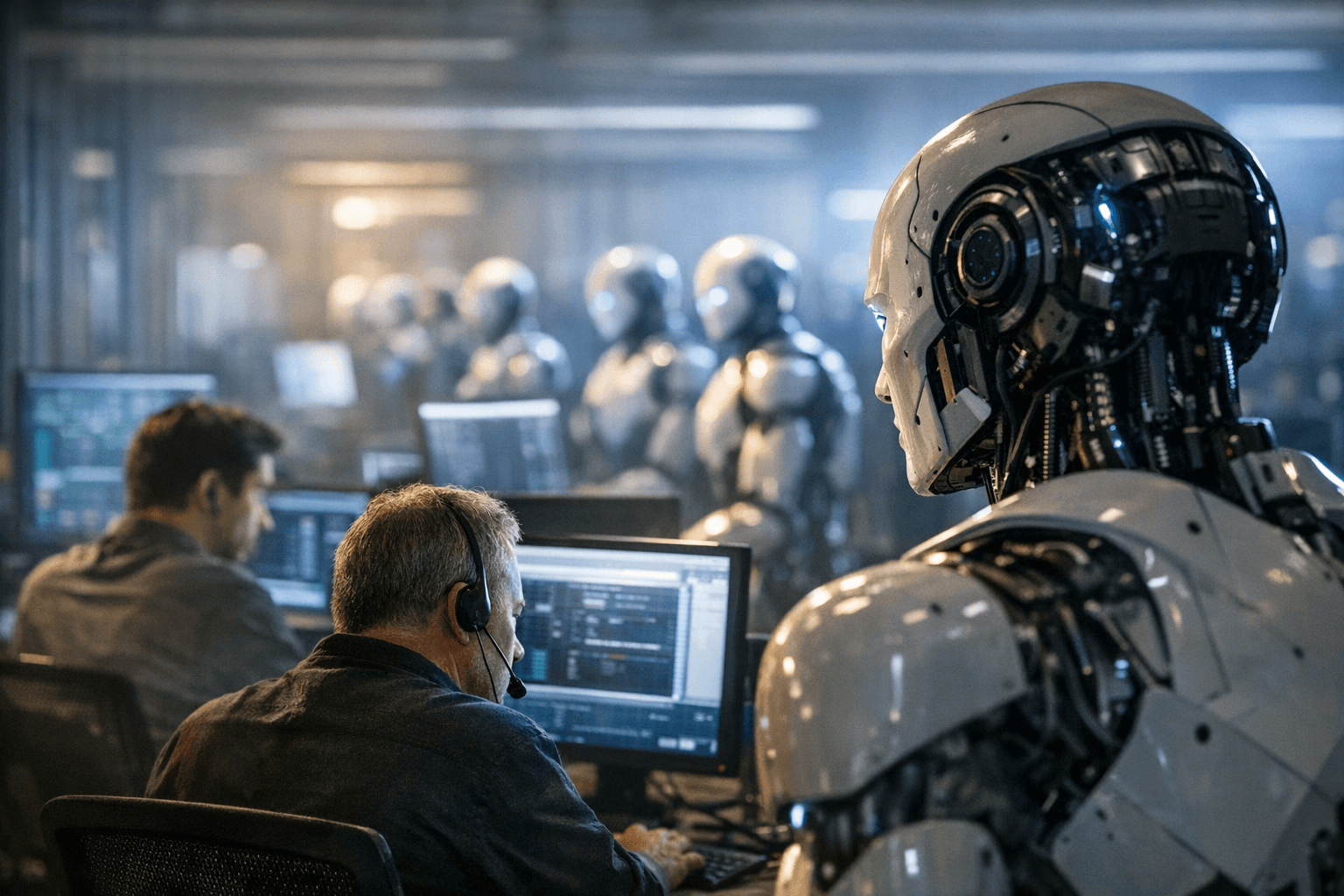
The language has been carefully chosen. When Nvidia CEO Jensen Huang stood before a capacity crowd at the SAP Center in San Jose on March 16, he did not say Nvidia planned to replace its workforce. He said, "Those 75,000 employees will be working with 7.5 million agents." The ratio, 100 AI workers for every human, was framed not as a displacement strategy but as a productivity vision. The word doing the heavy lifting was "with."
That rhetorical move, casting AI as a collaborative partner rather than a substitute, has become the defining script of 2026's tech leadership class. It converts a business decision with direct human cost into something that sounds like a natural law: not that companies are cutting people, but that AI simply works, autonomously and continuously, whether or not humans are in the loop.
At January's World Economic Forum in Davos, Salesforce CEO Marc Benioff declared that he and many other executives at the event would be the last cohort of CEOs to lead all-human workforces. The statement was received as a prophecy. In practice, it was also a confession. Benioff's Salesforce cut roughly 4,000 customer service roles as AI agents stepped in to do the work, with the CEO noting he simply "needs less heads" now that the technology handles over a million consumer conversations and has reduced support costs by 17 percent since early 2025. Salesforce's support workforce shrank from 9,000 to 5,000 employees during that period. Benioff also announced that Salesforce would not be hiring any additional software engineers during fiscal year 2026, relying instead on AI-powered coding tools.
OpenAI CEO Sam Altman set the tone in a January 2025 blog post, writing that "in 2025, we may see the first AI agents 'join the workforce' and materially change the output of companies." The framing of agents "joining" rather than displacing was deliberate: it positions AI as an addition to labor supply rather than a reduction in human demand.
Meanwhile, Anthropic CEO Dario Amodei told Davos attendees that "by 2026 or 2027, we will have AI systems that are broadly better than almost all humans at almost all things." Such predictions carry enormous weight with investors and create adoption pressure on enterprise buyers who fear being left behind if they keep humans on payroll.
At Nvidia's GTC conference, Huang proposed giving engineers AI token budgets worth roughly half their base salary, a compensation structure that effectively monetizes how aggressively workers adopt the tools designed to reduce the need for them. Around 65 percent of executives expect between 11 and 30 percent of their workforce to be redeployed or reskilled due to AI by 2026. Redeployment, like "working with," is language that softens the ledger.
Entry-level jobs face the greatest risk, as AI eliminates the stepping-stone tasks historically used to train new workers, further widening the skills gap at a time when demand for AI-literate workers is accelerating. The pipeline that once built careers from the ground up is being dismantled in the name of efficiency, with no clear replacement structure in sight.
Goldman Sachs has estimated AI could automate 25 percent of U.S. work hours while displacing 6 to 7 percent of jobs outright. Those numbers do not appear in keynote addresses. What does appear is the word "agentic," which has become the industry's preferred way of saying that the system acts on its own. The implication, rarely stated but structurally present, is that when an AI agent takes a job, no one made that choice.
Know something we missed? Have a correction or additional information?
Submit a Tip