Telegram links briefly go offline after t.me DNS suspension
Telegram’s t.me links vanished worldwide after a registry-level hold cut the domain from DNS, while the app itself kept working.
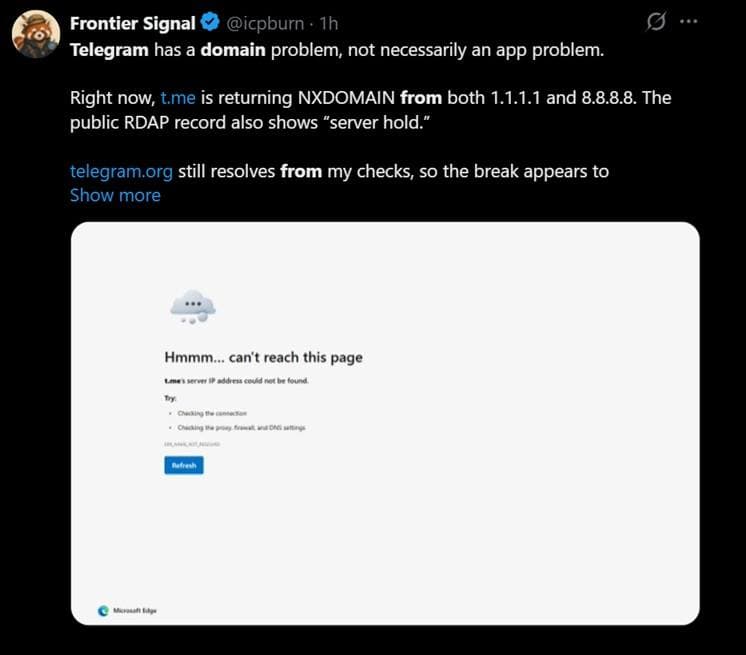
Telegram’s t.me short-link domain went dark worldwide after the .me registry placed it on registry-level serverHold, breaking usernames, channels, bots, invite links and shared posts across the platform. Pavel Durov confirmed the outage in a tweet, saying the app’s short-links had “stopped working.”
The disruption began on July 13, 2026, when serverHold removed t.me from global DNS resolution. Telegram’s core messaging service kept running, and its main website remained accessible, but links posted across the internet no longer resolved for users trying to open profiles, channels, groups, bots and individual posts. Telegram’s own documentation says clients must support both HTTPS t.me links and tg:// deep links, which made the short-link domain a critical entry point for public content rather than a minor convenience.

WHOIS records showed t.me remained registered with GoDaddy.com, LLC, with a creation date of May 20, 2010 and an expiry date of May 20, 2035, making clear the failure was not the result of a routine renewal lapse. CybersecurityNews said the domain carried eight status flags after the change, including serverHold, clientDeleteProhibited and serverDeleteProhibited, with an update timestamp of 2026-07-13T19:24:55Z. The registry action, not Telegram’s app infrastructure, was what cut the links off from global resolution.
Users and observers reported widespread failures across Telegram profiles, channels, groups, bots and mini-apps, showing how heavily the service depends on a single public gateway for discovery and sharing. Domain Name Wire noted that Telegram uses t.me in the format t.me/username for accounts, t.me/channelname for channels, and similar paths for other destinations inside the app. Some reports said users could temporarily work around the outage by replacing t.me with telegram.me in URLs.
The domain came back online after about a day-long suspension, restoring access to the short-link system. The brief outage left Telegram’s core service intact, but it exposed how much of the platform’s reach, verification and distribution still runs through one registry-controlled shortcut.
This article was produced by Prism’s automated news system from verified source data, official records, and press releases, then run through automated quality and moderation checks before publishing. The system is built and supervised by the people who set the standards it runs under. Read our full AI policy.
Did this article answer your question?