Tesla hikes 2026 spending above $25 billion for AI, robots, chips
Tesla lifted 2026 capital spending above $25 billion as it pours cash into AI, robots and chips, even as free cash flow turns negative and car-market pressure persists.
Tesla is asking investors to fund a far bigger bet on robots, chips and autonomy just as its core auto business faces tougher scrutiny. The company raised its 2026 capital-spending plan to more than $25 billion, up from about $20 billion, and signaled that free cash flow would turn negative for the rest of the year.
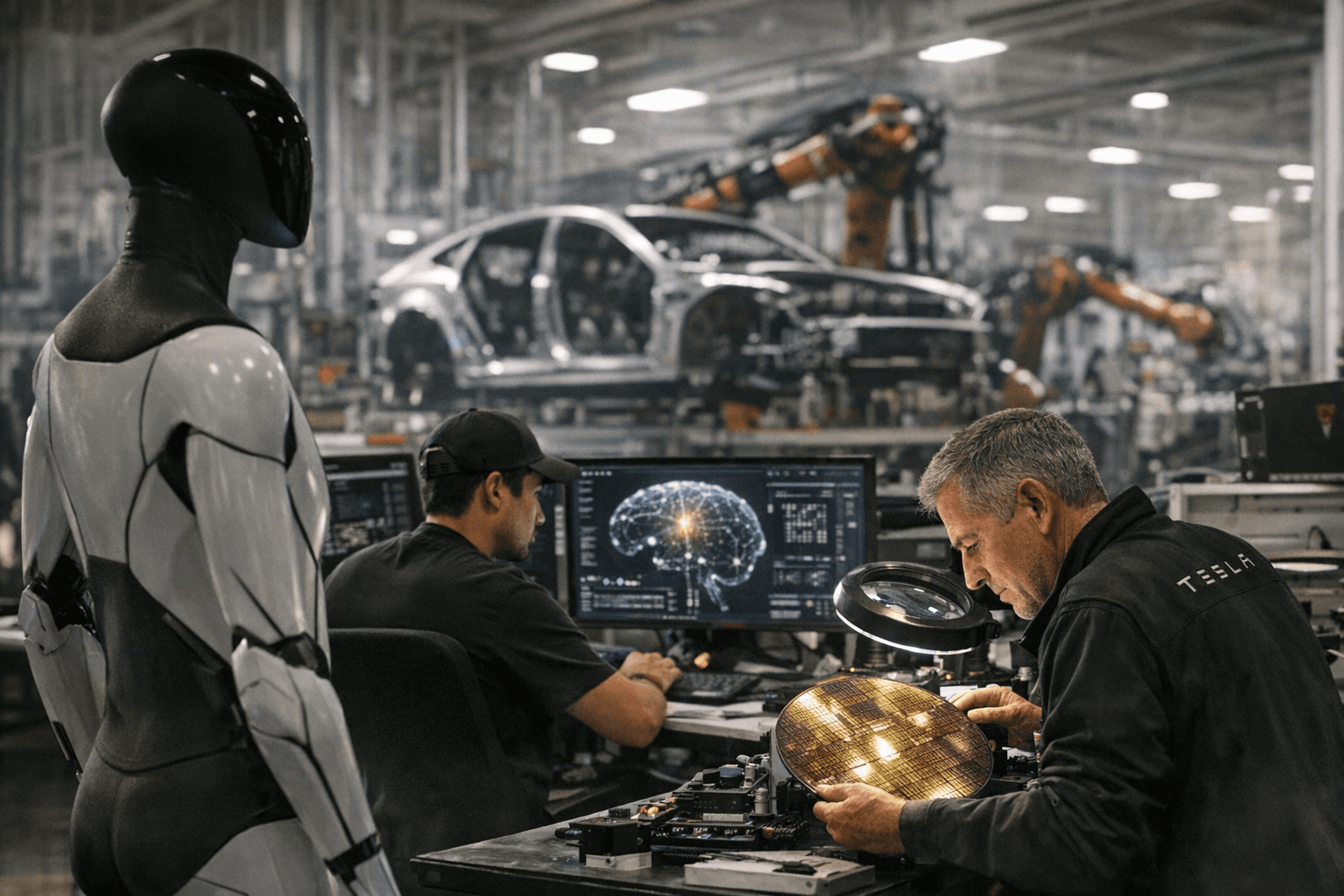
The spending commitment is close to three times Tesla’s outlay last year and arrives while Elon Musk is trying to reframe the company as an AI and robotics platform rather than a carmaker alone. Tesla said the money will go toward artificial intelligence compute, robotics, new factories for batteries and battery materials, and production lines for Cybercab, the Tesla Semi and Optimus, its humanoid robot.

Tesla’s first-quarter numbers show why the market is uneasy. Revenue rose 16% from a year earlier to $22.38 billion, while GAAP operating income came in at $0.9 billion and GAAP net income at $0.5 billion. Free cash flow was $1.4 billion, and Tesla said cash and investments still increased by $0.7 billion. But the company’s finance chief warned that cash generation would swing negative through the rest of 2026, putting the burden squarely on future products to justify the investment.
Musk and Tesla are pointing to early autonomy milestones. The company said it launched unsupervised Robotaxi rides in Dallas and Houston in April and won approval for FSD, or Supervised, in the Netherlands the same month. Tesla also said preparations for its first large-scale Optimus factory would begin in the second quarter, with the first-generation Fremont, California, line designed for 1 million robots a year and set to replace the Model S and Model X lines.
Musk said Optimus production at Fremont would begin in late July or August, but warned the ramp would be “quite slow” because the robot has 10,000 unique parts. He also said Tesla is building a second Optimus factory at Gigafactory Texas, with production expected around summer 2027.
That timetable captures the investor dilemma. Tesla’s stock has lagged all of its megacap peers this year as BYD, Xiaomi and other EV rivals squeeze the car business, yet Musk is asking Wall Street to value Tesla on a much larger future in autonomy and robotics. The spending plan now gives investors a testable roadmap, but it also raises the stakes: Tesla has to prove that AI and robots can become real businesses before the cash drain becomes a deeper drag on the company’s core automotive franchise.
This article was produced by Prism’s automated news system from verified source data, official records, and press releases, then run through automated quality and moderation checks before publishing. The system is built and supervised by the people who set the standards it runs under. Read our full AI policy.
Did this article answer your question?