Texas Proposal Would Make Bible Stories Required Reading in Public Schools
Texas moved to mandate Bible passages in all public school classrooms, testing First Amendment limits for 5.4 million students; courts may get the final say.
The Texas Education Agency proposed embedding passages from the King James Bible into the first mandatory statewide reading list in Texas public school history, an overhaul affecting 5.4 million students from kindergarten through 12th grade and setting up a direct collision with the First Amendment.
House Bill 1605, passed in the 2023 Texas legislative session, directed the State Board of Education to identify at least one required literary work per grade level. The agency went far beyond that floor. The resulting list tops 300 titles, with 11 drawn directly from the Christian Bible and three more as Biblical retellings from the state's existing Bluebonnet Learning curriculum.
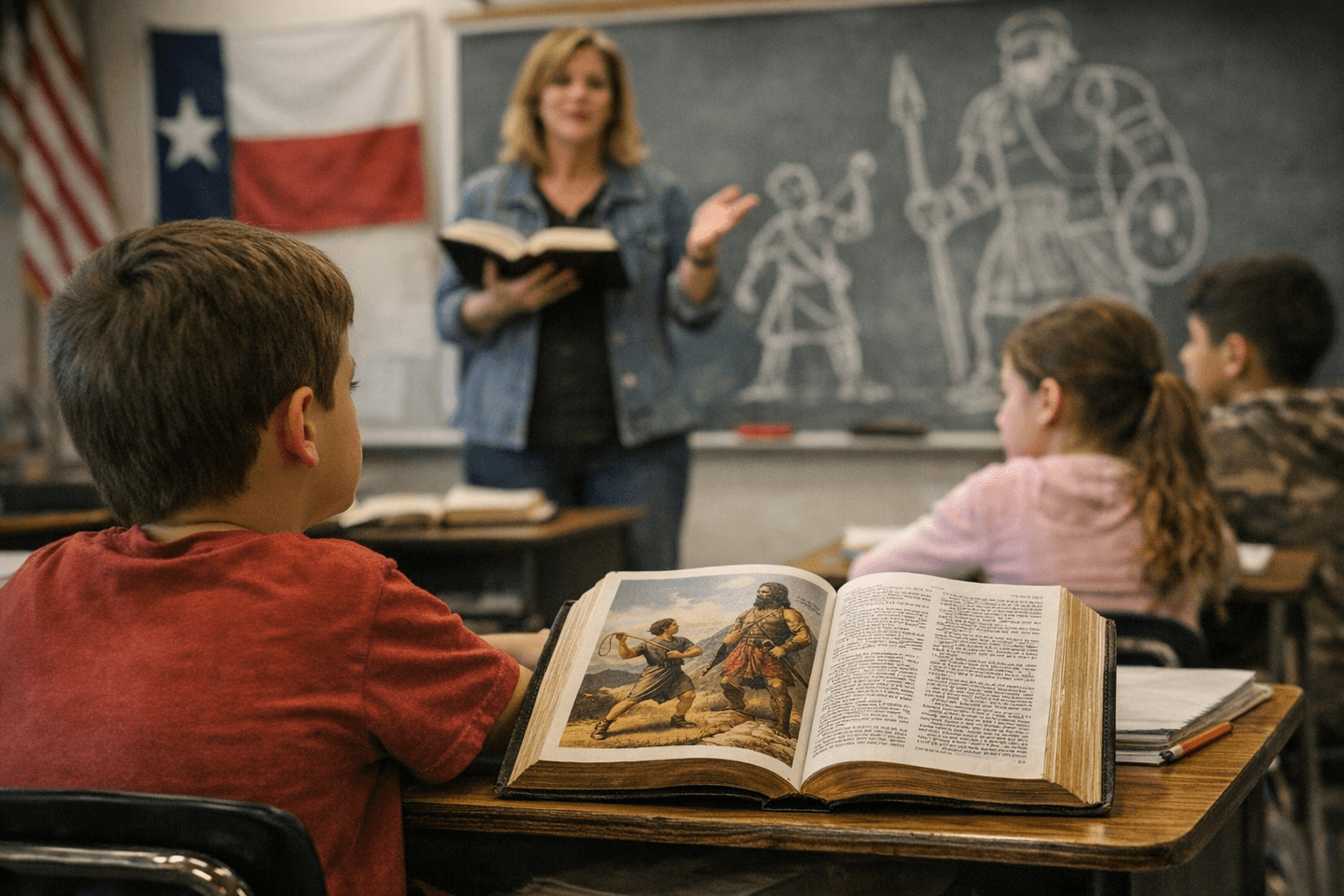
The grade-level assignments are theologically precise. First graders would read Jesus' Parable of the Prodigal Son. Third graders would encounter "Road to Damascus," recounting the Apostle Paul's conversion to Christianity. By seventh grade, students would cover Jonah and the Whale, Psalm 23, the Tower of Babel, and David and Goliath. High school seniors would study the Book of Job, with all biblical passages drawn from the King James Version.
Constitutional precedent cuts against the proposal. U.S. District Judge Orlando L. Garcia had already issued a preliminary injunction against a Texas law requiring Ten Commandments displays in classrooms, ruling it violated the Establishment Clause; about two dozen districts subsequently removed the posters. David Brockman, a scholar at Rice University's Baker Institute for Public Policy, warned the reading list would "turn students, parents, and teachers who are not Christians or Jews into outsiders in their own public schools." The ACLU of Texas characterized the effort as flagrantly disregarding religious freedom.
The State Board of Education delayed an initial vote after a public hearing drew an overflow crowd, with testimony running overwhelmingly opposed. A preliminary vote had been expected in April 2025, with final adoption of the rules set for April 2026. Under the proposed timeline, implementation would not reach classrooms until 2030, and publishers would face a two-and-a-half-year process of preparing aligned textbooks.
Supporters framed the list as foundational learning long overdue. Nathan Irving, a pastor and father of eight from Myrtle Springs, Texas, testified: "Our children need truth. This country and this state were founded upon a Christian worldview." Jeremy Wayne Tate, founder of the Classical Learning Test, called it "the revolution America needs." Gov. Greg Abbott said the materials would "bring students back to the basics of education."
Opposition came from multiple directions. Frank Strong, co-director of the Texas Freedom to Read Project, argued the list would "limit what students read in their classrooms rather than expanding their options." One teacher noted the proposed ninth-grade list contains no Hispanic authors despite the state's large Hispanic student population. A Christian mother testified: "It is not the state's job to shed [religion] through the lens of a teacher who may not share the same beliefs I do."
The proposal extends a pattern of Texas Republicans testing church-state limits in public education. In 2023, the state became the first in the nation to allow school chaplains, and Attorney General Ken Paxton has since issued an opinion encouraging all districts to incorporate prayer and scripture. The optional Bluebonnet Learning curriculum, approved in late 2024 by a single SBOE vote after roughly $100 million in state spending, was rejected in full by Houston and Dallas ISDs. Unlike Bluebonnet, the new reading list would carry no opt-out.
Texas educates roughly one in 10 of the nation's public school students, giving its curriculum decisions an outsized national footprint. With final adoption expected and legal challenges nearly certain, the question of which texts belong in a public classroom is headed for the courts.
This article was produced by Prism’s automated news system from verified source data, official records, and press releases, then run through automated quality and moderation checks before publishing. The system is built and supervised by the people who set the standards it runs under. Read our full AI policy.
Did this article answer your question?