Thailand revives $30 billion land bridge to bypass Malacca Strait
Thailand revived a 1 trillion baht land bridge linking Chumphon and Ranong, betting it could cut cargo costs nearly 30% and bypass Malacca.
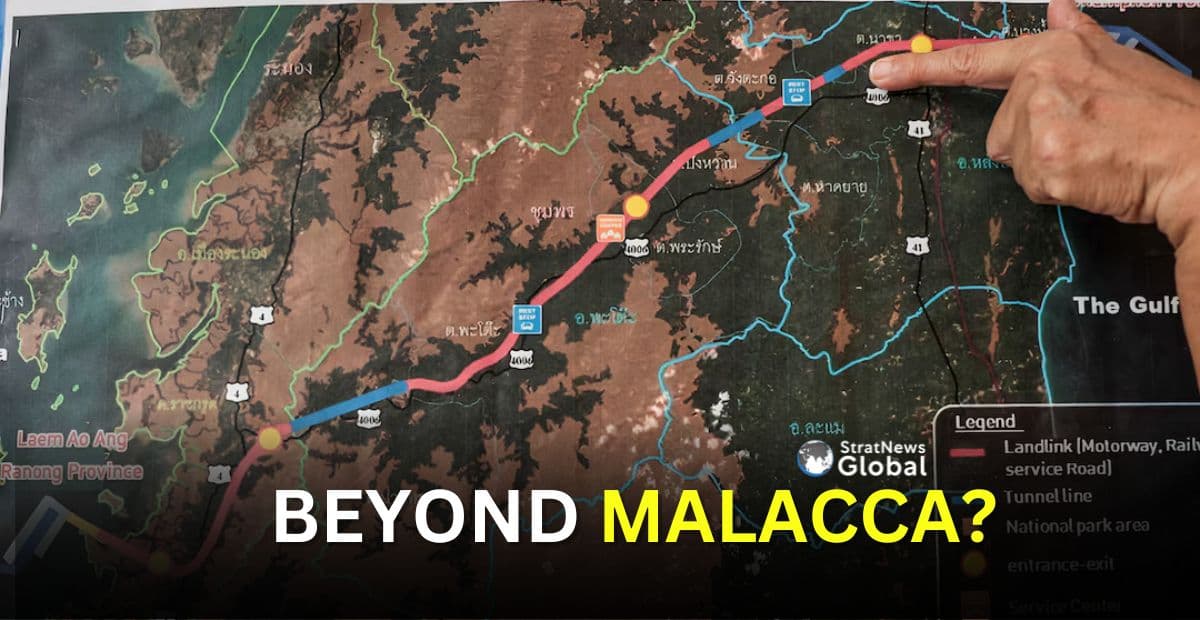
Thailand revived a 1 trillion baht land bridge that would cut a 90-kilometre corridor across its south, linking new deep-sea ports at Chumphon on the Gulf of Thailand and Ranong on the Andaman Sea. The pitch was straightforward and ambitious: give shipping companies a route around the Strait of Malacca, reduce logistics costs by nearly 30%, and cut transit times by as much as 14 days for cargo moving between southern China and Indian Ocean ports serving South Asia and the Middle East.
The commercial logic was bigger than a single bypass. Thailand framed the project as part of the Southern Economic Corridor, a public-private partnership built around a 50-year concession model with a single private operator responsible for construction and management. If it moved ahead, the clearest beneficiaries would be shipping lines, port developers, logistics firms and exporters that could use a shorter, land-based transfer instead of relying entirely on a congested maritime funnel. The deeper strategic prize was leverage: a coast-to-coast corridor would let Bangkok position itself as a managed transit point between two seas, reducing dependence on one of the world’s most important chokepoints and giving Thailand a more visible role in regional trade and energy routes.

That appeal gained force after the war in Iran and the closure of the Hormuz Strait once again exposed how fragile global supply chains can be when they depend on a handful of sea lanes. But the existing route remains formidable. The Straits of Malacca and Singapore handled 94,301 ship transits in 2024, a record, and more than 100,000 vessel transits in 2025, underscoring how deeply entrenched the current corridor already is in Asian commerce.
The land bridge has stalled before for the same reasons it faced again in 2026: financing, environmental scrutiny, public consent and engineering difficulty. Some reporting has put deep-sea port construction alone at roughly 630 billion baht, a scale that has made major investors cautious. Fishermen and coastal residents in southern Thailand have warned that the project could disrupt mangrove forests, near-shore fishing grounds and small community economies, while the National Human Rights Commission of Thailand urged the government in May 2026 to reconsider or suspend the plan over environmental impacts, livelihood risks and weak public participation.
The idea itself was not new. It reached cabinet for feasibility-study approval in 2005, was later revived under Prayut Chan-o-cha, and had earlier been estimated at about 1.19 trillion baht. Srettha Thavisin then promoted it to investors in the United States and China in 2024, and by early May 2026 Thai officials had acknowledged the human-rights commission’s recommendations. The pattern was familiar: every revival cast the land bridge as a national-security asset, and every pause exposed the same obstacle, a megaproject that still has to prove it can beat Malacca economically without breaking the coast it is meant to transform.
This article was produced by Prism’s automated news system from verified source data, official records, and press releases, then run through automated quality and moderation checks before publishing. The system is built and supervised by the people who set the standards it runs under. Read our full AI policy.
Did this article answer your question?