Thailand's early election triggers tense three-way contest for power
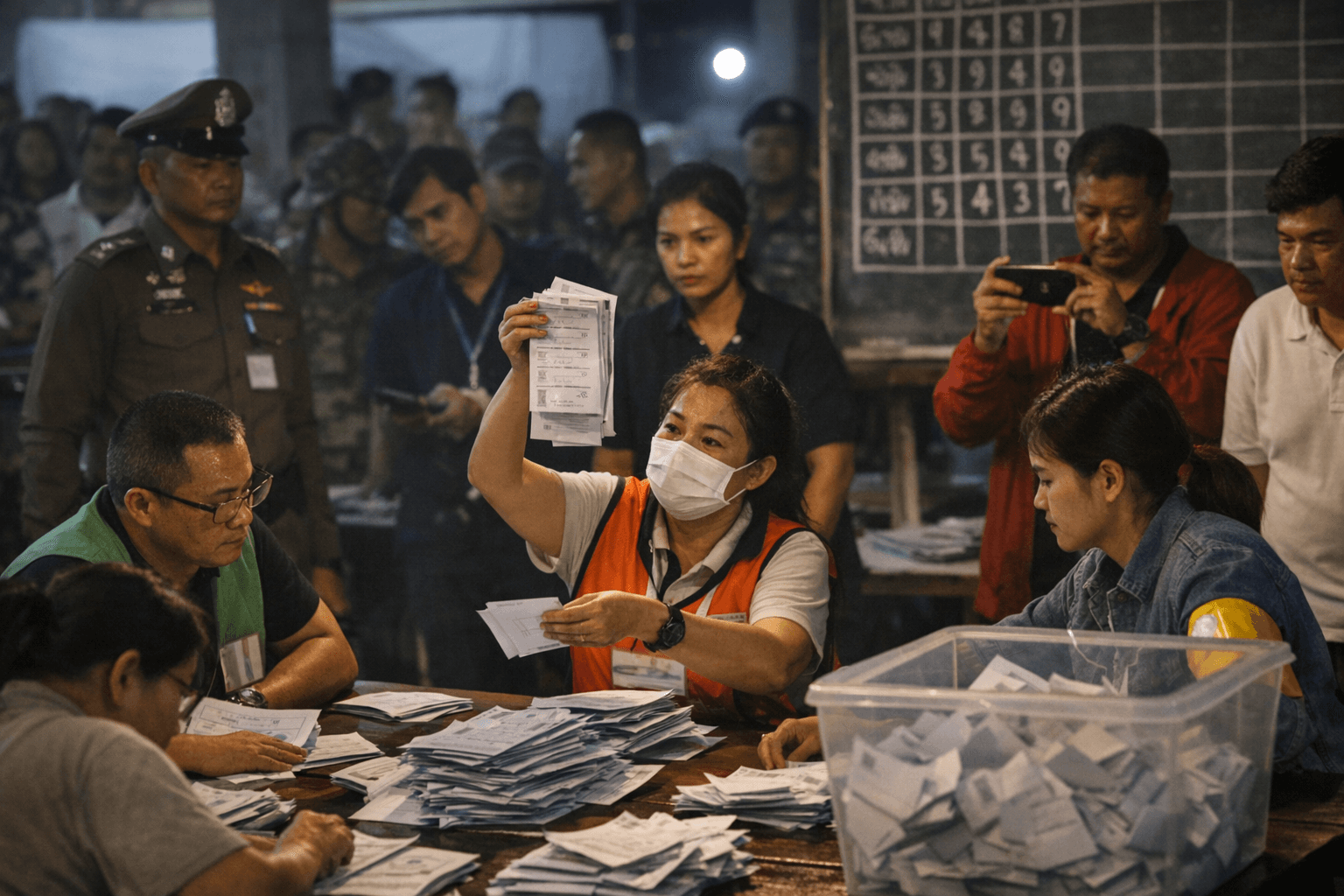
Vote counting is underway after Thais cast ballots in an early election where three main camps compete to form the next government.

Vote counting is underway across Thailand after millions of voters turned out for an early general election that pits progressive reformers, establishment-aligned populists and a long-standing populist movement against one another. About 53 million Thais were registered to vote in a poll that also included a referendum on whether to replace the 2017 military-drafted constitution.
Polling stations opened at 08:00 local time and closed at 17:00, and election officials began tallying ballots soon after. In the capital, volunteers and security personnel were photographed checking ballots, equipment and sealed ballot boxes the day before the vote as officials sought to reassure the public of orderly logistics. Advance voting registration opened on 20 December and, on its first day, 98,900 voters registered to cast ballots ahead of election day.
The balance of power now rests with 500 elected lawmakers. The next prime minister will be chosen by a simple majority of those elected MPs, a calculation that makes coalition arithmetic decisive even if one party finishes first. No single party is expected to secure an outright majority, and analysts say protracted negotiations are likely.
Three parties dominate the national conversation. The progressive People’s Party, led by Natthaphong Ruengpanyawut and widely seen as the successor to the reformist Move Forward movement, is favoured to win the most seats on a platform that promises to curb the influence of the military and the courts and to break up entrenched economic concentrations. But the party faces a dilemma: winning enough votes at the ballot box does not guarantee control of government if rivals unite to exclude it.
“Softening its politics risks weakening its core support, already at risk because the last election had positioned it squarely as the alternative to nine previous years of military-led government, a situation it can't fruitfully exploit this time. At the same time, its positions critical of the military can be a political liability with the surge of patriotism that emerged during last year's border clashes with Cambodia,” said Napon Jatusripitak, director of the Center for Politics and Geopolitics at Thailand Future.
Bhumjaithai, led by incumbent prime minister Anutin Charnvirakul, campaigned on economic stimulus and national security, tapping into nationalist sentiment that intensified after deadly border clashes with Cambodia last year. The party is seen by many as the preferred choice of establishment elements that place a premium on stability and security.
Pheu Thai, the latest incarnation of the movement linked to former prime minister Thaksin Shinawatra, ran on economic revival and populist pledges such as cash handouts. On 16 December, Pheu Thai announced three candidates for prime minister: Yodchanan Wongsawat, party leader Julapun Amornvivat, and Suriya Juangroongruangkit; the party also nominated Yodchanan as its lead candidate.
Polls in late January showed the People’s Party leading in several surveys, though margins varied and a large share of voters remained undecided in some samples. A NIDA survey (fieldwork 23–27 January, n=2,500) put the People’s Party at 34.20 percent and Bhumjaithai at 22.60 percent, while a Nation Poll (23–26 January, n=10,890) recorded 21.89 percent for the People’s Party and 20.59 percent for Bhumjaithai, with nearly a quarter of respondents undecided. Other polls in Bangkok and nationwide showed similar patterns of a leading reformist party facing strong challenges from populist rivals.
The international implications are immediate. A government committed to rolling back military influence would alter civil-military relations in Southeast Asia and could shift Bangkok’s posture on rule of law and economic policy, affecting investors and regional partners. Conversely, a coalition dominated by establishment forces would likely prioritize security and continuity.
With counting ongoing, the immediate question is not only who wins the most seats but how parties translate ballots into coalitions. Expect negotiations that will test both Thailand’s fragile post-coup politics and its democratic institutions.
This article was produced by Prism’s automated news system from verified source data, official records, and press releases, then run through automated quality and moderation checks before publishing. The system is built and supervised by the people who set the standards it runs under. Read our full AI policy.
Did this article answer your question?


