Thomson Reuters revenue jumps 10%, AI products drive growth target progress
Thomson Reuters showed its AI push is turning into revenue, with GenAI products now 30% of annualized contract value. Core legal and tax tools kept growing.
Thomson Reuters is turning its AI pivot into a steadier subscription engine. The Toronto-based company said first-quarter revenue rose 10% to $2.087 billion, while organic revenue increased 8%, as customers kept buying software and information tools built for legal, tax and corporate work.
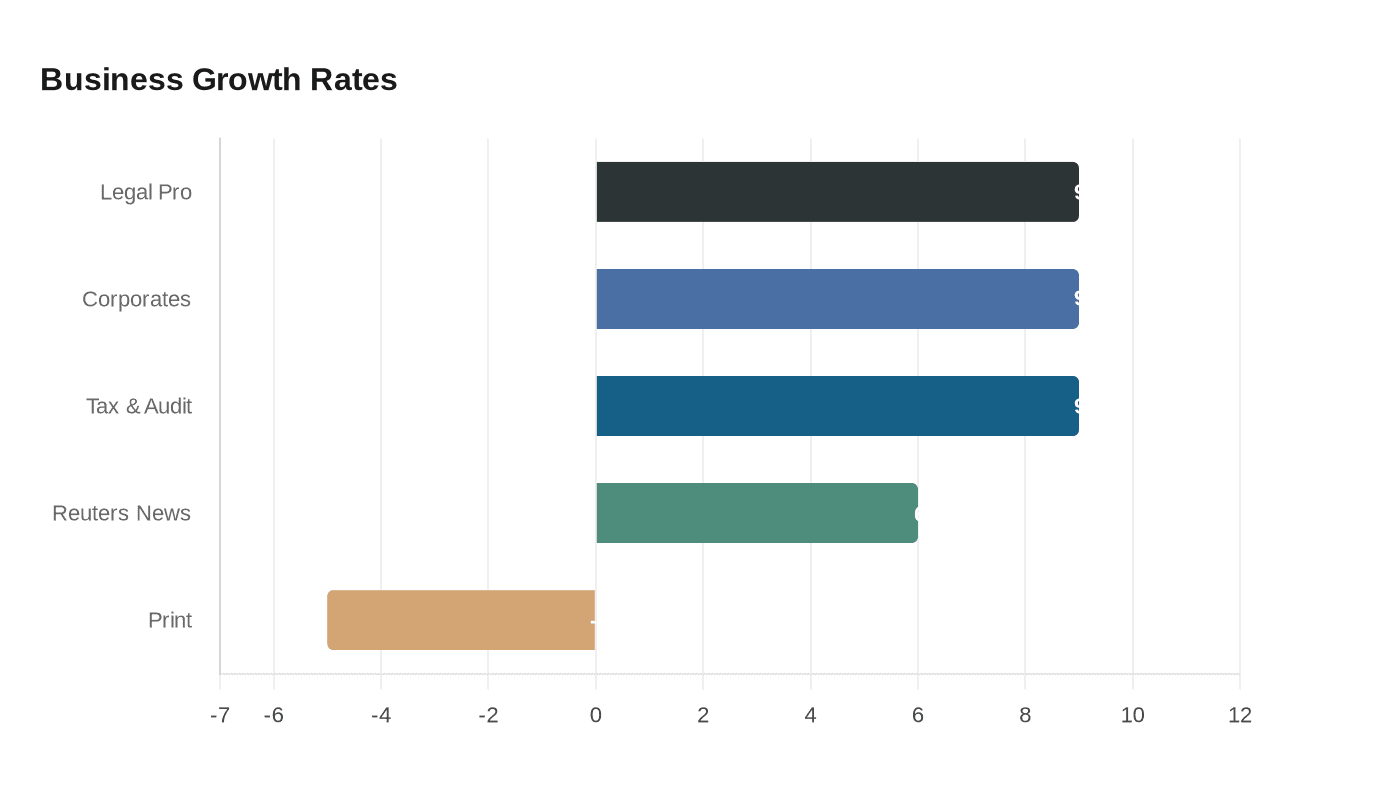
The strongest signal was not the headline growth rate but where it came from. Thomson Reuters said its three biggest professional businesses, Legal Professionals, Corporates, and Tax, Audit & Accounting Professionals, each grew 9% organically in the quarter. That matters because these are the customers most likely to pay for products that promise reliability, documentation and compliance, not just flashy AI demos. Reuters News rose 6% organically, while global print revenue fell 5%, underscoring how far the company has moved from legacy publishing toward software-led workflows.

Chief executive Steve Hasker framed that shift as a sellable advantage in a crowded AI market. He said Thomson Reuters is seeing demand for what he called “fiduciary-grade AI,” arguing that the company’s tools are grounded in authoritative content, designed and tested by domain experts, and built so their results can be verified and audited under real-world scrutiny. Hasker also said Thomson Reuters has 2,700 legal experts and hundreds of accountants supporting content and product development, a human layer he says helps differentiate the company from frontier AI models in regulated fields.

The commercial traction is already showing up in contract data. Thomson Reuters said 30% of annualized contract value now comes from GenAI-enabled products, up from 28% in the prior quarter and 15% five quarters earlier. That climb suggests the company is converting AI from a marketing theme into a measurable subscription driver.

Financially, the quarter was solid across the board. Adjusted EBITDA rose 9% to $881 million, adjusted earnings per share increased 10% to $1.23, and free cash flow climbed 19% to $332 million. Thomson Reuters reaffirmed its full-year 2026 organic revenue growth outlook of 7.5% to 8%, and its 2026 framework still calls for about 100 basis points of adjusted EBITDA margin expansion from 2025’s 39.2%.
Investors welcomed the update. Thomson Reuters shares rose 2.3% in premarket trading after the results, even though the stock had fallen nearly 30% so far in 2026. Analyst Paolo Pescatore of PP Foresight said the company had done enough to calm immediate AI concerns. Thomson Reuters also returned cash aggressively, completing a $605 million return of capital transaction on May 4, repurchasing $262 million, or 2.5 million shares, under its $600 million buyback program, and raising its annualized common share dividend 10% to $2.62. For legacy information companies, the message is clear: AI is becoming valuable not when it replaces trusted content, but when it reinforces it.
This article was produced by Prism’s automated news system from verified source data, official records, and press releases, then run through automated quality and moderation checks before publishing. The system is built and supervised by the people who set the standards it runs under. Read our full AI policy.
Did this article answer your question?