Thousands gather at Belfast City Hall to protest racism after unrest
Thousands packed Belfast City Hall with anti-racism placards after a week of arson, bus attacks and police clashes shook the city.
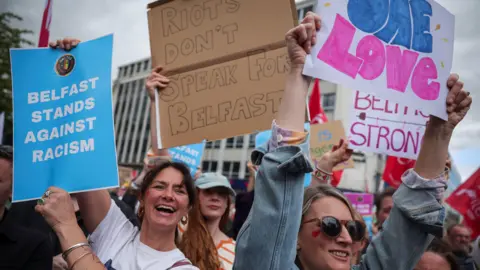
Thousands filled the pavements outside Belfast City Hall on Saturday afternoon, turning a city shaken by arson, blocked roads and bus attacks into a public rejection of racism. The scale and tone of the crowd stood in sharp contrast to the disorder that had gripped Belfast during the week.
The Together Against Hate event, organised by Unite Against Racism, began at about 13:00. People from political parties and trade unions stood alongside families and activists, with placards reading “Racists go home”, “The problem is evil and violence, not race”, “Strike back against racism” and “Refugees welcome”.

The rally followed unrest triggered by footage of a knife attack in north Belfast on Monday night, June 8, being widely shared on social media. In that attack, Stephen Ogilvie lost his left eye and suffered deep cuts to his head, face and back. A 30-year-old Sudanese man was charged with attempted murder, possession of an article with blade or point in a public place, and threats to kill. Ogilvie’s family condemned the protests and said anti-migrant demonstrations should not continue in the name of their loved one.
Across Belfast, the violence escalated into fires, road blockages, attacks on buses and clashes with police. Vehicles were set alight, a Glider bus was burned on the Newtownards Road, and residents were removed from homes that caught fire on Lendrick Street. Translink suspended all services in and out of Belfast after attacks on public transport, while the Police Service of Northern Ireland deployed 200 extra officers in the city on Wednesday night to contain the unrest.
Political leaders moved to steady the situation as the disorder deepened. Northern Ireland’s First Minister Michelle O’Neill and deputy First Minister Emma Little-Pengelly appealed for calm, while police chief Jon Boutcher described the riots as “an insult” to Stephen Ogilvie and “an act of self-harm” by those involved.
Campaigners said the violence reflected a wider and worsening pattern. Amnesty International UK said families were targeted because of the colour of their skin or their country of origin, and argued that responsibility lay not only with those carrying out the attacks but also with those helping create a climate in which racism could flourish. It said this was the third consecutive summer Northern Ireland had experienced organised racist violence. PSNI and NISRA figures published on May 14, 2026, recorded 1,507 racist hate crimes and 2,367 racist incidents in the 12 months to March 31, 2026, both record highs, after the previous year also set new peaks.
For Belfast, the rally outside City Hall became more than a protest. It was a test of whether the city’s institutions can stop hate hardening into a broader security threat before another summer of violence takes hold.
This article was produced by Prism’s automated news system from verified source data, official records, and press releases, then run through automated quality and moderation checks before publishing. The system is built and supervised by the people who set the standards it runs under. Read our full AI policy.
Did this article answer your question?