Thrift store painting bought for under $100 sells for $254,000
A thrift-shop canvas bought in White Plains for under $100 resurfaced as a Cadell and brought £189,200 in Edinburgh.
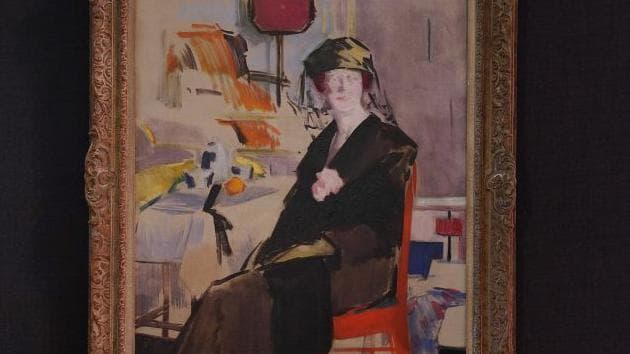
A painting Helene Plotkin picked up in White Plains, New York, in 1966 for under $100 sold for £189,200, about $254,000, after her son Barry Plotkin used Google Gemini to investigate what had hung in the family living room for nearly 60 years. The work, Interior: The Lady in Black, emerged not as an anonymous decor piece but as a Francis Campbell Boileau Cadell, a Scottish artist whose place in the market has now been reshaped by a family curiosity and a chatbot.
Gemini helped point Barry Plotkin toward Cadell by flagging the painting’s bold brushwork and orange accents, but it also got the sitter wrong. That misstep mattered. The final identification came only after experts at Lyon & Turnbull confirmed the artist as Francis Campbell Boileau Cadell. The episode shows both sides of generative AI as a provenance tool: it can surface a promising lead fast enough for an ordinary owner to act on it, but it can also sound authoritative while misreading the details that matter to scholars, auction specialists and buyers.
The painting went under the hammer at Lyon & Turnbull’s Scottish Paintings & Sculpture auction in Edinburgh on June 4, 2026, and was bought by a private buyer. Plotkin, now 88 and living in Palm Beach Gardens, Florida, said the discovery confirmed her artistic eye, and she asked that the painting be displayed publicly someday so her grandchildren could see it. For families who inherit unlabeled objects, the route from wall hanging to art-market revelation can now begin with a chatbot, but the authentication still depends on human expertise.
Auction records show the work had been sold at Christie’s London on March 18, 1966, before it was acquired in New York later that year. How it ended up in a suburban New York charity shop remains unknown, adding another gap to a paper trail that now stretches back across the Atlantic. Cadell, born in Edinburgh in 1883 and dead there in 1937, was one of the four Scottish Colourists and is closely associated with portraits, interiors and landscapes. His name now sits at the center of a case that shows how A.I. is becoming a new front door to the art market, even as the risk of a confident but wrong identification remains part of the bargain.
This article was produced by Prism’s automated news system from verified source data, official records, and press releases, then run through automated quality and moderation checks before publishing. The system is built and supervised by the people who set the standards it runs under. Read our full AI policy.
Know something we missed? Have a correction or additional information?
Submit a Tip