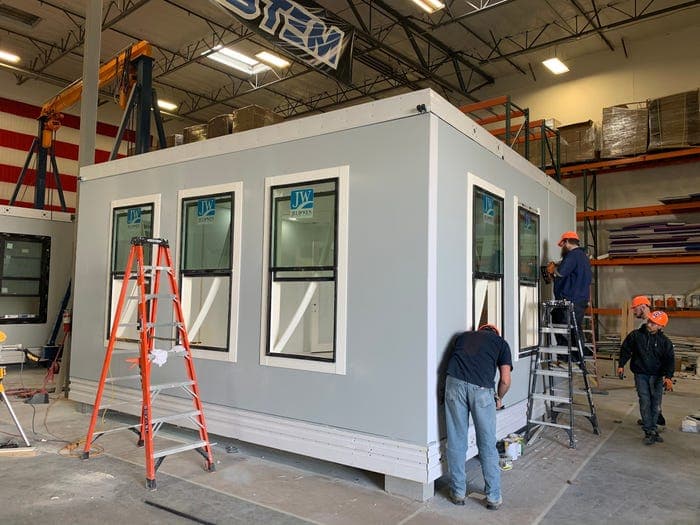
Tiny homes market projected to grow rapidly worldwide through 2030
ResearchAndMarkets projects the global tiny homes market will reach $17.73 billion by 2030, while other forecasts range from $1.68 billion to $30.2 billion, reflecting divergent definitions and horizons.

ResearchAndMarkets projects the global tiny homes market will expand to an estimated $17.73 billion by 2030, and it places short‑term growth at $13.17 billion in 2025 rising to $14.00 billion in 2026, a trajectory the report describes as "growing strongly" with a 6.4 percent compound annual growth rate for 2025 to 2026. That projection, repeated in a GlobeNewswire summary, highlights smart home automation, eco‑friendly builds and AI‑based design optimization as explicit growth drivers and names Tiny SMART House, Boxabl, Skyline, Timbercraft Tiny Homes and Tumbleweed Tiny House among leading vendors.
Yet industry estimates diverge sharply. MordorIntelligence values the market at USD 1.31 billion in 2024 and projects USD 1.68 billion by 2030, with a 4.32 percent CAGR for 2025 to 2030, and reports stationary tiny homes accounted for 53.7 percent of 2024 revenue while mobile units on wheels showed the fastest growth. StrategicMarketResearch gives a much larger footprint, stating the market was USD 18.5 billion in 2023 and is expected to hit USD 30.2 billion by 2030 at a 7.1 percent CAGR. BusinessResearchInsights presents inconsistent series within its material, one sequence showing USD 22.91 billion in 2025 and USD 33.18 billion by 2035 and another table listing US$ 3.62 billion in 2026 rising to US$ 4.93 billion by 2035, both cited with a 3.5 percent CAGR.
Those gaps track to definitional and timing differences in the underlying data: ResearchAndMarkets emphasizes near‑term retail and industry metrics, MordorIntelligence focuses on a 2024 base with segmentation detail, StrategicMarketResearch uses a 2023 valuation and a longer CAGR, and BusinessResearchInsights presents contradictory figures within the same excerpt. The conflicting totals underscore the practical question for manufacturers and investors: are they sizing a niche worth a few billion dollars or a mass market approaching tens of billions.

Concrete market mechanics are clearer. BusinessResearchInsights reports "over 30,000 prefabricated and modular tiny homes have been sold in North America in the last two years, accounting for 60% of total tiny home sales," a statistic that aligns with ResearchAndMarkets and GlobeNewswire emphasis on modular assembly and local material sourcing to shorten supply chains. MordorIntelligence highlights financing shifts, noting "conventional mortgages remain limited, but equity‑backed ADU loans and specialized RV financing are widening buyer access," and it flags Asia Pacific as a hot spot with a projected 6.31 percent CAGR through 2030 driven by urban land scarcity and supportive regulation.
Price and regulatory friction remain central. BusinessResearchInsights states tiny homes cost between USD 10,000 and USD 30,000 and can be "up to 90% cheaper than conventional homes," while the same excerpt warns that "around 40% of urban municipalities impose zoning or regulatory restrictions on tiny home construction," a contrast MordorIntelligence balances by noting government planners are easing ADU rules in some jurisdictions.

The result is an industry in active definition: timber still dominates framing even as steel and composite panels enter factories, stationary units supplied most 2024 revenue while transportable and prefab lines scale rapidly, and a mix of smart automation, AI design and new financing models are widening addressable demand. Whether the sector coalesces around a multibillion dollar mainstream market or remains a fragmented collection of regional niches will hinge on how quickly prefab supply chains, ADU financing and municipal zoning evolve over the next five years.
Know something we missed? Have a correction or additional information?
Submit a Tip