Torrential rains trigger deadly landslide in West Java village
Predawn slide buries hamlets in West Bandung, killing at least eight and leaving about 82 missing.
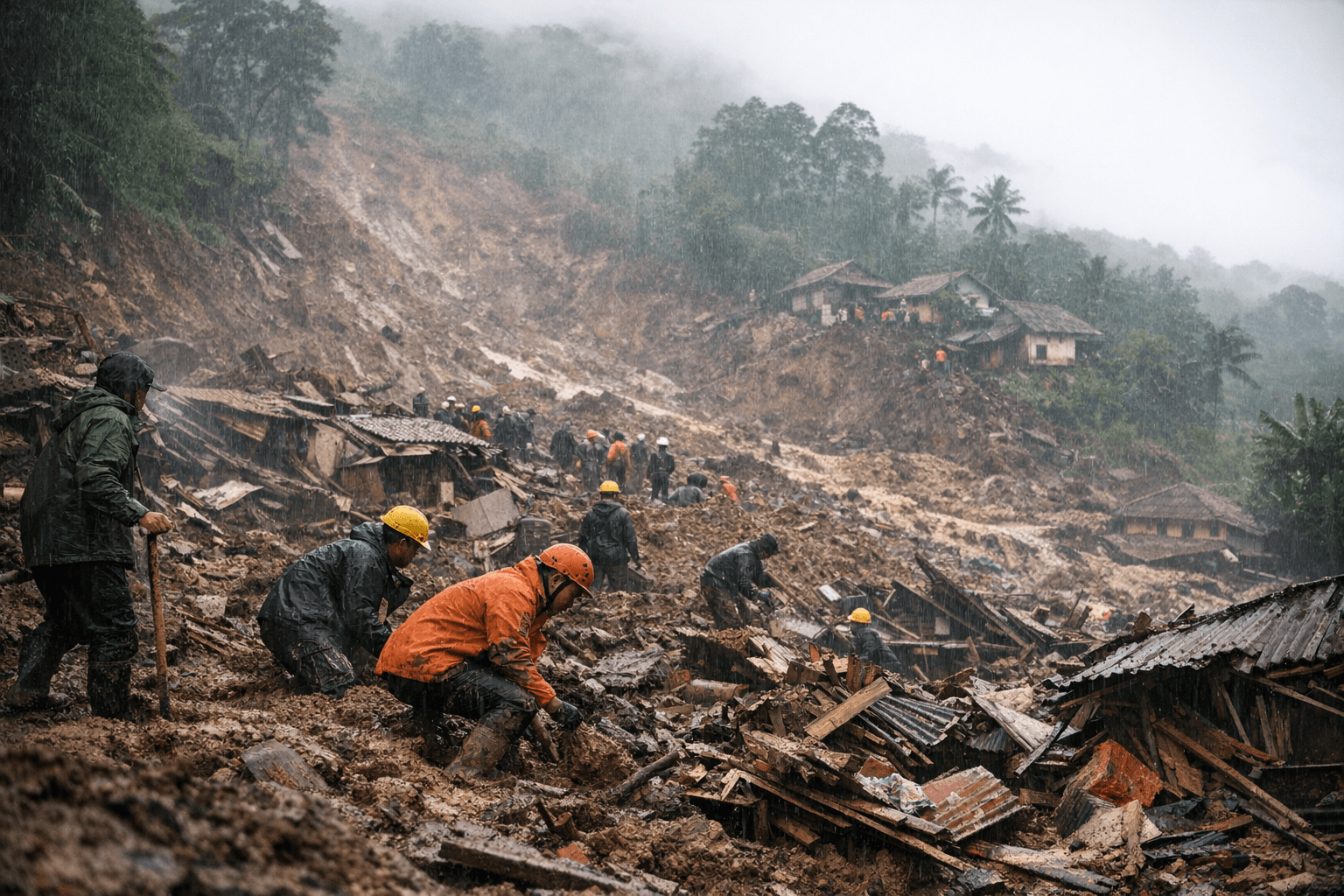
A predawn landslide carved through Pasir Langu village in West Bandung district after days of torrential rain, killing at least eight people and leaving about 82 others missing, officials say. The slide struck around 3 a.m., sweeping away roughly 34 houses and overwhelming rescue efforts as teams raced to find survivors amid unstable terrain.
Rescuers are contending with mud-choked roads and continuing rain that complicates recovery operations and raises the risk of secondary slides. Local emergency crews, supported by volunteers, have been forced to pause some search efforts at times because of dangerous conditions, slowing the tally of casualties and missing persons. Families in submerged hamlets remain cut off from basic services, and initial assessments point to significant displacement and loss of property.
The human toll is already stark: entire households were buried, and survivors are concentrated in temporary shelters at nearby community centers and schools. With dozens unaccounted for, the immediate priority is search and rescue, but officials are also preparing for short-term humanitarian needs, food, clean water, medical care and shelter, as mud and debris make local infrastructure unusable.
Economically, the landslide highlights recurring vulnerabilities in Indonesia’s hilly and densely settled Java highlands. Loss of 34 homes in one slide is a concentrated shock to a small local economy where household assets, informal employment and smallholder agriculture underpin livelihoods. Damage to roads and utilities will impede commerce and could disrupt supply chains for food and other goods for surrounding towns until debris is cleared. Insurance coverage for such localized disasters is limited, so reconstruction costs are likely to fall on affected families and municipal budgets, adding fiscal pressure at the provincial level.
The event also fits a broader climate and policy context. Scientific assessments have linked intensifying extreme rainfall to climate change, raising the frequency of the very events that trigger shallow and deep-seated landslides in deforested or heavily farmed slopes. In many parts of Indonesia, land-use change, slope cultivation and informal housing on marginal lands increase exposure to rainfall-driven disasters. The recurrence of deadly slides underscores gaps in risk zoning, enforcement of slope-management regulations and investment in early-warning systems.
Policy responses now will matter for both immediate recovery and longer-term resilience. Rapid, transparent damage assessments are needed to channel emergency aid efficiently and to prioritize slope stabilization and relocation where risk is acute. Investing in drainage infrastructure, reforestation and community-based early warning systems can reduce future losses, but those measures require sustained funding and enforcement. Absent stronger land-use governance and climate adaptation finance, reconstruction may simply restore the same vulnerabilities.
Search-and-rescue operations continue as authorities work to account for the missing and to stabilize the site. The unfolding humanitarian needs are likely to stretch local resources and will test provincial coordination in the coming days as officials balance urgent relief with the longer task of rebuilding safer communities.
This article was produced by Prism’s automated news system from verified source data, official records, and press releases, then run through automated quality and moderation checks before publishing. The system is built and supervised by the people who set the standards it runs under. Read our full AI policy.
Did this article answer your question?