Trader Joe’s Neighborhood Shares Donates Unsold Food Daily to Local Nonprofits
Every Trader Joe’s store donates unsold but safe-to-eat food daily; the company reports more than 104 million pounds given away in 2023 and about 98 million pounds in 2024.
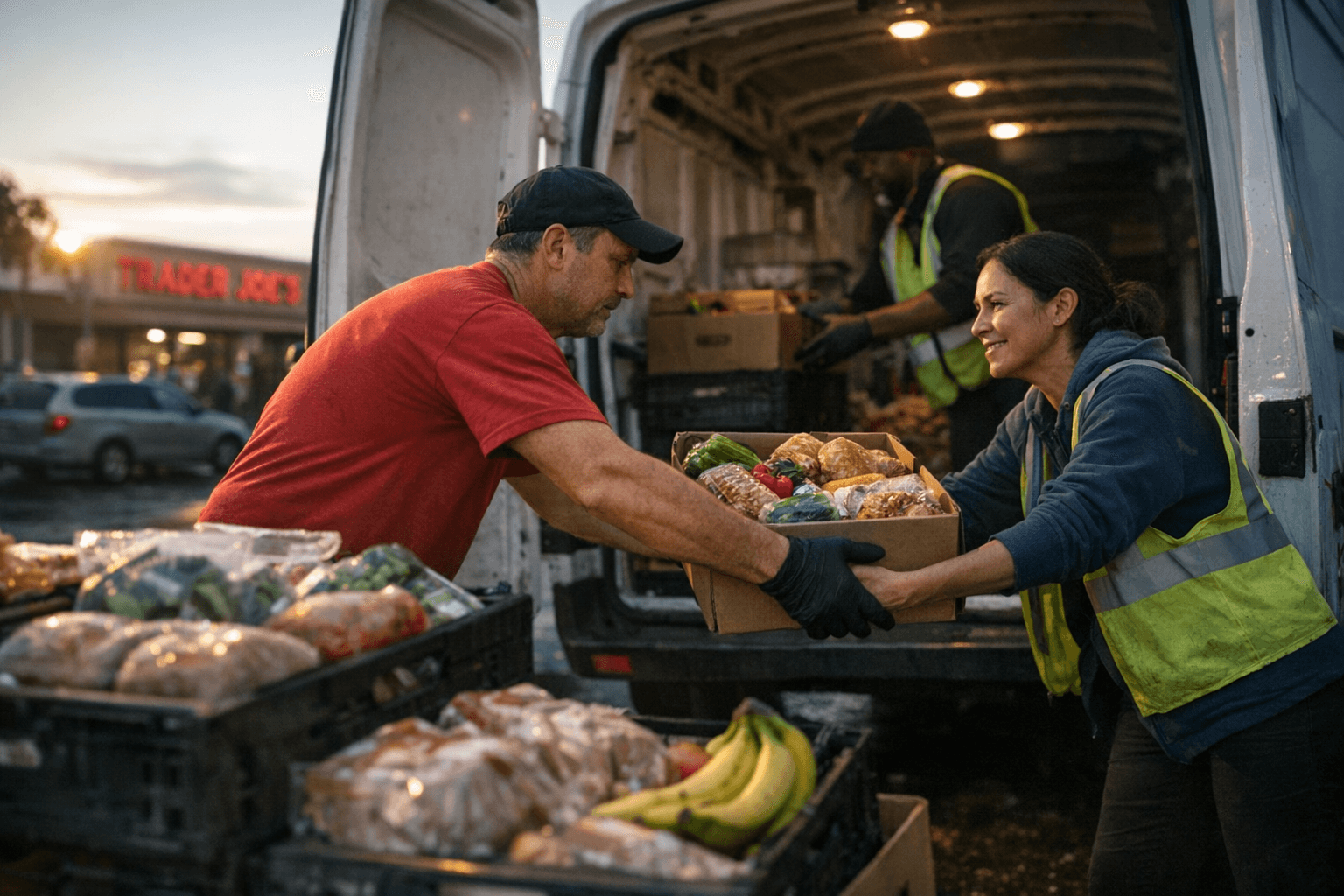
Trader Joe’s Neighborhood Shares runs out of every store, seven days a week, with crew members at more than 500 locations coordinating daily pickups to redistribute unsold but safe-to-eat food to local nonprofits. Jenn, who supports the stores’ donations program, frames the effort as a long-standing pledge: “And that is our longstanding commitment to donate a 100% of products that go unsold but are safe for consumption. I also like to say ‘fit to be enjoyed’ because we donate flowers and our HABA products as well.”
On the ground the program looks like a logistics puzzle. Matt, a company speaker, describes store-level staffing: “Within the crew at each store there’s a designated crew member, a person who’s the donation coordinator, and they’re trying to piece together a puzzle that is getting stuff picked up every day of the week.” He adds the scale challenge: “We have more than 500 stores, so that’s a lot of stores to support.” Jenn notes that pickup cadence varies by volume: “Some of our larger volume stores have pickups twice a day.” Matt sums the continuous pace plainly: “Donations never sleep.”
Neighborhood Shares moves produce, bakery goods, flowers and some HABA items from shelf to partner organizations. Miggi gives a local example: “So Larry, he connects with us on a daily basis, trying to make sure that what he is taking is still safe to eat for our community. The strawberries, the bread, whatever it might be.” Miggi also describes pandemic-era changes to delivery routines: “As far as flowers are concerned, that does break my heart because we would take the flowers in, you know, shopping carts around the block to the senior center. And we can't do that anymore, unfortunately, because they're our most vulnerable and we want to make sure that they're okay and that they're protected.” Staff adapted by shifting to contact-minimized handoffs and outdoor distributions, a practice Miggi recalled as “giving customers hugs from a distance.”
The program’s scale is substantial in company-cited totals: company figures show more than 104 million pounds donated in 2023 and just over 98 million pounds in 2024. A $469 million valuation for 2023 donations has been cited in posts referencing company and media sources. Trader Joe’s also reports working with over 700 nonprofit partners supporting stores, while broader tallies place the number of organizations linked to the chain’s redistribution work at roughly 2,000; definitions of “partner” appear to vary between store-level regular partners and larger regional or occasional collaborators.
Operationally the donations flow from a demand-driven ordering system. Matt and Tara explain the push-pull dynamic: stores generally order what they need, and when a store “pulls” less than planned—“We might've planned for a 100 of something, but stores pulled 30,” Tara and Matt say—the remaining inventory is channeled into Neighborhood Shares. That daily mismatch, combined with irregular partner pickup windows and high-volume stores that require twice-daily pickups, creates the coordination work Matt called a “puzzle.”
Industry context matters: grocers handle inedible waste with composting, animal feed, or energy programs, while edible surplus is routed to local agencies; Trader Joe’s presents Neighborhood Shares as its in-store mechanism for that redistribution. The program’s everyday logistics, the company’s 100% pledge for safe-to-eat unsold items, and the differing partner and valuation figures together paint a picture of a program that is both operationally intensive and central to how Trader Joe’s manages surplus food at scale.
Know something we missed? Have a correction or additional information?
Submit a Tip