Tropical Cyclone Narelle Paints Western Australia Skies Blood Red With Dust
Cyclone Narelle's winds vacuumed iron-rich outback dust across Shark Bay and the Pilbara, turning daylight blood red in a haze that blotted out the sun.
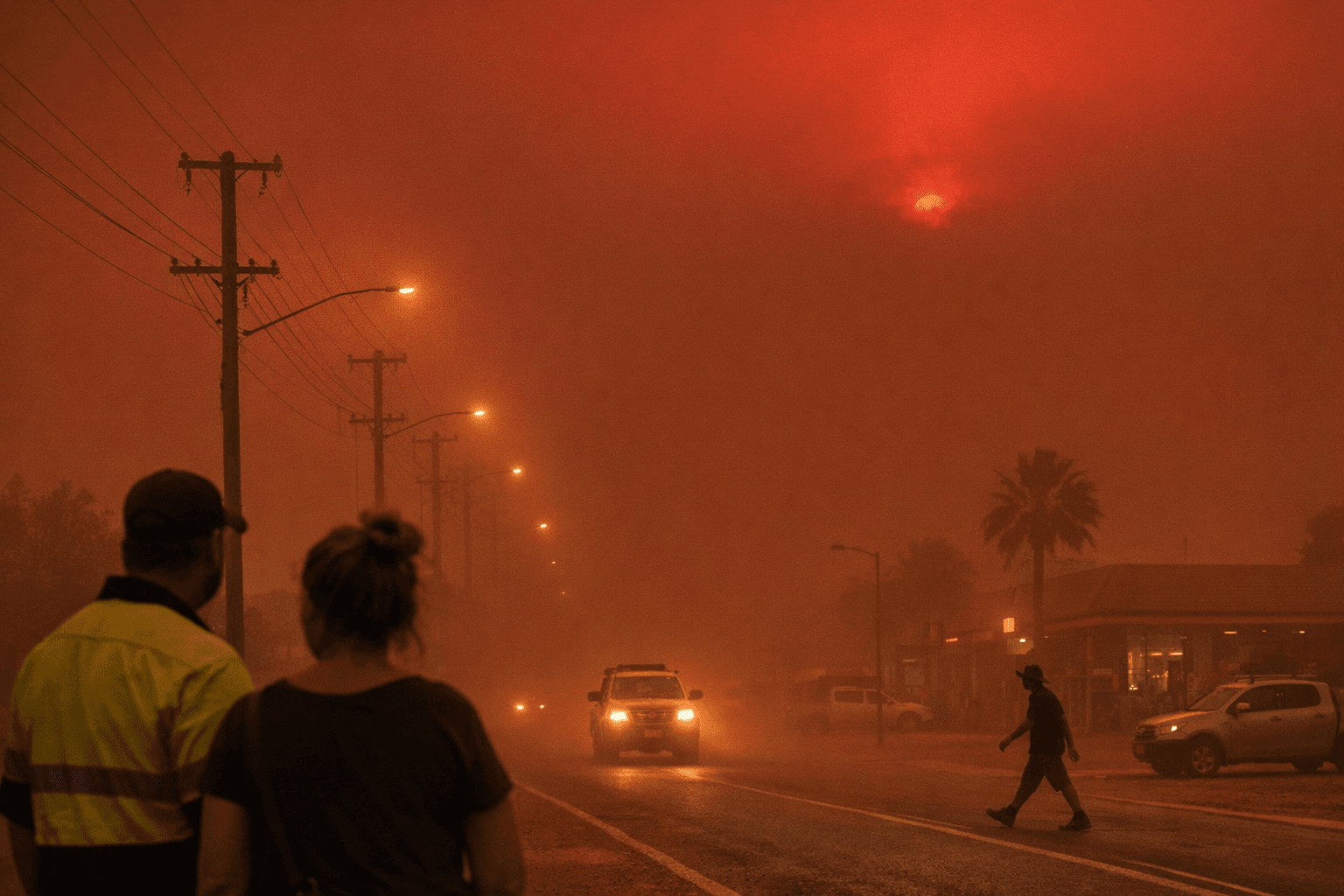
Shark Bay went dark red in broad daylight. As Tropical Cyclone Narelle closed in on the Western Australian coast, its powerful winds tore across the arid outback and vacuumed up massive quantities of iron-rich dust, suspending it high in the atmosphere and turning the sky a deep, blood-red hue that residents and social media users initially mistook for a digital filter.
The phenomenon gripped Shark Bay, the coastal town of Denham, and the broader Pilbara region beginning March 27. The cyclone's winds lofted iron-rich red soil from the interior, where a dense concentration of fine particles scattered shorter blue wavelengths of light and allowed only the longer red wavelengths to pass through, creating a crimson glow that blotted out the sun.
Chief Meteorologist Veronica Johnson explained that larger particles like desert sand enhance what scientists call Mie scattering, which "boosts the red and orange tones and can make the sky look dramatically deeper in color, sometimes even blood-red." Johnson noted that winds from Cyclone Narelle off the coast likely kicked up much of the desert sand, driving that effect to its vivid extreme.
AccuWeather captured the collective disbelief on March 28 when it posted: "NO, that's not a filter! The sky turned an eerie shade of red in Western Australia as dust filled the air ahead of Tropical Cyclone Narelle." Social media user Surajit described "apocalyptic orange skies" engulfing Shark Bay as the cyclone closed in, turning "day into a haunting orange haze." Commentator Mario Nawfal called the imagery "biblical," writing that "between the meteors and now this, 2026 is giving very biblical vibes and we're only in March."
The storm itself, characterized as a "rare and persistent 'triple-strike' storm," generated images that redirected attention from meteorological tracking to an atmospheric spectacle visible across hundreds of kilometers of coastline and interior desert.
The science follows the same principle as a vivid red sunrise. When fine particles interact with sunlight, they absorb and scatter shorter wavelengths while transmitting longer red and orange bands. Cyclone Narelle provided the mechanism on an unusually large scale, pulling dust from the outback in concentrations dense enough to transform afternoon light into something resembling a blood moon at ground level.
No official wind speed or cyclone category data were immediately available, and no air quality advisories from Western Australian health authorities had been confirmed. What the images made undeniable was the geographic sweep: a stretch of Western Australia from Shark Bay to the Pilbara, swallowed in crimson, the sun reduced to a faint smear behind iron-red haze.
This article was produced by Prism’s automated news system from verified source data, official records, and press releases, then run through automated quality and moderation checks before publishing. The system is built and supervised by the people who set the standards it runs under. Read our full AI policy.
Did this article answer your question?