Trump administration dismisses entire National Science Board amid NSF turmoil
The White House told National Science Board members their posts were being terminated, ending a 25-member body that steers NSF policy and major awards.

The White House notified members of the National Science Board that their positions were being terminated, wiping out the independent panel that sets National Science Foundation policy, approves major awards, gives testimony to Congress and advises both the president and lawmakers on science and engineering.
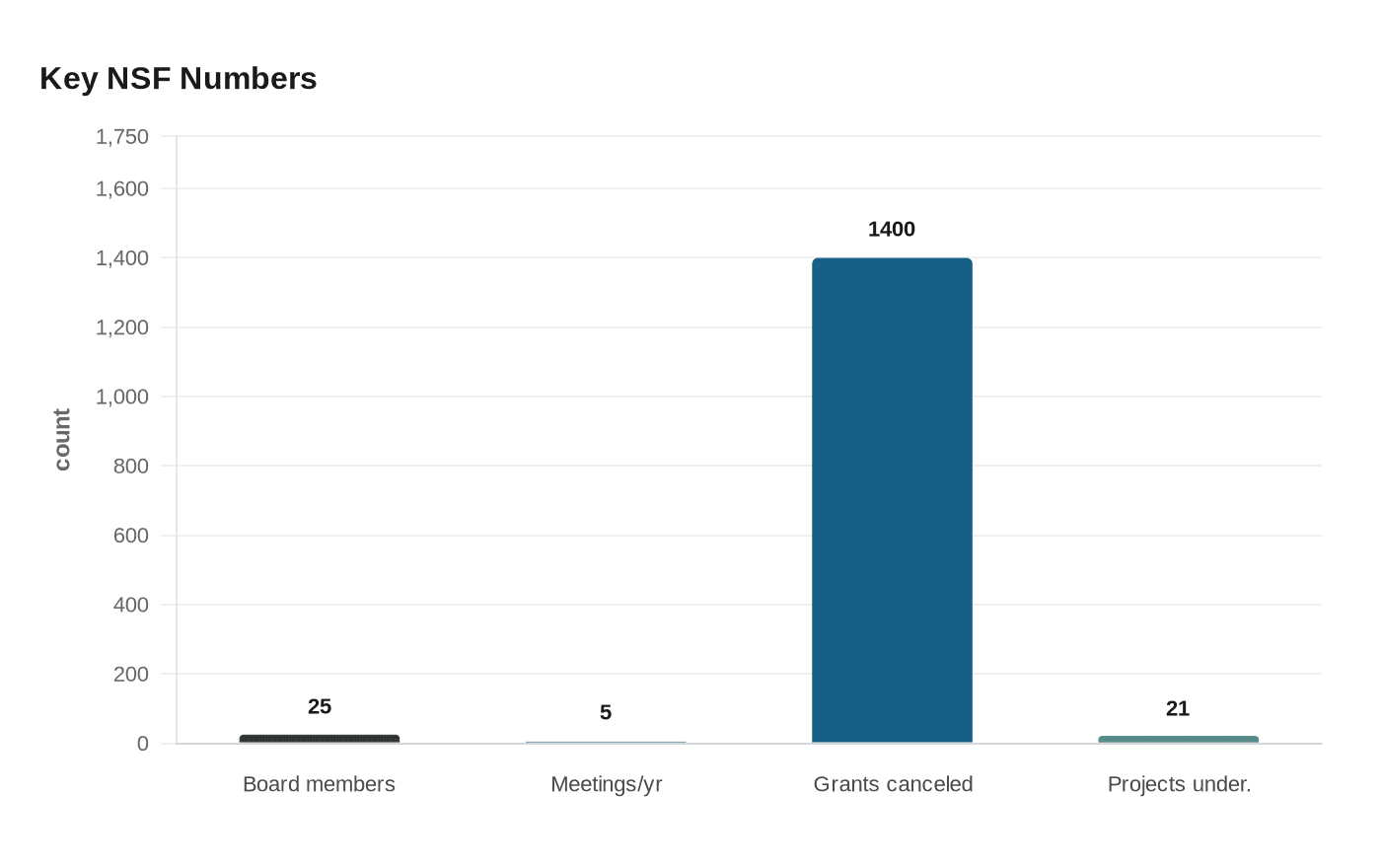
That move matters because the board is not a ceremonial body. Under the NSF Act of 1950, it is supposed to be apolitical and made up of eminent scientists, engineers, educators and public-affairs leaders drawn from across the country. The board has 25 presidentially appointed members who serve six-year terms, with one-third of the seats filled every two years except for the NSF director. It typically meets about five times a year, usually four times at NSF headquarters in Alexandria, Virginia, and once elsewhere.

The dismissal landed after months of upheaval at the National Science Foundation. NSF Director Sethuraman Panchanathan resigned on April 24, 2025, more than a year before his term was due to end, as the agency faced widespread layoffs, canceled grants and sharply restricted travel. Since Donald Trump returned to the White House, nearly 1,400 NSF grants have been canceled or suspended, and the number of new awards has fallen sharply, deepening concern among universities and science groups that the agency’s grant pipeline has been slowed to a trickle.
The board’s role has made it central to the agency’s direction, from strategic budget planning to major program approvals. That is why the purge is being read as more than a personnel shake-up. Alondra Nelson, who resigned from the board before the dismissals, said it had been “strategically neutralized” and turned into a ceremonial body. House Science Committee ranking member Zoe Lofgren described the broader leadership changes as part of an “anti-science crusade” and warned the damage could take decades to undo.
The disruption also comes as NSF’s financing and projects remain under strain. The White House’s FY 2026 discretionary budget request for NSF was $3.9 billion, released on May 2, 2025, far below recent appropriations levels. The Government Accountability Office reported on February 24, 2026, that NSF had 21 major and midscale research infrastructure projects underway as of July 2025, with some facing delays of up to 27 months because of budget uncertainty, labor shortages, contractor underperformance and design problems.
NSF is a major funder of basic research at U.S. universities and supports everything from computing and artificial intelligence to astronomy and Antarctic facilities. Removing the entire board raises a sharper question than a normal leadership transition: whether this is an isolated purge or a broader effort to bring federal research governance under tighter political control.
This article was produced by Prism’s automated news system from verified source data, official records, and press releases, then run through automated quality and moderation checks before publishing. The system is built and supervised by the people who set the standards it runs under. Read our full AI policy.
Did this article answer your question?

