Trump AI Czar David Sacks Faces Conflict of Interest Questions Over Tech Investments
David Sacks confirmed his 130-day stint as Trump's AI czar is over, moving to a toothless advisory role — even as ethics experts call his investment waivers "sham" documents and "graft."
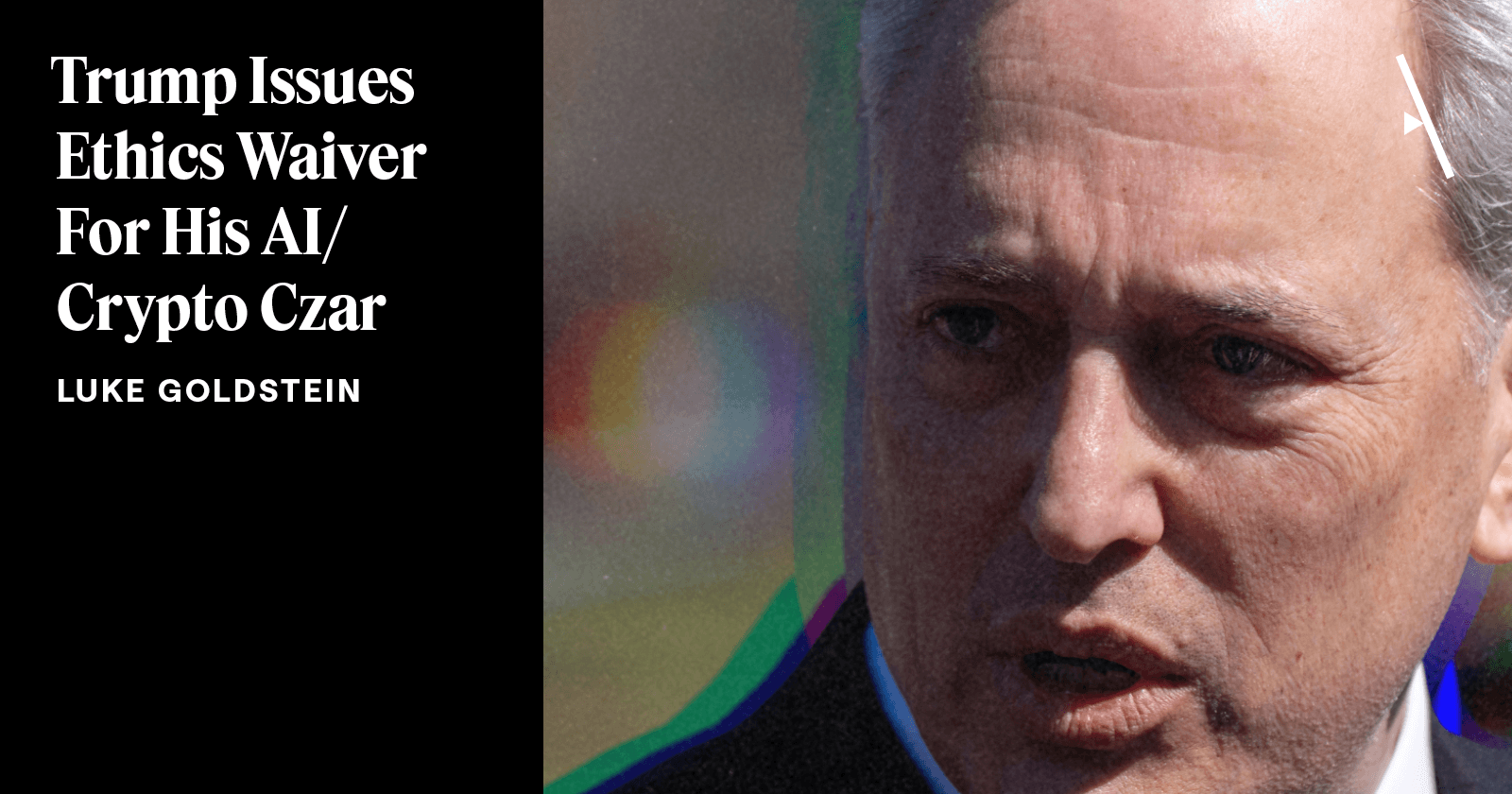
David Sacks confirmed Thursday that his non-consecutive 130-day stint as a special government employee is over, and that he is moving on to co-chair the President's Council of Advisors on Science and Technology alongside senior White House technology adviser Michael Kratsios. The announcement closed out one of the most ethically contentious tenures in recent Washington memory, leaving unanswered questions about how a billionaire venture capitalist shaped federal AI and crypto policy while sitting atop a portfolio of hundreds of tech investments.
What that transition means in practice is that Sacks is now much further from the power center in Washington than he was at the outset of Trump's second term. As AI czar, he had a direct line to the president and a hand in shaping policy. PCAST is a federal advisory body that studies issues, produces reports, and sends recommendations up the chain, but it doesn't make policy.
The ethics controversy that shadowed his tenure centered on an arrangement critics described as structurally unprecedented. Sacks secured not one but two ethics waivers allowing him to shape federal policy while maintaining financial stakes in the very industries he oversaw. The first, an 11-page document from March, covered his crypto investments. The second, issued in June, specifically addressed his AI holdings. Sacks did divest from some tech holdings like Amazon, Meta, and Musk's xAI, but public documents show that he and his firm, Craft Ventures, maintained more than 400 investments in tech firms with ties to AI.
Kathleen Clark, a government ethics expert at Washington University in St. Louis, was unsparing in her assessment. "These are sham ethics waivers," Clark said. "They lack the kind of rigorous objective ethics analysis that would ensure that public policy is made for public benefit. Instead, they were aimed at enabling Sacks to profit from his government position," she said, describing the waivers as "like a presidential pardon in advance." Clark went further in a separate assessment, calling the arrangement "graft."
One example of Sacks' concrete financial exposure: Craft Ventures invested in crypto company BitGo, which works with stablecoin issuers. In his role as czar, Sacks backed the GENIUS Act, which provided more guidance and regulation to stablecoin companies. BitGo celebrated the act as "a defining moment" for stablecoin legislation. After the legislation passed, BitGo filed for an IPO, with Craft owning 7.8% of the company, which was valued at more than $130 million in 2023.
The White House issued Sacks' first ethics waiver on March 5 over his crypto holdings. The memo from White House Counsel David Warrington acknowledged that Sacks retained financial interests in venture capital funds that "may presently have some minor digital asset industry holdings or might in the future." According to his waivers, Sacks and Craft Ventures divested over $200 million in digital assets, with at least $85 million directly attributable to him personally. He also sold stakes in fast-growing companies, including his position in Elon Musk's xAI, and initiated the sale of interests in approximately 90 venture capital funds, including Sequoia funds.
Sacks pushed back hard against the scrutiny. "The truth is that I divested hundreds of millions of dollars in positions in promising technology ventures at a substantial cost to my net worth," he said. "So not only is this job not benefiting me, it's actually cost me a lot of money to serve." He emphasized that the Office of Government Ethics approved his public waivers and concluded he had no conflicts of interest among his venture firm's investments.
The conflict-of-interest questions arrived alongside a significant policy win. Sacks helped shape an executive order aimed at undoing some of the more than 100 laws states had passed to regulate AI, most of which targeted AI deepfakes or required transparency and disclosure around how AI models operate. The idea had been shelved the first few times Sacks advocated for it, but the president signing the order was something Silicon Valley executives had wanted for months. On Fox Business, Sacks was blunt about his targets: "We don't like seeing blue states trying to insert their woke ideology in AI models, and we really want to try and stop that."
Senator Elizabeth Warren and Representative Melanie Stansbury led a congressional investigation into whether Sacks had exceeded the 130-day term limit for serving in his role as a Special Government Employee. The White House had already waived ethics restrictions to allow Sacks to maintain deep investments in crypto and AI companies that he had the power to impact as czar. Investigators alleged Sacks may have been exceeding that 130-day term limit, raising additional ethics concerns.
Sacks is a prominent venture capitalist who, along with Elon Musk and Peter Thiel, is a member of the PayPal Mafia, a group of executives of the online payments company who helped spark the digital economy after the dot-com bust. That Silicon Valley identity shaped both his appointment and the criticism that followed it. Whether the arrangement he embodied represents a new normal for Silicon Valley relations with Washington remains to be seen. Traditional ethics frameworks may be inadequate for an era when venture capitalists can maintain their investment activities while simultaneously shaping the policies that determine those investments' future value.
This article was produced by Prism’s automated news system from verified source data, official records, and press releases, then run through automated quality and moderation checks before publishing. The system is built and supervised by the people who set the standards it runs under. Read our full AI policy.
Did this article answer your question?

