Trump-Aligned Panel Approves White House Ballroom Despite Legal Challenges
A Trump-stacked planning commission voted 7-2 to approve a $400 million White House ballroom just two days after a federal judge ordered construction halted.

The National Capital Planning Commission voted Thursday to approve President Donald Trump's $400 million, 90,000-square-foot White House ballroom project, a decision that came just two days after a federal judge ordered construction halted pending congressional authorization and deepened concerns about the independence of the oversight bodies responsible for safeguarding the nation's most iconic address.
The 12-member commission, chaired by White House staff secretary Will Scharf, voted 7 in favor, with two abstentions, two present votes, and a single dissent from D.C. Council Chairman Phil Mendelson. Trump appointed three members of the commission himself, including Scharf and two other White House officials, a composition critics say rendered the body a loyalist rubber stamp. The commission deliberated and voted to authorize the plan to erect the ballroom in place of the historic East Wing, which was demolished last fall to make way for the project.
Trump went ahead with the ballroom before seeking input from the National Capital Planning Commission and the Commission of Fine Arts, which he had separately reconstituted with allies and supporters. The National Trust for Historic Preservation, a private nonprofit, sued after Trump demolished the East Wing. The vote included an amendment to the original ballroom blueprint that removed a proposed staircase from the south portico and added a switchback feature to a planned southwest staircase.
U.S. District Judge Richard Leon, nominated by Republican President George W. Bush, granted the National Trust's request for a preliminary injunction, concluding that the organization is likely to succeed on the merits. Leon wrote that "no statute comes close to giving the President the authority he claims to have" and ordered that ballroom construction must stop until Congress authorizes its completion. He suspended enforcement of the order for 14 days to allow the administration time to appeal.
The commission pressed ahead with Thursday's vote anyway, with a spokesperson arguing that Leon's ruling affected construction activities, not planning decisions. Scharf pushed back against public critique of the project, stating that the White House has grown "in fits and spurts" since its first century and arguing that the complex is "ever changing, ever evolving."
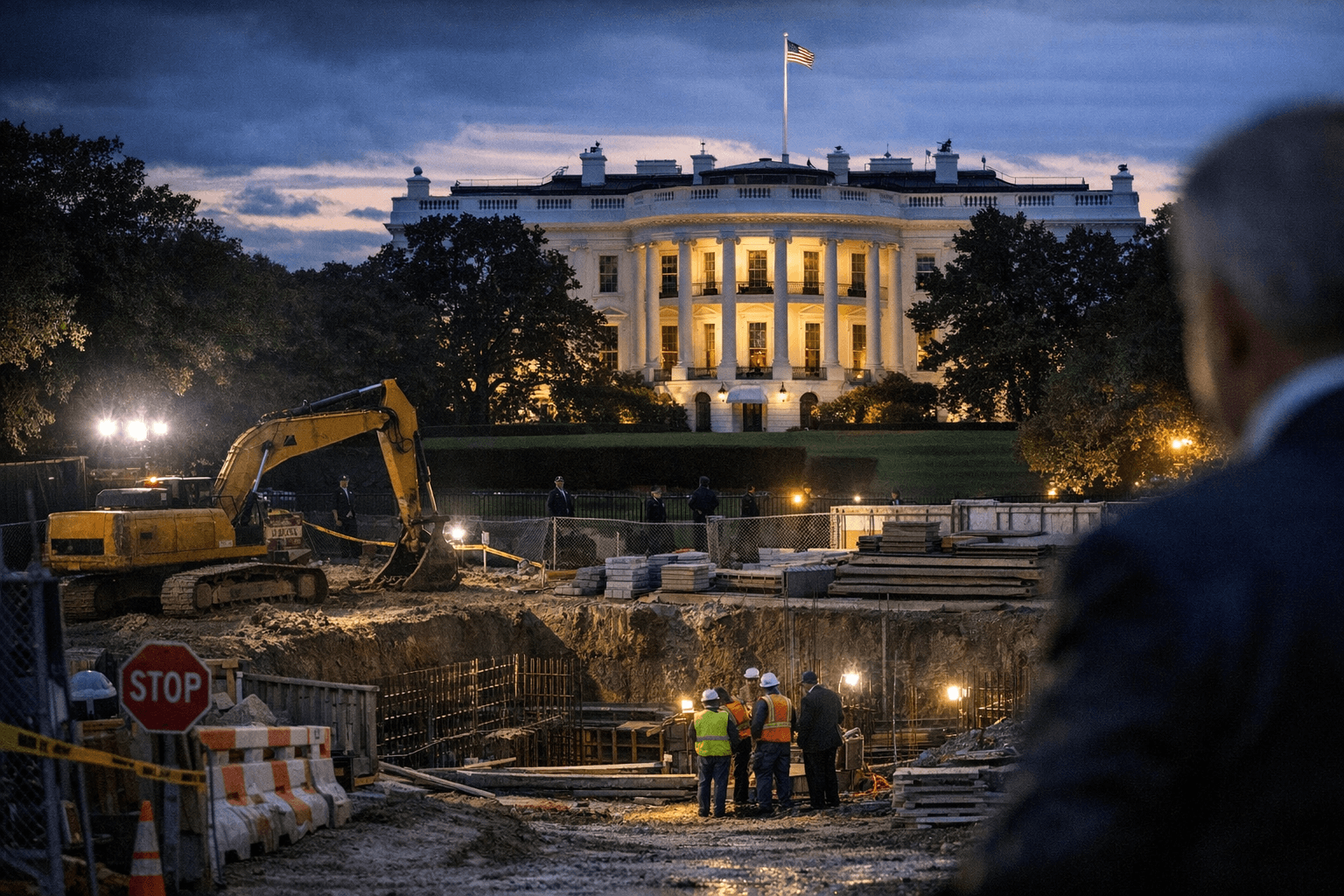
A separate dimension of the project surfaced days before the vote when Trump himself disclosed the scale of what lies beneath the future ballroom. Trump revealed that the U.S. military is constructing a "massive" underground complex beneath the 90,000-square-foot structure, telling reporters aboard Air Force One that the ballroom "essentially becomes a shield for what's being built under by the military." The Presidential Emergency Operations Center, originally created during World War II to protect Franklin D. Roosevelt, had been dismantled during the East Wing demolition, and a new modernized facility is now in the works. Officials have suggested the classified underground work is partly why construction moved ahead without standard National Capital Planning Commission review. While Trump says the $400 million above-ground ballroom will be financed through private donations, public dollars are paying for the underground bunkers and security upgrades on the White House grounds.
National Trust President and CEO Carol Quillen praised the initial court ruling. "We are pleased with Judge Leon's ruling today to order a halt to any further ballroom construction until the Administration complies with the law and obtains express authorization to go forward," she said, calling it "a win for the American people on a project that forever impacts one of the most beloved and iconic places in our nation."
The NCPC approval now sets up a direct confrontation between the commission's green light and Leon's injunction. With the administration's 14-day window to appeal running out and above-ground construction previously scheduled to begin this month, the question of whether Congress will grant the authorization Leon demands has become the project's central legal obstacle.
This article was produced by Prism’s automated news system from verified source data, official records, and press releases, then run through automated quality and moderation checks before publishing. The system is built and supervised by the people who set the standards it runs under. Read our full AI policy.
Did this article answer your question?

