Trump and Aides Send Mixed Signals on Regime Change in Iran
Trump declared "we've had regime change" in Iran even as Defense Secretary Hegseth insisted just weeks earlier the war was never about toppling the government.
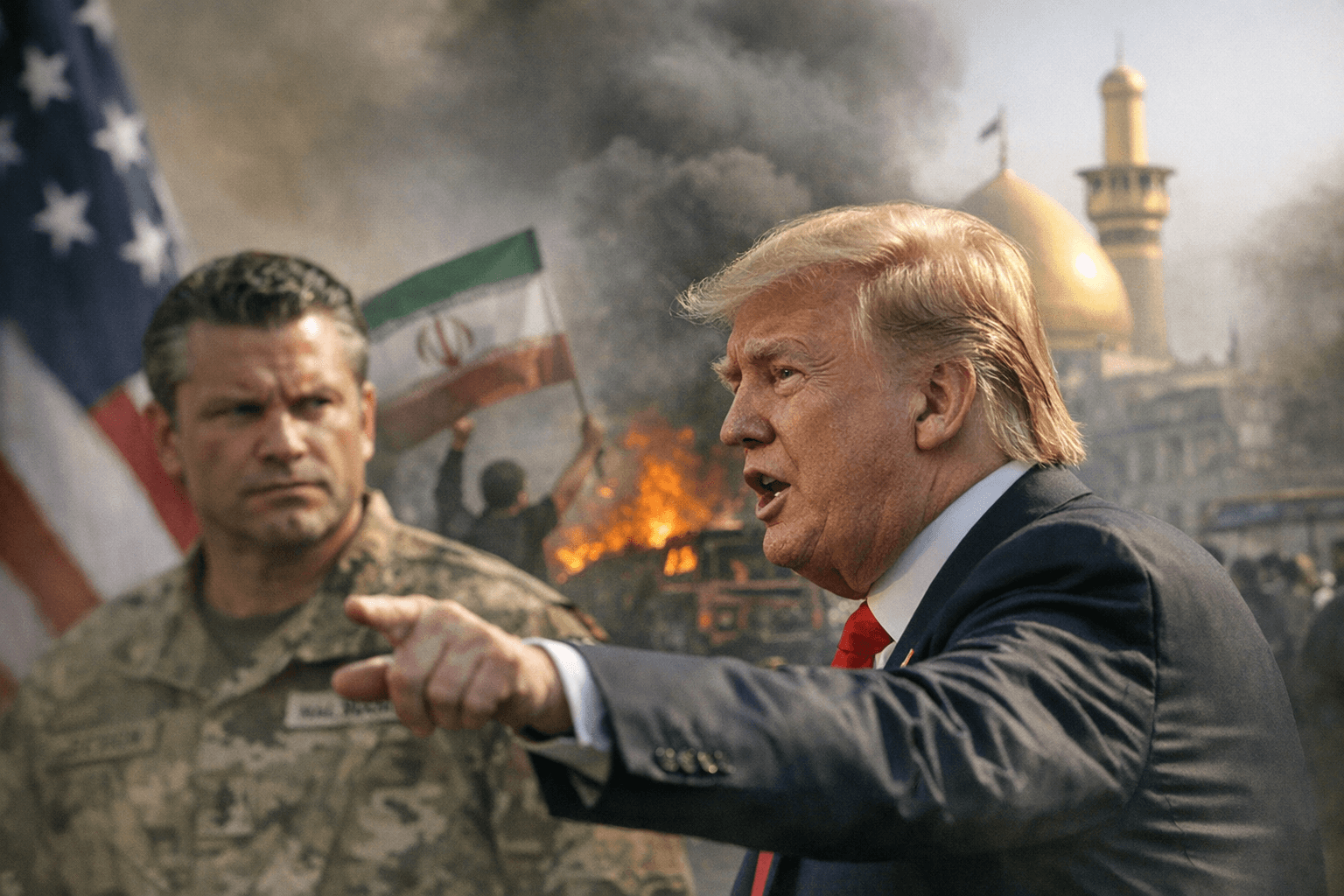
The administration that launched a joint U.S.-Israel military campaign in Iran on February 28, 2026, has never been able to agree on what victory looks like, and the contradiction grew sharper this week when President Trump declared the war had already achieved regime change while his own cabinet officials continued to resist that label.
Aboard Air Force One on March 29, Trump told reporters that his administration was having "very good" negotiations with Iran. "We've had regime change," he said. "If you look already because the one regime was decimated, destroyed. They're all dead. The next regime is mostly dead."
That claim collided directly with the posture Defense Secretary Pete Hegseth had adopted just weeks earlier. At a March 2 Pentagon press briefing, Hegseth said: "This is not a so-called regime change war, but the regime sure did change and the world is better off for it." The formulation captured the administration's core problem: insisting on a legal and strategic boundary it simultaneously claimed to have crossed.
The contradiction ran deeper than a single week's messaging. Before the war, Vice President J.D. Vance and Secretary of State Marco Rubio had insisted "we don't want a regime change" and "we're not into the regime change business here." Rubio pivoted after the strikes began, arguing before congressional leaders on March 2 that the campaign was primarily a preemptive strike. "We knew that there was going to be an Israeli action, we knew that would precipitate an attack against American forces and we knew that if we didn't preemptively go after them before they launched those attacks, we would suffer higher casualties," Rubio told reporters before briefing lawmakers.
The objectives themselves have been a moving target. When announcing the strikes, Trump said the U.S. military would destroy Iran's ballistic missile program, prevent the regime from obtaining a nuclear weapon, and stop support of military proxy networks. But the rationale kept expanding. Sen. Mark Warner, D-Va., put it plainly after a classified briefing: "It was about the Iranian nuclear capacity, a few days later it was about taking out the ballistic missiles, it was then, in the president's own words, about regime change, and now we hear it's about sinking the Iranian fleet. I'm not sure which of those goals, if met, means that we're at an endgame."
The factual record on the ground further complicates Trump's assertion. Joint U.S.-Israeli strikes killed Supreme Leader Ayatollah Ali Khamenei, along with Ali Larijani, secretary of the Supreme National Security Council; Gholamreza Soleimani, commander of Iran's Basij force; Defense Minister Aziz Nasirzadeh; IRGC commander Mohammad Pakpour; IRGC navy commander Alireza Tangsiri; and Iran Defense Council Secretary Ali Shamkhani. But key leaders remain alive, including President Masoud Pezeshkian and Chief Justice Gholam-Hossein Mohseni-Eje'i. Khamenei was succeeded by his son Mojtaba, whom Trump has criticized as "unacceptable."
Danny Citrinowicz, a senior researcher in the Iran and Shi'ite Axis Program at the Institute for National Security Studies in Tel Aviv, argued the leadership shifts do not constitute regime change. Rather, he said, what is visible is "a transformation within the regime itself, one that has made it more extreme."
Trump himself had appeared to pull back from the regime-change framing in mid-March, telling NPR on March 13 that it did not matter whether Tehran actually said it surrendered as long as the U.S. had a position of dominance. Then, on March 23, Trump returned to the regime-change language, telling reporters: "There's automatically a regime change," noting that all the previous leaders were dead and that his team was dealing with new people he described as "very reasonable, very solid." Iran publicly said it was not engaged in any direct or indirect talks with the U.S.
The U.S. is reportedly in talks with Iran's Parliament speaker, Mohammed-Baqer Qalibaf, and is eyeing him as a potential U.S.-backed leader for Iran. Qalibaf has denied having direct negotiations with the Trump administration, while officially Pakistan is serving as the intermediary between the two governments.
Despite Trump's desire to conclude the war quickly, officials have struggled in recent classified briefings to detail how they plan to achieve key objectives if Iran does not cooperate, including reopening the Strait of Hormuz or permanently ending Iran's nuclear ambitions, according to lawmakers in those rooms. Whether "regime change" is a war aim, an unintended outcome, or a retroactive justification, the administration has yet to answer a more fundamental question: what exact condition ends the war.
This article was produced by Prism’s automated news system from verified source data, official records, and press releases, then run through automated quality and moderation checks before publishing. The system is built and supervised by the people who set the standards it runs under. Read our full AI policy.
Did this article answer your question?


