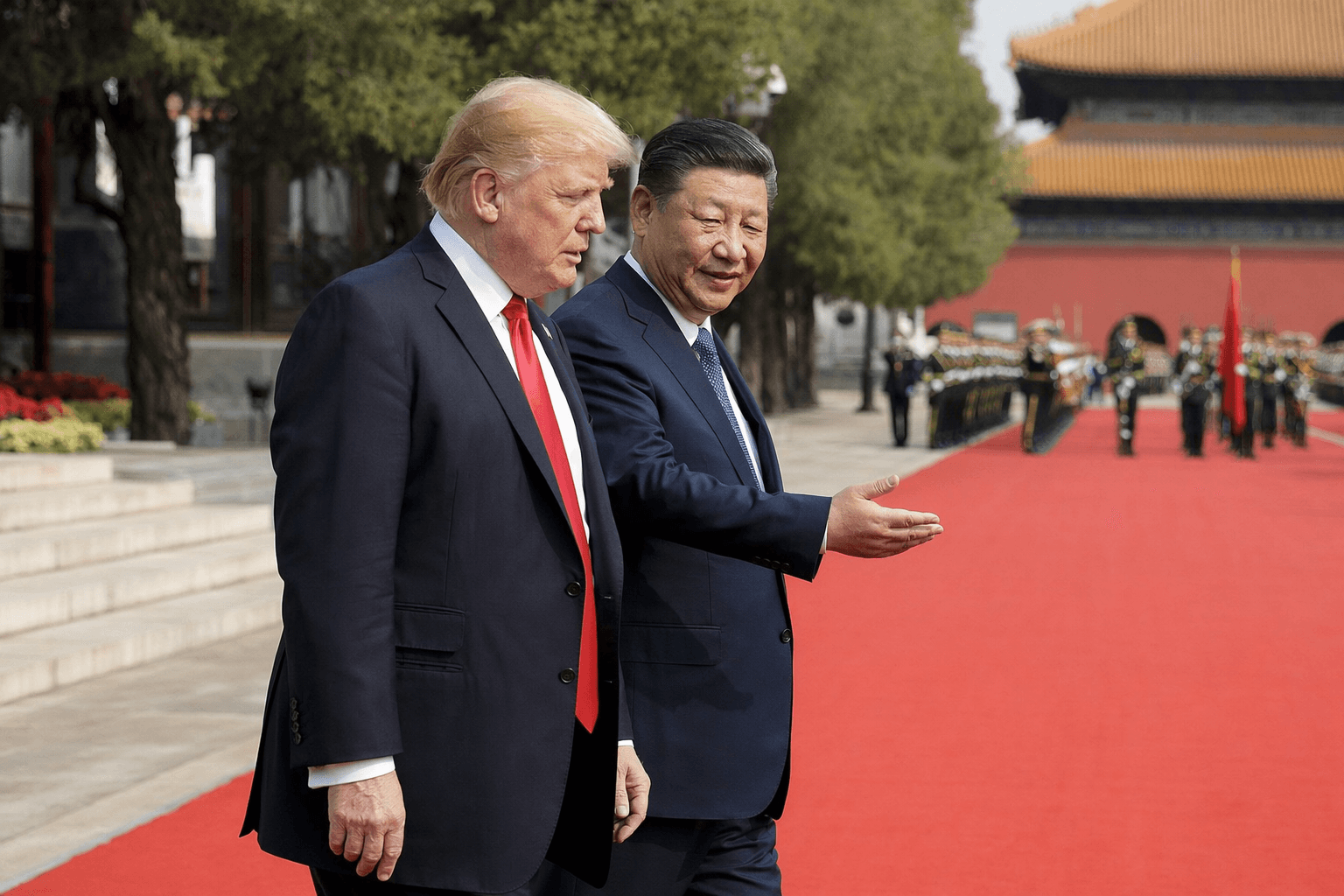
Trump and Xi meet in Beijing for high-stakes summit
Trump and Xi met in Beijing as trade, Taiwan and the Iran war set the bargaining table. The ceremony signaled warmth, but the real scorecard was leverage.

Ceremonial warmth framed the summit, but the real measure of the meeting between Donald Trump and Xi Jinping was always likely to be what changed on trade, Taiwan and Iran. Trump landed in Beijing on Wednesday evening local time and met Xi on Thursday morning during a state visit scheduled for May 13 to 15, 2026, an invitation from Xi that gave the trip a formal sheen while leaving the hardest issues unsettled.
The talks took place against a tense economic backdrop. Tariffs and broader trade friction have strained the relationship between the world’s two largest economies, and the question hanging over Beijing was whether Trump and Xi could produce even a temporary reset. Analysts had warned that the trip might amount to more pageantry and symbolism than major bilateral breakthroughs, a prediction reinforced by the carefully staged arrival and the political pressure surrounding the meeting.
Taiwan sat near the center of the agenda. CBS News reported that the island was one of the key issues in the summit, and the U.S. State Department says Taiwan is the United States’ ninth-largest trading partner while the United States is Taiwan’s second-largest trading partner. Washington maintains a robust unofficial relationship with Taipei despite the absence of formal diplomatic ties, a reality that makes any shift in language or posture from Beijing and Washington important well beyond the bilateral relationship.
China’s leadership has long treated Taiwan as a core sovereignty issue, and the Beijing talks were set to reflect that. The Ministry of Foreign Affairs of the People’s Republic of China said the Trump visit was at Xi’s invitation, underscoring how tightly Beijing controlled the optics around the summit. For Chinese officials, any movement on Taiwan would likely be less about a public concession than about testing whether Washington would soften its stance or narrow its support for Taipei.
The war with Iran added another layer of urgency. CBS said the conflict had already delayed parts of Trump’s Asia travel and remained part of the immediate context for the summit, placing additional pressure on a White House already navigating economic uncertainty at home. That meant the next 24 to 72 hours would be judged less by ceremony than by whether either side could show progress on tariffs, preserve their positions on Taiwan and avoid letting the Iran crisis widen the diplomatic gap. In Beijing, the scoreboard was not applause; it was leverage.
Know something we missed? Have a correction or additional information?
Submit a Tip