Trump Claims Iran Wants Nuclear Deal, Tehran Denies Talks Are Happening
Iran rejected Trump's 15-point ceasefire plan, with Foreign Minister Araghchi declaring "speaking of negotiations now is an admission of defeat," even as 6,000 U.S. troops head to the region.
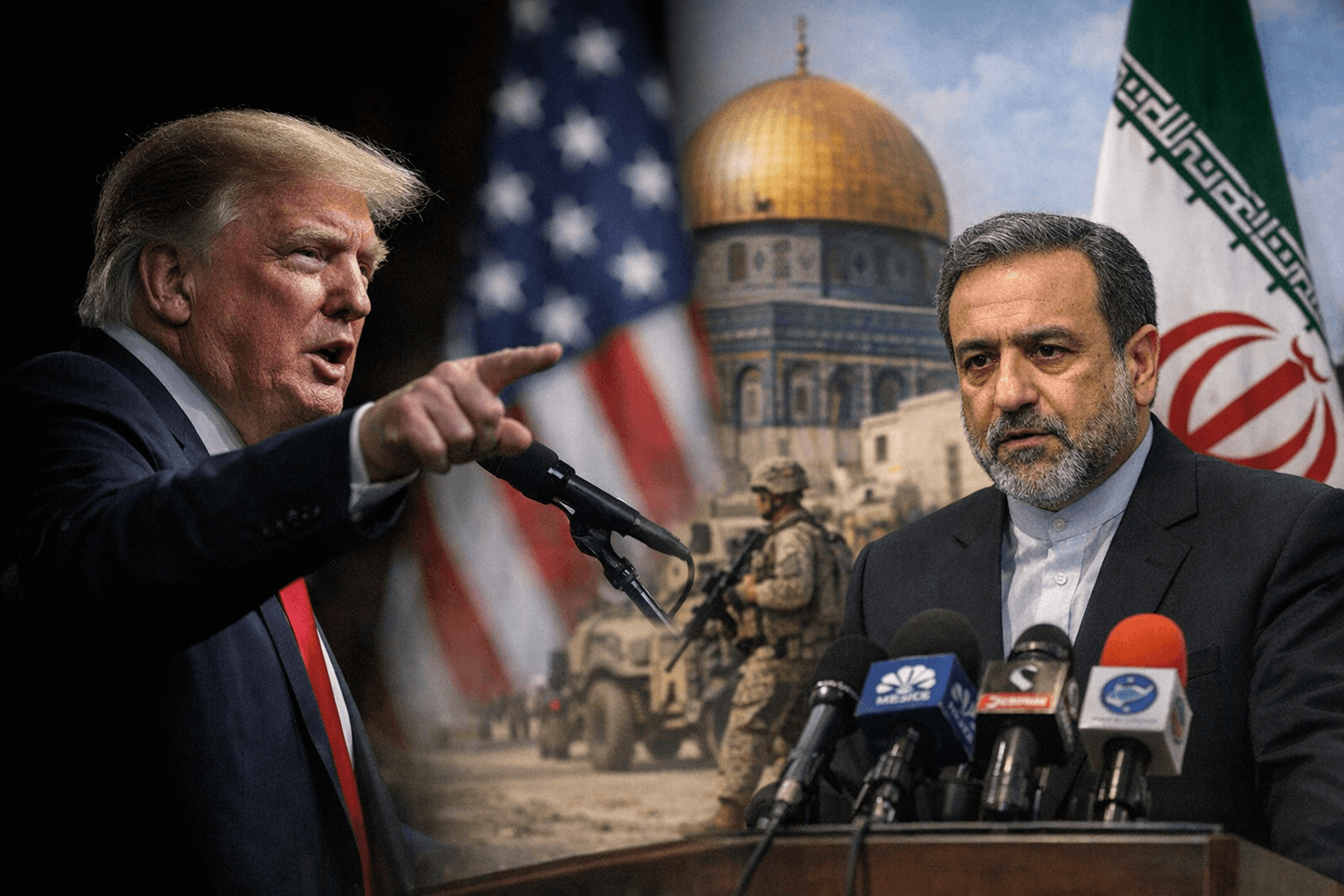
At a National Republican Congressional Committee fundraising dinner Wednesday, Trump told the crowd that Iran's leaders "are negotiating, by the way, and they want to make a deal so badly, but they're afraid to say it because they figure they'll be killed by their own people." In Tehran, the response was contempt.
Iranian Foreign Minister Abbas Araghchi said Wednesday that Iran did not plan to negotiate with the U.S. and intended to keep fighting. "At present, our policy is the continuation of resistance," Araghchi said on state television, adding: "We do not intend to negotiate — so far, no negotiations have taken place, and I believe our position is completely principled." "Speaking of negotiations now is an admission of defeat," he said.
The exchange laid bare the sharpest diplomatic contradiction of the now nearly month-old conflict: Trump said that Washington and Tehran have had "very good and productive conversations" aimed at ending the war, while Iran has consistently denied that it is holding talks with the U.S. Iranian leaders said the U.S. is "negotiating with itself."
At the center of the dispute is a 15-point ceasefire proposal the Trump administration transmitted to Iran through Pakistan. The reported proposal, described by Pakistani and Egyptian officials speaking to the Associated Press, covers sanctions relief, civilian nuclear cooperation, curbs on Iran's nuclear and missile programs, stronger International Atomic Energy Agency monitoring, and guarantees for shipping through the Strait of Hormuz. Citing unnamed officials in Islamabad, Pakistan's capital, AP said intermediaries had delivered the plan to the Iranian government.
Iran rejected the U.S.-backed 15-point ceasefire proposal, according to its state-run English-language broadcaster Press TV, which cited an anonymous official. One Egyptian official described it as a "comprehensive deal," but said it was being treated only as a basis for further talks, adding that Iranian officials remained "very skeptical" of the Trump administration.
Araghchi questioned U.S. calls for negotiations, saying Washington's shift in tone amounts to an acknowledgment of failure after previously demanding "unconditional surrender." "Didn't the Americans say 'unconditional surrender'?" he said in a televised interview on the state-run IRIB network. "So why are they talking about negotiation now?" He added: "The fact that messages are being sent and we respond with warnings or state our positions is not called negotiation or dialogue; it is an exchange of messages."
Araghchi did acknowledge that "various ideas" from the U.S. had been "conveyed to the senior officials of the country," and that messages were "being exchanged through friendly countries or through certain different individuals," but insisted "this is neither called dialogue nor negotiation."
Iran has also put forward its own ceasefire proposal, calling for war reparations and sovereignty over the Strait of Hormuz. Iran has told intermediaries that Lebanon must be included in any ceasefire agreement with the U.S. and Israel, according to six regional sources familiar with Iran's position. Hezbollah's chief Naim Qassem made the stakes of that demand explicit, saying that negotiating with Israel under fire would amount to "surrender" for Lebanon.
The diplomatic impasse is unfolding alongside a significant U.S. military buildup. The United States was moving about 1,000 troops from the 82nd Airborne Division to the region and deploying two Marine units. The proposal came as the Trump administration also prepared to deploy two Marine expeditionary units that would add about 5,000 Marines and thousands of sailors to the region, moves being framed as Trump maneuvering to give himself "max flexibility" on what he does next, according to the Associated Press. Central Command separately claimed the U.S. is "on plan" to eliminate Iran's ability to project power, an assertion that undercuts any purely diplomatic reading of Washington's intentions.
The war, which the U.S. and Israel launched on February 28 as negotiations with Iran were ongoing, has had a high cost, roiling energy and stock markets worldwide, disrupting shipping and resulting in casualties across the Middle East. Iran has effectively shuttered the Strait of Hormuz, a conduit for about a fifth of the world's oil and liquefied natural gas, triggering a global supply shock that has sparked fears of an inflation crisis and worldwide food shortages.
Israeli officials were described as surprised by the submission of a ceasefire plan, having pushed Trump to keep up military pressure. On Wednesday, the White House threatened to "unleash hell" on Iran if it did not negotiate a peace deal.
Major uncertainties remain over who in Iran has the authority to negotiate, what terms Tehran might ultimately accept, and whether any proposal can survive continued fighting. One source with knowledge of the positions said bluntly: "The maximum Iran might be willing to give does not meet the minimum the US is demanding.
This article was produced by Prism’s automated news system from verified source data, official records, and press releases, then run through automated quality and moderation checks before publishing. The system is built and supervised by the people who set the standards it runs under. Read our full AI policy.
Did this article answer your question?