Trump Could Withdraw From USMCA Next Year, USTR Warns
The U.S. trade representative told Politico that President Donald Trump could decide in 2026 to withdraw the United States from the United States Mexico Canada Agreement. The prospect raises immediate questions about tariffs, cross border supply chains, manufacturing competitiveness and political accountability at home and in North America.
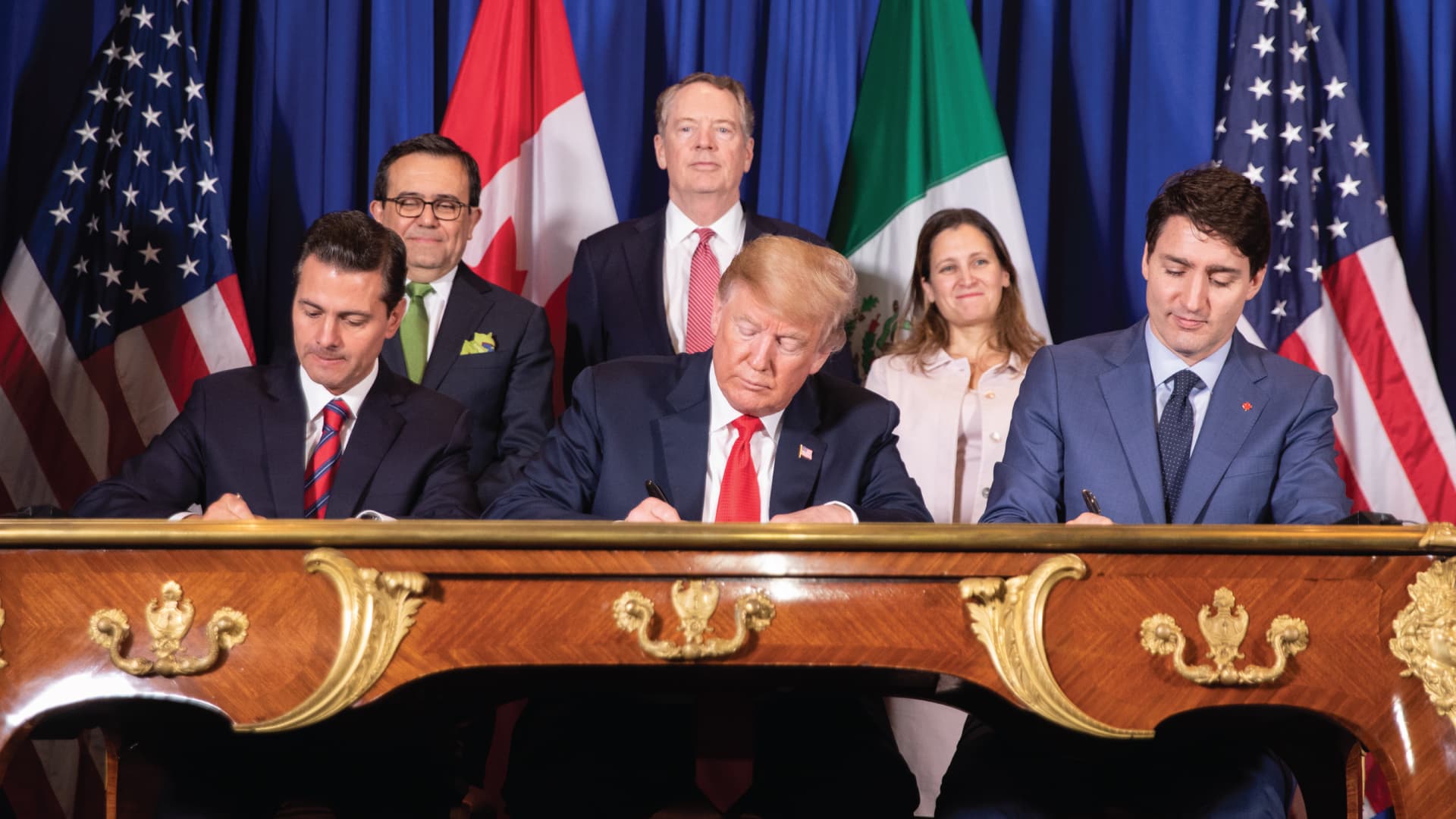
U.S. Trade Representative Jamieson Greer told Politico that President Donald Trump could decide in 2026 to withdraw the United States from the United States Mexico Canada Agreement, Reuters reported on December 4. Reuters relayed Politico reporting of Greer’s remarks, underscoring the uncertainty surrounding the pact that governs the bulk of commerce across North America.
If the United States were to withdraw from USMCA the practical consequences would be swift and wide ranging. Tariff protections and dispute resolution mechanisms that have underpinned integrated manufacturing networks would be called into question, increasing the risk of higher costs for automakers, parts suppliers, agricultural exporters and retailers. Companies that reorganized production and procurement to take advantage of the agreement now face the prospect of disrupted supply chains and added compliance costs.
The announcement also intensifies political pressure inside the United States. USMCA was implemented with congressional approval and has supporters in both parties who represent manufacturing and agricultural districts. Withdrawal would force lawmakers to confront a choice between backing an executive decision that could hit local employers and resisting a policy perceived by the White House as central to an America First trade posture. The timing of such a move could shape campaign narratives and voting patterns in key states where trade and manufacturing employment remain politically decisive.
Mexico and Canada would have immediate leverage as well. Withdrawal could provoke strong political and economic responses from those governments as they weigh reciprocal measures and contingency plans to protect their industries. That dynamic would make any unilateral U.S. action costly not only economically but diplomatically, complicating cooperation on cross border security issues, migration and investment.

For businesses and consumers the uncertainty alone matters. Firms face a binary scenario in which planning assumptions used for the past several years no longer hold. Short term disruption could translate into higher consumer prices if tariffs are reimposed or if companies respond by reshoring production at higher cost. Smaller exporters and suppliers with limited negotiating power would be most exposed.
Institutionally the possibility of withdrawal highlights gaps in transparency and accountability around trade policy decision making. Stakeholders from state governments to labor unions and business groups will seek clear explanations of the legal basis for any exit and the administration’s contingency plans. Congress will likely demand briefings and potentially move to assert its prerogatives if an executive decision is imminent.
The USTR comments, as relayed by Reuters on December 4, illustrate how trade policy remains a live political instrument. The prospect of withdrawing from USMCA elevates trade from a technocratic negotiation to a central electoral and governance issue for 2026. Voters in regions dependent on integrated North American production chains will be watching closely for concrete policy proposals, legal steps and economic impact assessments as the debate unfolds.
This article was produced by Prism’s automated news system from verified source data, official records, and press releases, then run through automated quality and moderation checks before publishing. The system is built and supervised by the people who set the standards it runs under. Read our full AI policy.
Did this article answer your question?

