Trump Hails Destruction of Iranian Bridge, Warning ‘More to Follow’
A second U.S. strike hit Iran's newly opened B1 Bridge while rescue teams were treating victims of the first attack, killing 8 and wounding 95.
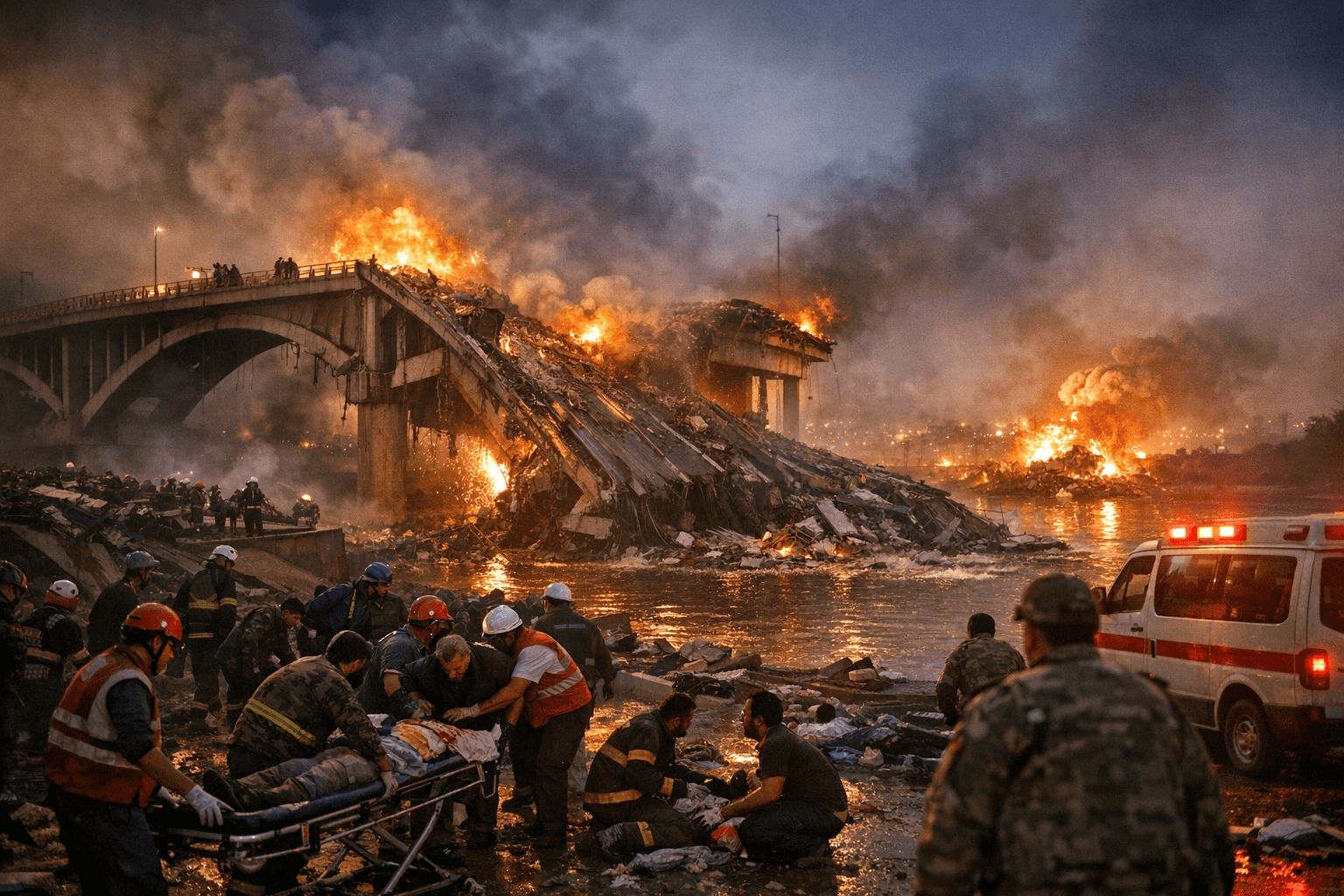
The second U.S. strike on Iran's B1 Bridge in Karaj arrived while rescue workers were still pulling victims from the wreckage of the first. Iran's state media reported that eight people were killed and 95 wounded in the attack on the Iranian highway bridge connecting Tehran to the city of Karaj. State television confirmed that American and Israeli forces struck the B1 bridge a second time while rescue operations from the initial strike were still underway.
President Donald Trump heralded the attack on Truth Social, posting footage of smoke rising from the B1 bridge in Karaj, around 20 miles southwest of Tehran, and warning there would be further strikes. His post included a 10-second video clip and the message: "The biggest bridge in Iran comes tumbling down, never to be used again — Much more to follow! IT IS TIME FOR IRAN TO MAKE A DEAL BEFORE IT IS TOO LATE."
The B1 bridge links Iran's highest bridge connecting Tehran and Karaj, a major transport artery opened earlier this year. Iranian media had described the structure, standing approximately 136 to 146 meters tall in Karaj's Azimiya area on the Karaj Northern Bypass in Alborz province, as the highest bridge in the Middle East and an "engineering masterpiece." The bridge sits along the road leading to Chalous Avenue, a mountainous corridor connecting Tehran to the Caspian Sea coast.
An i24NEWS source with knowledge of the operation said the bridge was a central transit route and its destruction was intended to cut off supply routes bringing drone parts and missiles to Iranian firing units that launch them at U.S. and Israeli forces. U.S. defense officials separately confirmed the military rationale, saying the strike was designed to prevent Iranian armed forces from moving weapons and supplies across the structure.
White House press secretary Karoline Leavitt defended the action, saying Trump's statement showed that Iran's "best move is to make a deal," and added: "The United States Armed Forces has capabilities beyond their wildest imagination, and the president is not afraid to use them."
The attack marks the first time U.S. forces struck Iranian civilian infrastructure during the current conflict, a threshold that had already drawn scrutiny from legal experts. Earlier in the week, Trump had threatened to "completely obliterate" all Iranian electrical-generation plants and oil wells, sharpening questions about whether expanding the target set to civilian infrastructure could run afoul of international law.
Iran's IRGC responded to the strike by threatening to attack several key bridges in the Middle East in retaliation, with an affiliated outlet publishing a list of bridges in Kuwait, Saudi Arabia, Abu Dhabi, and Jordan as potential targets. The IRGC has also previously threatened 18 major American technology and infrastructure companies.
U.S. defense officials told Axios that more Iranian bridges are likely to be targeted in the coming days, a projection consistent with Trump's own escalation vow. The bridge strike is part of a broader U.S.-Israeli military campaign against Iran, sometimes referred to as "Operation Epic Fury," that began in early 2026 and has disrupted global travel, trade, and shipping. Trump said separately the U.S. could end the war in "two to three weeks," though the IRGC's retaliatory target list spanning four countries suggests the region is bracing for a very different timeline.
This article was produced by Prism’s automated news system from verified source data, official records, and press releases, then run through automated quality and moderation checks before publishing. The system is built and supervised by the people who set the standards it runs under. Read our full AI policy.
Did this article answer your question?