Trump Lashes Out as Europe Tightens Restrictions on American Aircraft
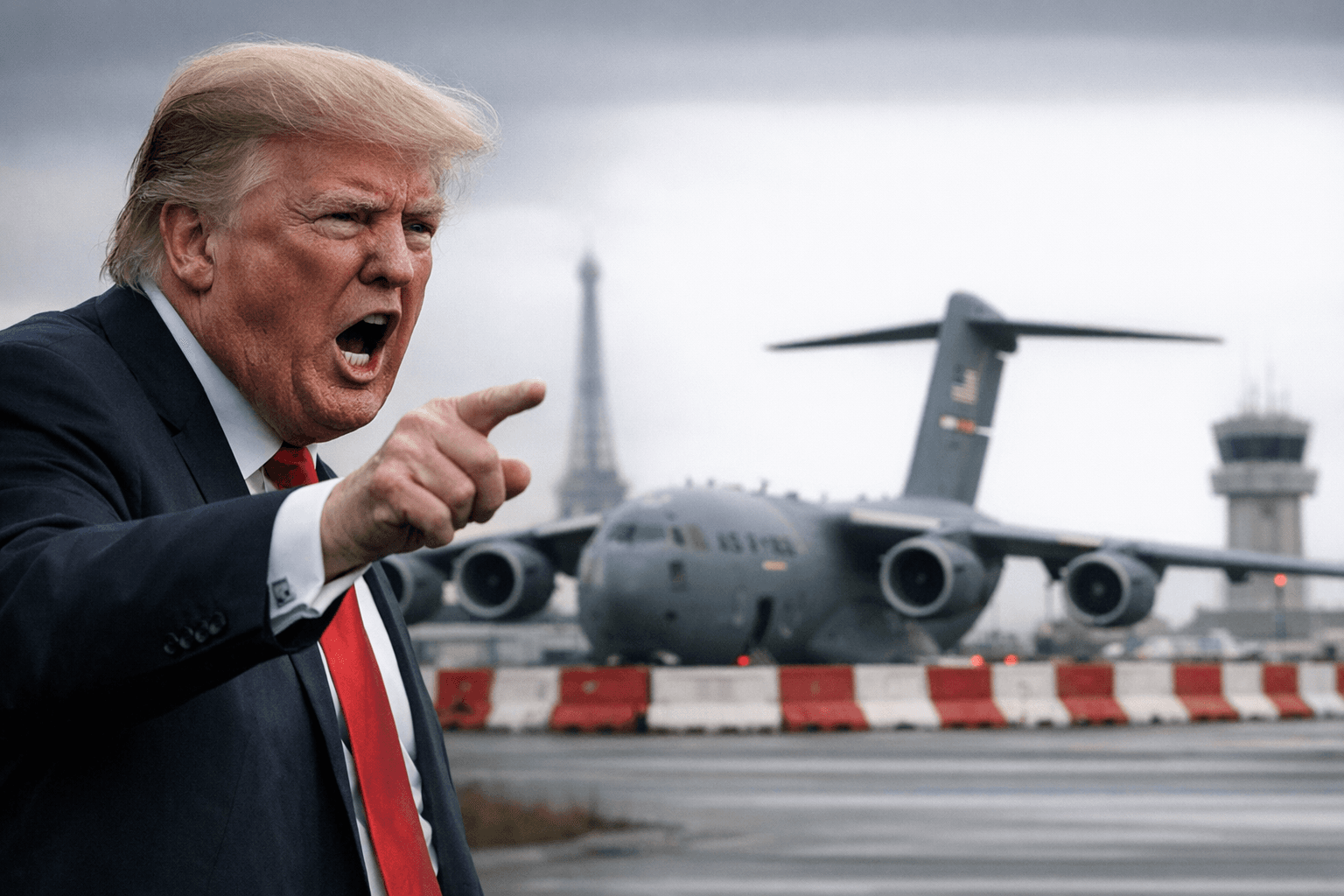
Trump attacked France, Spain, and Italy on Truth Social after all three nations blocked U.S. military aircraft, as Hormuz insurance costs soared to 10% of hull value per transit.
The transatlantic alliance absorbed fresh shocks Tuesday as President Trump unleashed back-to-back Truth Social broadsides against France, Spain, and Italy after all three nations moved to block American military aircraft from their airspace or bases, fracturing NATO coordination at a moment when Strait of Hormuz insurance costs had climbed to as high as 10 percent of a vessel's hull value per single transit.
Spain moved first. Prime Minister Pedro Sanchez confirmed that "all flight plans that involved actions related to the operation in Iran were rejected," while Defense Minister Margarita Robles was more explicit: "We will not authorize the use of Morón and Rota [bases] for any acts related to the war in Iran." Italy then denied U.S. military aircraft permission to land at a base in Sicily. France followed, closing its airspace to planes carrying military supplies to Israel.
Trump responded with a string of posts that left no ambiguity about his view of allied solidarity. Addressing nations struggling to secure jet fuel after Iran's effective closure of the Strait of Hormuz since late February, he wrote: "All of those countries that can't get jet fuel because of the Strait of Hormuz, like the United Kingdom, which refused to get involved in the decapitation of Iran, I have a suggestion for you: Number 1, buy from the U.S., we have plenty, and Number 2, build up some delayed courage, go to the Strait, and just TAKE IT." He added that European governments would have "to start learning how to fight for yourself, the U.S.A. won't be there to help you anymore, just like you weren't there for us."
The military logistics dispute sits atop a widening economic crisis. War-risk ship insurance premiums for Hormuz transit, which began the year at 0.125 percent of insured value, have surged to between 5 and 10 percent of hull value since the U.S.-Israeli strikes that killed Supreme Leader Ali Khamenei on February 28. For a very large crude carrier valued at roughly $100 million, that translates into several million dollars in additional costs per crossing. Norway's Gard and Skuld, Britain's NorthStandard, and the London P&I Club have all cancelled war risk cover for vessels in the region. Brent crude sat at $114 per barrel as of March 27, after briefly retreating to $102 when Trump signaled possible negotiations with Tehran.
The strait normally carries roughly one-third of seaborne crude oil trade, along with 19 percent of global liquefied natural gas flows and 14 percent of global refined product trade. European officials have noted the continent sources most crude and gas from outside the Middle East, but Brussels remains specifically alarmed about refined petroleum products, particularly jet fuel and diesel.
Each European government stressed its restrictions apply only to Iran-related operations and do not signal a broader break with NATO. The qualifications did little to suppress institutional anxiety. John Hemmings, director of the National Security Centre at the Henry Jackson Society in London, noted that Italy's refusal was particularly telling because it followed Poland's separate refusal to allow the repositioning of a U.S. Patriot anti-missile battery, pointing to a pattern wider than any bilateral grievance.
Trump extended to April 6 his deadline for Iran to reopen the Strait before he would authorize strikes on Iranian power plants. After four weeks of U.S. strikes, he wrote, "The hard part is done." Whether allied access survives the war's next phase is increasingly being answered not through diplomatic channels, but through a growing list of closed-airspace notifications landing in Washington.
This article was produced by Prism’s automated news system from verified source data, official records, and press releases, then run through automated quality and moderation checks before publishing. The system is built and supervised by the people who set the standards it runs under. Read our full AI policy.
Did this article answer your question?

