Trump orders Navy to shoot Iranian mine boats in Strait of Hormuz
Trump told the Navy to "shoot and kill" Iranian mine boats, escalating a fight in a 29-nautical-mile chokepoint that carries roughly a quarter of seaborne oil.
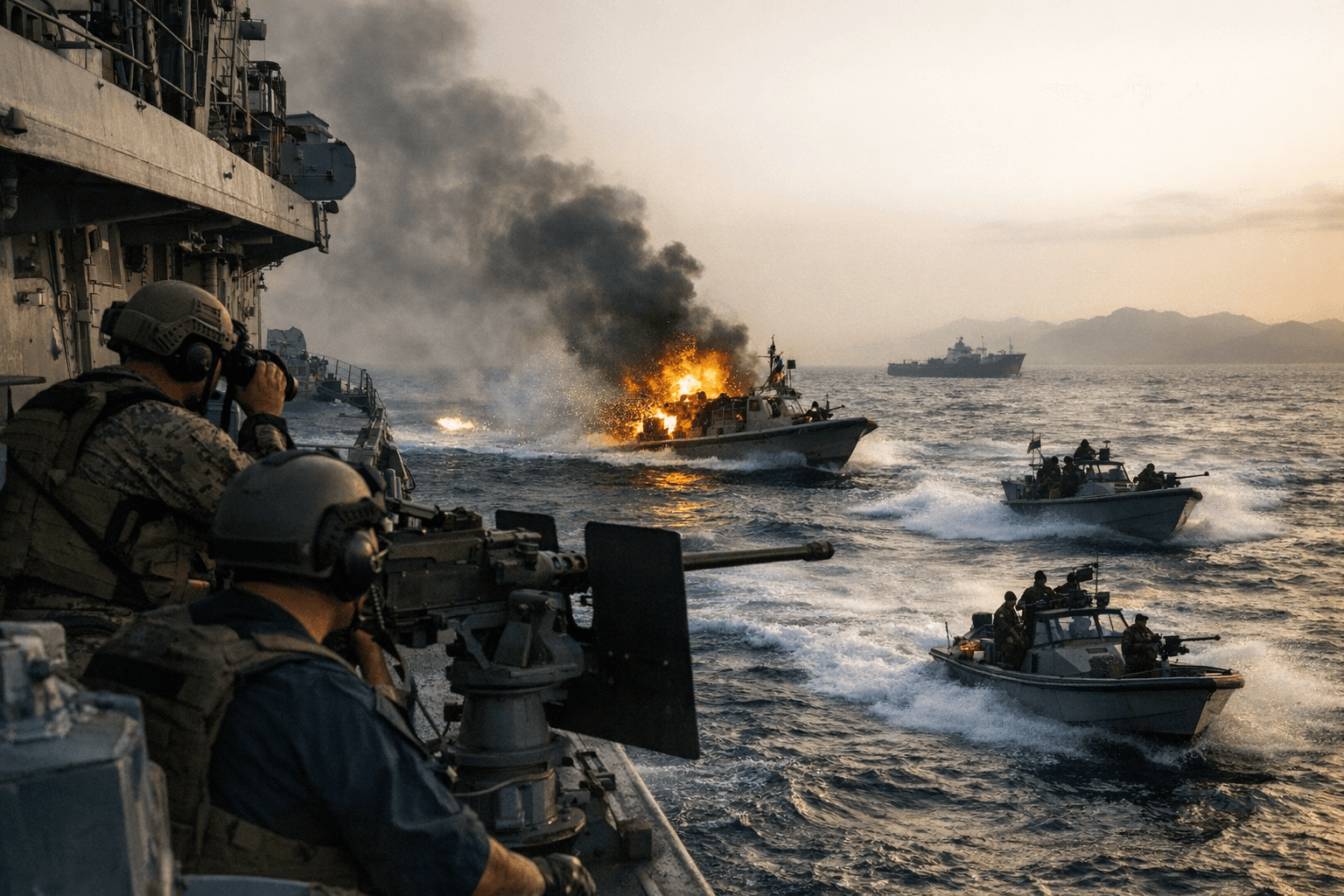
President Donald Trump ordered the U.S. Navy to "shoot and kill" any small Iranian boat laying mines in the Strait of Hormuz, telling forces there should be "no hesitation" as Washington stepped up its response to the most economically sensitive waterway in the Gulf.
The order, delivered Thursday, April 23, 2026, changed the stakes in a narrow passage only 29 nautical miles wide at its narrowest point. Trump said U.S. mine sweepers were already clearing the strait and ordered the effort raised to "a tripled up level," signaling that Washington was treating mine-laying craft as hostile targets in a corridor that links the Persian Gulf with the Gulf of Oman and the Arabian Sea.
That corridor is central to global energy flows. The International Energy Agency said about 20 million barrels per day of oil products moved through the Strait of Hormuz in 2025, roughly 25% of the world’s seaborne oil trade. The U.S. Energy Information Administration has called it the world’s most important oil chokepoint, saying it carried about 21 million barrels per day in 2022, equal to roughly 21% of global petroleum liquids consumption. Qatar and the United Arab Emirates also rely heavily on the route for liquefied natural gas exports, and a prolonged disruption could strand nearly 20% of global LNG shipments.
The military pressure on Tehran intensified even before Trump’s order. The Associated Press reported that the U.S. military seized another tanker tied to smuggling Iranian oil shortly before the announcement. U.S. officials identified the vessel as the Guinea-flagged Majestic X, which the U.S. Treasury Department had already sanctioned in 2024 for smuggling Iranian crude oil. The day before Trump spoke, Iran’s Revolutionary Guards attacked three cargo ships in the strait and captured two of them, deepening fears that the waterway was sliding toward open confrontation.
Markets have already been forced to price in the danger. A Dallas Federal Reserve analysis said a complete shutdown of Gulf exports would remove close to 20% of global oil supplies from the market, with about 80% of those exports going to Asia. Only Saudi Arabia and the United Arab Emirates have operating pipelines that can bypass the strait, leaving most producers and importers exposed if traffic is blocked or insured at sharply higher rates.
The operational challenge is just as severe. One Pentagon estimate cited in multiple reports said clearing mines from the strait could take up to six months, though the Pentagon later disputed that timeline. Even so, the order suggests the U.S. is prepared to meet Iranian mine-laying with lethal force, raising the risk of a direct U.S.-Iran naval clash in a waterway where a single miscalculation could rattle shipping, oil prices and the broader global economy.
This article was produced by Prism’s automated news system from verified source data, official records, and press releases, then run through automated quality and moderation checks before publishing. The system is built and supervised by the people who set the standards it runs under. Read our full AI policy.
Did this article answer your question?


