Trump Said He "Knew Nothing" About the Strike That Split Two Allies
Israel's attack on Iran's South Pars gasfield exposed a deepening rift between Trump and Netanyahu over what this war is actually for.
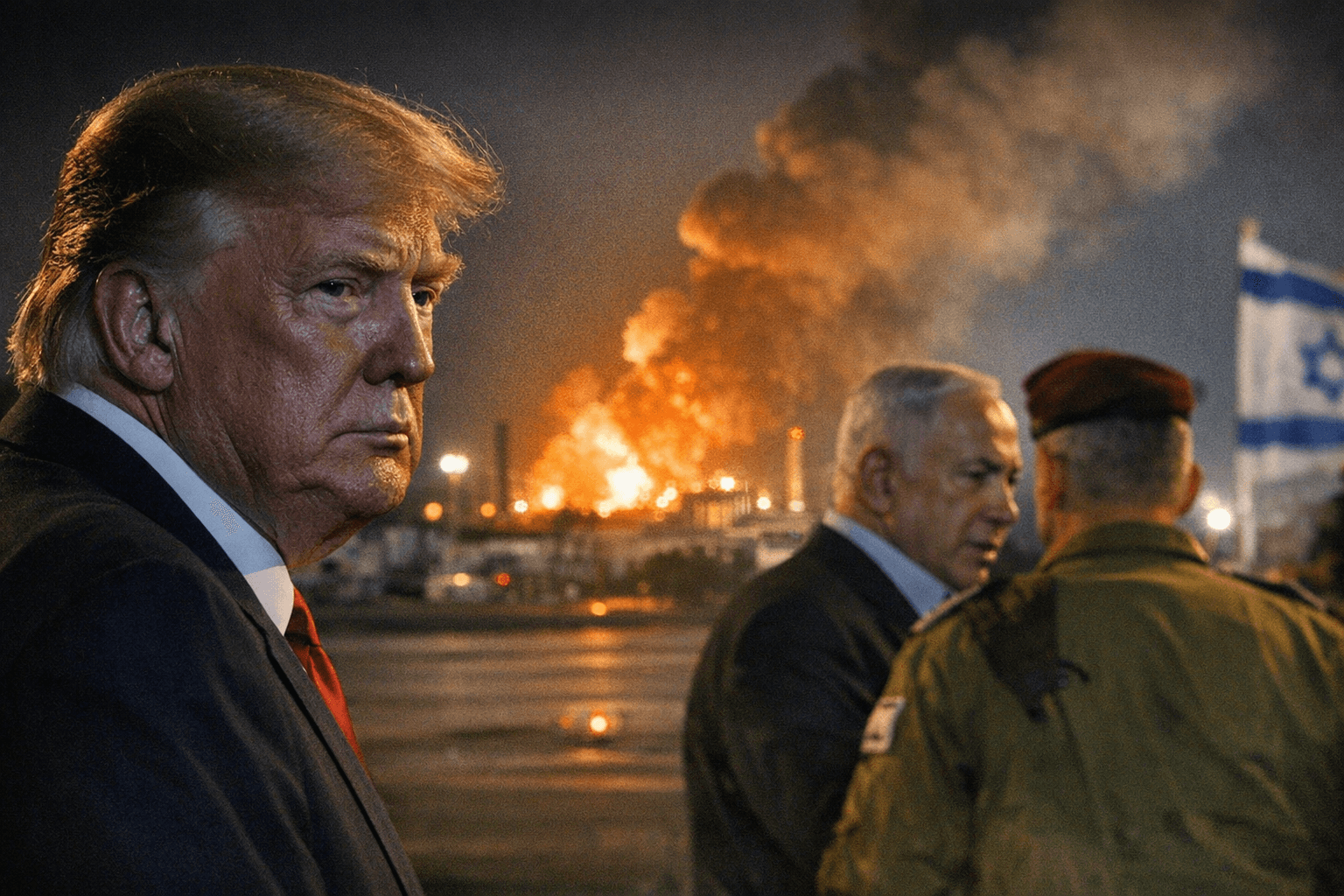
Israel's strike on Iran's South Pars gasfield this week triggered Iranian retaliation against Gulf state energy infrastructure, sent global fuel prices surging, and forced an uncomfortable question into the open: are the United States and Israel actually fighting the same war? President Trump first insisted the United States "knew nothing about" the strike, then backtracked and said he had warned Israel against attacking the complex. That sequence, reported by the New York Times, is not a minor diplomatic embarrassment. It marks, in the words of the Associated Press, "the most notable difference of opinion between the two leaders since the start of the 20-day war against Iran."
Nearly three weeks into a conflict that has reshaped Middle Eastern energy markets and alarmed Gulf allies, the alliance between Washington and Jerusalem is straining under the weight of two fundamentally different visions of what victory looks like.
The Strike That Made the Rift Visible
When the United States and Israel partnered late last month to launch strikes on Iran, both leaders framed their goals in strikingly similar terms. Trump called on the Iranian people "to take back" their country. Netanyahu told Iranians they were facing a "once-in-a-lifetime opportunity" to end the regime of Ayatollah Ali Khamenei. The shared rhetoric suggested shared strategy. Israel's attack on the South Pars gasfield shattered that impression. Iran retaliated against energy infrastructure across Gulf states, threatening global energy supplies and spiking fuel prices. Gulf allies responded by calling on Trump to rein in Netanyahu, placing the White House in the position of distancing itself from its own partner's military operation.
What Washington Says It Wants
The United States has articulated a defined and bounded set of military objectives. According to Director of National Intelligence Tulsi Gabbard, who cited the president's stated aims during a House intelligence committee hearing, those objectives are to destroy Iran's ballistic missile launching capability, its ballistic missile production capability, and its navy. Analysts note that this target list is deliberately structured to offer, as reporting from the New York Times and Al Jazeera describes it, "several avenues for Trump to claim some level of success and attempt to disengage." Trump has consistently emphasized that ensuring Iran "never has a nuclear weapon" is his primary goal, and in a Fox News Radio interview last week he was notably measured about the pathway ahead, expressing specific concerns about the paramilitary Basij force rather than signaling any appetite for regime transformation.
What Israel Says It Wants
Israel's objectives, as attributed by analysts and Netanyahu's own public statements, extend considerably further. Alex Vatanka, a senior fellow at the Middle East Institute in Washington, is unambiguous: "The bottom line for Netanyahu is regime change or at least devastating Iran as a country." Netanyahu has spent decades framing Iran as a threefold existential threat: its nuclear weapons program, its ballistic missile capacity, and its ability to sustain regional proxy groups including Hamas, Hezbollah, and the Houthis. Where Washington appears to be pursuing degradation with an eventual off-ramp, Jerusalem appears to be preparing for something far longer and more transformative. The Associated Press reports that Netanyahu is "preparing for what could be a prolonged campaign," and he is politically positioned to sustain one: Israeli public support for the war is significantly higher than American public support, giving him, as the AP notes, "the political leeway to support a sustained operation that could deliver a decisive blow to Iran's clerical rule."
Where the Two Allies Overlap and Diverge
The analyst identified only as Krieg by Al Jazeera draws the clearest map of this alignment: "They overlap on degrading Iran's missile forces, air defences, command structure and parts of the nuclear programme." The divergence begins the moment those shared targets are exhausted. "Israel appears to want a much deeper transformation of the Iranian system," Krieg told Al Jazeera, "whether that means durable incapacitation or some form of regime destabilisation." Suzanne Maloney, Iran expert and director of the foreign policy program at the Brookings Institution, told the New York Times that divergence between the two allies is "inevitable," adding that "the costs the two sides can bear are even more different, especially over time."
A Public Rupture Inside Washington
Gabbard became the first Trump administration official to publicly acknowledge the split, telling the House intelligence committee that "the objectives that have been laid out by the president are different from the objectives that have been laid out by the Israeli government." Defense Secretary Peter Hegseth praised Israel but noted it follows its own objectives. Intelligence official Joe Kent resigned. The mixed messaging reflects an administration that entered this conflict with a vision of a contained operation and is now navigating the consequences of a partner with far more expansive goals.
Two Leaders, Two Strategic Temperaments
The divergence in aims reflects something deeper than tactical disagreement. As former UK ambassador to Israel Matthew Gould wrote in the Sunday Times, both men share the profile of a populist who divides his country and dominates its political oxygen. But their relationship to military power differs sharply. Trump received five deferments to avoid service in the Vietnam War; Netanyahu served five years in the elite Sayeret Matkal commando unit from 1967 to 1972. Trump described the conflict in Iran as a "little excursion" and reportedly envisioned a swift operation; Netanyahu has consistently treated Iran as the defining strategic challenge of his political career and is not building toward an exit.
The Escalation Question
The stakes of this divergence are not abstract. Krieg's assessment for Al Jazeera frames the central military dilemma clearly: "That does not make boots on the ground inevitable, but it does mean that if Washington ever decides that complete elimination rather than delay is the goal, then air power will probably not be enough." The Pentagon has separately requested $200 billion for the war effort, according to an Al Jazeera report, a figure that signals the scale of planning underway regardless of which set of objectives ultimately prevails. Iran's retaliatory strikes on Gulf energy infrastructure have already demonstrated that the conflict's economic consequences will be felt well beyond the battlefield, from the Strait of Hormuz to global fuel markets.
The central tension of this alliance now rests on whether Trump can hold the line at his stated, limited objectives while Netanyahu prosecutes what he has always framed as an existential campaign, and whether Iran's willingness to strike at the region's energy arteries forces Washington to choose a side in its own coalition.
This article was produced by Prism’s automated news system from verified source data, official records, and press releases, then run through automated quality and moderation checks before publishing. The system is built and supervised by the people who set the standards it runs under. Read our full AI policy.
Did this article answer your question?


