Trump Says White House Ballroom Project Is Ahead of Schedule, Under Budget
Trump claimed the $400M White House ballroom project is "ahead of schedule and under budget," even as a federal judge signals fresh skepticism of the administration's legal arguments.

Holding up architectural drawings for reporters aboard Air Force One on Sunday, President Donald Trump offered his most detailed defense yet of the $400 million plan to replace the demolished White House East Wing with a 90,000-square-foot ballroom, insisting the project was running ahead of schedule and costing less than projected.
"We're doing very well, so we're ahead of schedule," Trump told reporters as the plane returned to Joint Base Andrews from his Mar-a-Lago residence in West Palm Beach, Florida. Trump said the project is financed by donors rather than taxpayer appropriations, a funding structure that has itself drawn scrutiny. He also revealed an unexpected dimension of the construction: "The military is building a massive complex under the ballroom," Trump said. "The ballroom essentially becomes a shed."
Demolition of the East Wing began in October 2025 to clear the site for the new ballroom, a venue where state dinners, galas and other events are expected to be held. The project is slated for completion by 2028.
The administration's legal position, however, remains contested. U.S. District Judge Richard Leon, a George W. Bush appointee, rejected a request in February to block construction, ruling the National Trust for Historic Preservation was unlikely to succeed on the merits of its challenge. But the judge has since signaled renewed skepticism. In a subsequent hearing, Leon pressed the Justice Department on varying authorities it cited as legal justification for the project and questioned whether the president has the power to tear down part of what he called "an icon that's a national institution," describing the private donation funding scheme as a "Rube Goldberg contraption" that would evade congressional oversight.
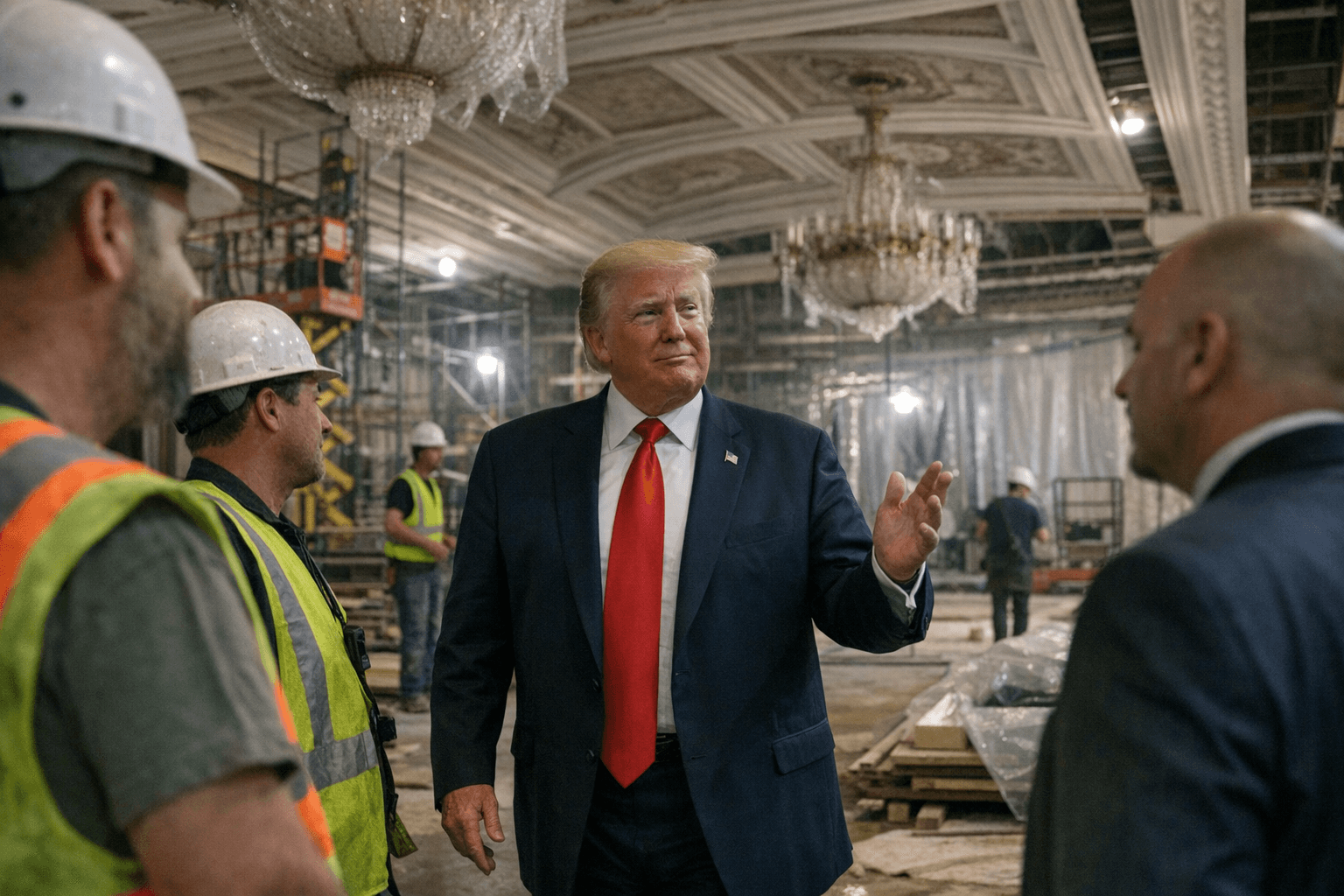
The National Trust for Historic Preservation, a privately funded group, sought to halt the project until it cleared independent reviews and won congressional approval. White House officials countered with structural arguments. Josh Fisher, director of the White House Office of Administration, cited an unstable colonnade, water leakage and mold contamination in explaining why it was more economical to demolish the East Wing than renovate it.
Trump's remarks aboard Air Force One were aimed squarely at that narrative of competence: a signature presidential project proceeding on time, within budget and delivering more than originally advertised. Whether courts allow that trajectory to continue uninterrupted may depend on how Judge Leon rules on the amended preservation challenge, a decision that could either ratify the administration's aggressive use of executive authority over a national landmark or force a costly redesign of a project already well underway.
This article was produced by Prism’s automated news system from verified source data, official records, and press releases, then run through automated quality and moderation checks before publishing. The system is built and supervised by the people who set the standards it runs under. Read our full AI policy.
Did this article answer your question?

