Trump Signs 100% Pharma Tariff, Offering Exemptions for Price, Manufacturing Deals
Trump signed a 100% tariff on patented drug imports, but 13 of 17 major pharma companies had already secured deals reducing their effective rate to zero.

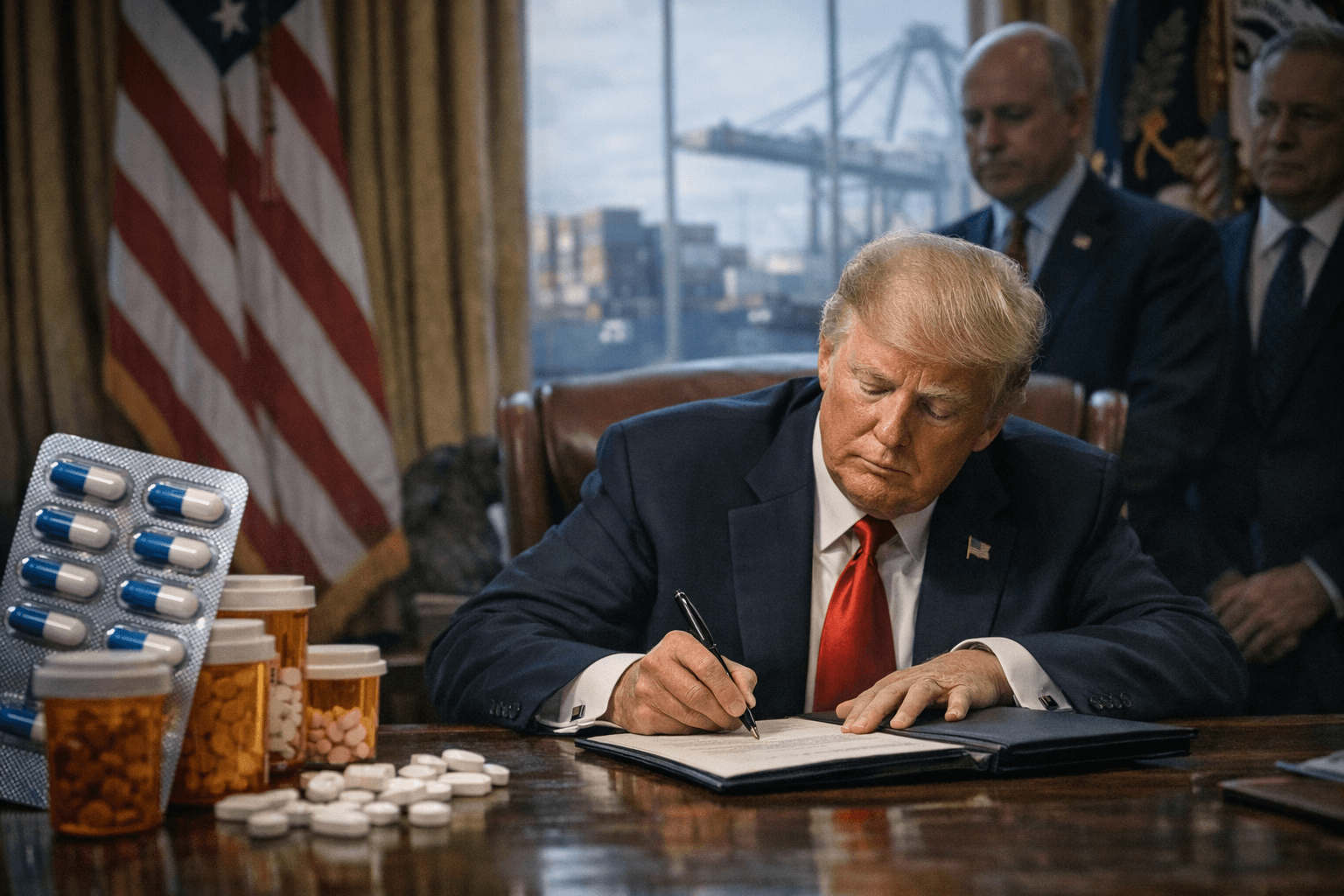
President Trump signed an executive order imposing a 100% tariff on patented pharmaceutical imports, but built the measure as much around its incentive pathways as its penalties: 13 of the 17 major drug companies formally approached by the administration had already negotiated deals that reduce their tariff exposure to zero.
The order, signed on the one-year anniversary of Trump's "Liberation Day" tariff announcement, invokes Section 232 of the Trade Expansion Act of 1962, the same national-security authority Commerce Secretary Howard Lutnick used to initiate steel, aluminum, and copper investigations.
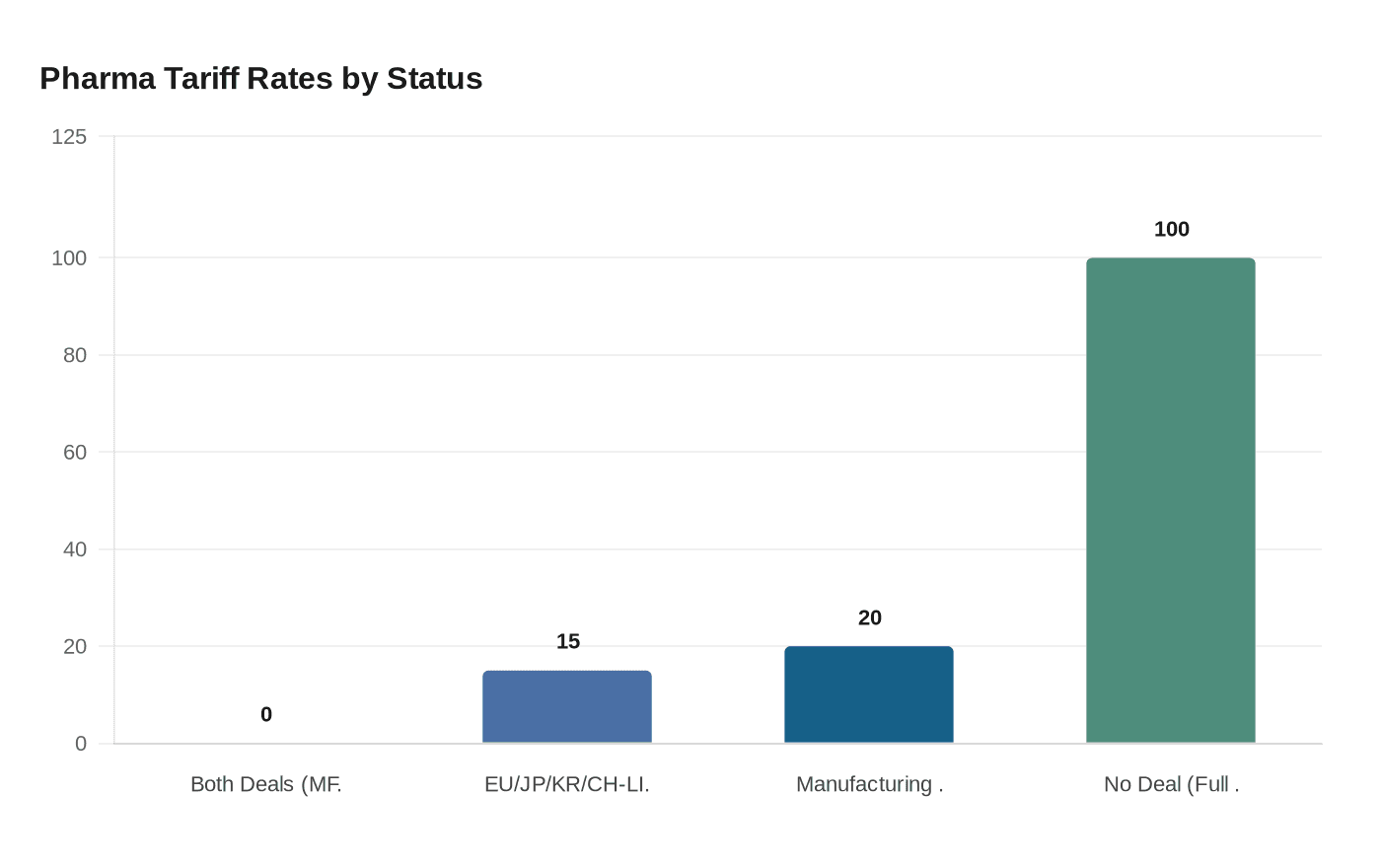
The structure is deliberately tiered. Companies that signed both a Most Favored Nation pricing agreement with the Department of Health and Human Services and a domestic manufacturing commitment with the Department of Commerce face a 0% rate through January 20, 2029. Companies that committed only to onshoring face a reduced 20% rate, which climbs to the full 100% if they fail to follow through within four years. Large companies have 120 days before tariffs take effect; smaller ones have 180.
Pfizer, AstraZeneca, Eli Lilly, Novo Nordisk, Amgen, Bristol Myers Squibb, Gilead, GSK, Merck, Novartis, Sanofi, Roche's Genentech unit, Boehringer Ingelheim, and EMD Serono all reached agreements, securing a three-year window free of the levy. Under the MFN terms, those companies agreed to sell most of their drugs to Medicaid at prices matching other wealthy nations and to participate in the administration's direct-to-consumer purchasing platform. AbbVie, Johnson and Johnson, and Regeneron had not finalized deals at the time of the signing, though Regeneron spokeswoman Alexandra Bowie said discussions with the administration remained ongoing.
Geographic carve-outs further narrow the order's actual reach. Pharmaceutical imports from the European Union, Japan, South Korea, and Switzerland and Liechtenstein are capped at 15% under existing trade agreements. The United Kingdom faces a below-100% rate under a recently concluded bilateral pharmaceutical accord. Generic drugs, biosimilars, and orphan drugs are exempt entirely, though generics face reassessment within one year.
The White House credited the tariff threat with spurring roughly $400 billion in new U.S. pharmaceutical investment commitments. Alongside the pharmaceutical order, Trump also overhauled Section 232 metal tariffs on steel, aluminum, and copper. The core 50% rate on raw imports stays in place, but duties will now be assessed on the price American buyers actually pay, not on production costs declared by foreign exporters. A senior administration official said foreign sellers had been "gaming the system" by deflating those declared figures to reduce their tariff liability. Under the revised derivative-products rules, goods where metals account for less than 15% of total weight are exempt from the separate metals tariff, while products substantially made of steel, aluminum, or copper face a flat 25% tariff on the full product value.
Both actions rely on Section 232 after the Supreme Court struck down Trump's broader tariff regime in February 2026, ruling that measures imposed under the International Emergency Economic Powers Act after Liberation Day constituted an unconstitutional overreach of presidential authority.
Critics are warning of a quieter cost accumulating downstream. Lindsay Bealor Greenleaf, head of market access policy strategy at ADVI, said the biggest risk from these policies "lies squarely on the concerns around innovation and drugs launching in the future." She cited an American Action Forum projection from 2020 estimating that MFN pricing applied only to Medicare Part B drugs could yield 60 fewer drug launches over a decade, and noted the current policy extends considerably further than that scope.
The Tax Foundation has characterized the broader Trump tariff program as the largest U.S. tax increase as a share of GDP since 1993, amounting to an average burden of roughly $1,500 per household in 2026. The pharmaceutical order adds another layer to that total, structured to reward companies willing to accept pricing constraints and manufacturing commitments while penalizing those that hold out. For the three major holdouts, the clock on that choice is now running.
Sources:
Know something we missed? Have a correction or additional information?
Submit a Tip