Trump Signs Executive Order Restricting Mail-In Voting, States Vow Legal Challenge
Two states pledged immediate court challenges after Trump signed an order directing USPS to gatekeep mail ballot delivery and threatening noncompliant states with funding cuts.
Before Arizona Secretary of State Adrian Fontes had finished reading President Donald Trump's new election executive order, he had a name for it: "a disgusting overreach from the federal government." Oregon Secretary of State Tobias Read had a message for Trump: "We'll see you in court."
The order, formally titled "Ensuring Citizenship Verification and Integrity in Federal Elections" and signed March 31, 2026, in the Oval Office with Commerce Secretary Howard Lutnick in attendance, is the most sweeping attempt yet by a president to assert federal control over how Americans cast ballots. It directs the Department of Homeland Security and the Social Security Administration to compile state-by-state lists of confirmed eligible voters and transmit them to each state's chief election official no fewer than 60 days before any federal election. It instructs the U.S. Postal Service to transmit mail ballots only to voters on a separate state-specific list, with states required to notify USPS of their intended mail voters at least 90 days before an election. All mailed ballots must carry secure envelopes with unique tracking barcodes.
The order also requires mailed ballots to be physically received by election offices on Election Day itself, a provision that would eliminate grace periods in dozens of states that currently count ballots postmarked by Election Day but arriving days later. States that do not comply face a loss of federal funding, and the order directs the Attorney General to prioritize investigation and prosecution of any election official who distributes ballots to ineligible voters.
Election law scholars were unsparing in their assessment. Rick Hasen, a professor of election law, said "the Constitution doesn't give DHS any power over elections" and added that "the timing here makes this virtually impossible to implement in time for November's elections." David Becker, founder of the nonpartisan Center for Election Innovation and Research, was equally direct: "The president has no power over elections in the states. This will be blocked as soon as lawyers can get to the courthouse." The Constitution assigns authority over elections to the states and, where Congress chooses to act, to Congress; the president holds no role.
Fontes pointed out an inconvenient political history: Arizona's vote-by-mail system was originally designed by Republicans. Oregon, which votes entirely by mail, has the most to lose from the USPS ballot controls. The ACLU condemned the order as "unlawful" and part of a "pattern of unconstitutional attacks on our freedom to vote."
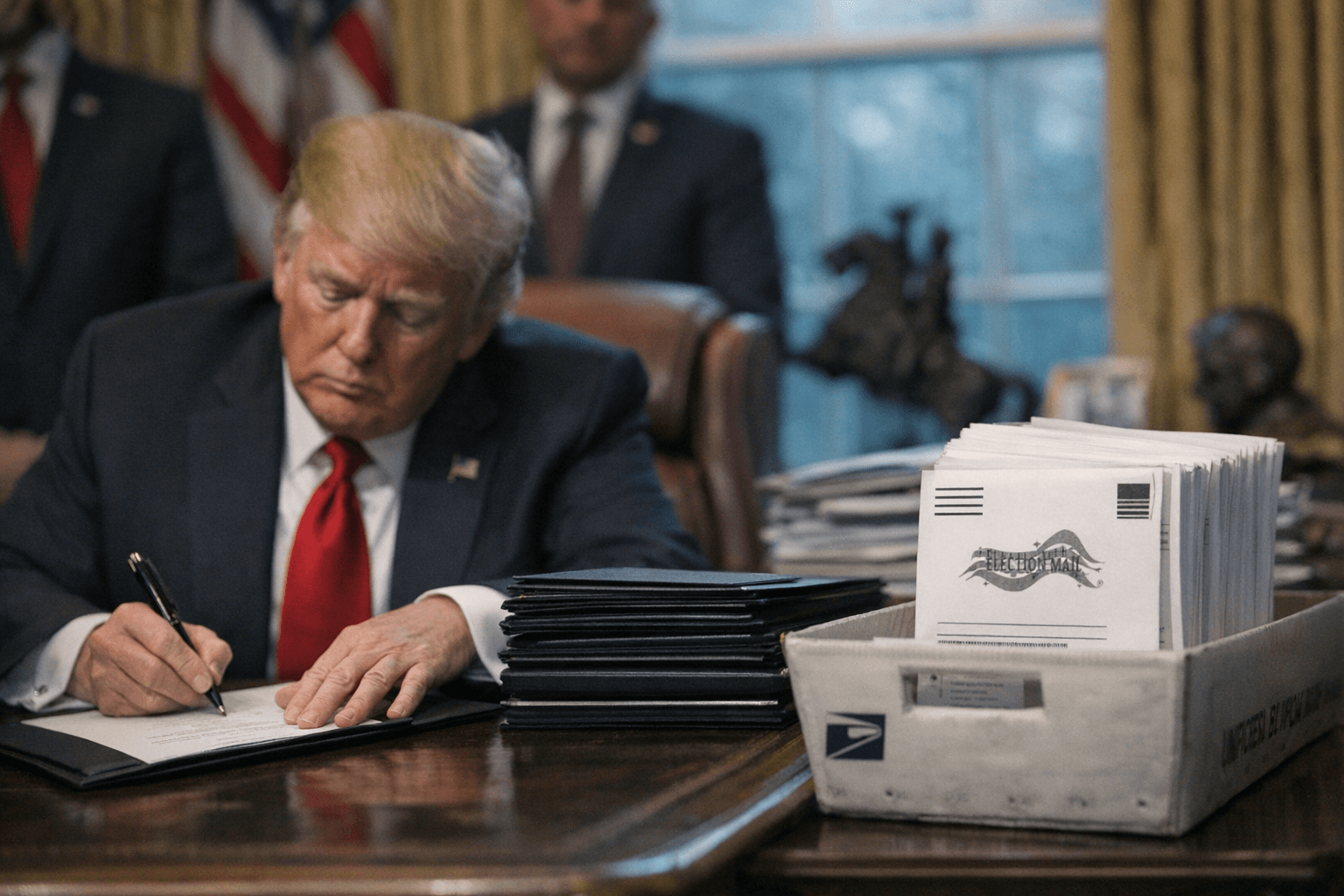
Legally, the order faces long odds. Trump's first election executive order, EO 14248, signed in March 2025, attempted similar restrictions and was largely blocked by federal courts, including in Washington v. Trump, where a district court ruled a key provision unlawful as applied to Washington State and Oregon.
While signing the order, Trump repeated discredited claims about mail-in voting, declaring the practice was "legendary" cheating and asserting he had won "three times," a claim refuted by audits, court decisions, and investigations in every state where it was raised. Noncitizen voting in federal elections is already a federal crime, and experts note it remains exceedingly rare. Trump himself voted by mail in a recent Florida election.
The signing comes as the U.S. Senate continues to debate the SAVE America Act, which would require proof of citizenship and ID to vote and restrict approved reasons for mail-in ballots. The executive order appears to be Trump's attempt to impose, unilaterally, what Congress has so far declined to pass. White House aide Will Sharf defended the order; legal challenges are expected to reach federal courts within days.
This article was produced by Prism’s automated news system from verified source data, official records, and press releases, then run through automated quality and moderation checks before publishing. The system is built and supervised by the people who set the standards it runs under. Read our full AI policy.
Did this article answer your question?

