Trump softens China tariffs as trade fights widen, talks drag on
Trump’s China tariff push peaked at 145% before a Geneva truce cut duties by 115% on each side and exposed how market and supply-chain pressure forced a retreat.
Donald Trump’s hardest line on China did not hold once it ran into financial markets, allied negotiations and the practical limits of U.S. supply chains. After entering his second term on January 20, 2025, he used emergency tariff powers, including the International Emergency Economic Powers Act and Section 232, with Section 301 still available, to broaden pressure on trading partners. But the campaign quickly shifted from confrontation to bargaining as the White House pursued framework deals with the United Kingdom and the European Union, preliminary understandings with several Asian economies, and a temporary truce with Beijing.
The China escalation came first. On April 2, 2025, Trump announced an additional 34% tariff on Chinese goods as part of his reciprocal tariff push. After Beijing retaliated, U.S. tariffs on China were pushed up to 145 percentage points by April. On April 9, Trump paused most country-specific reciprocal tariffs for 90 days, but China was left in the crosshairs. That split showed where the administration was willing to blink and where it was not. Broad global tariffs could be delayed; the confrontation with Xi Jinping could not be sold away so easily.
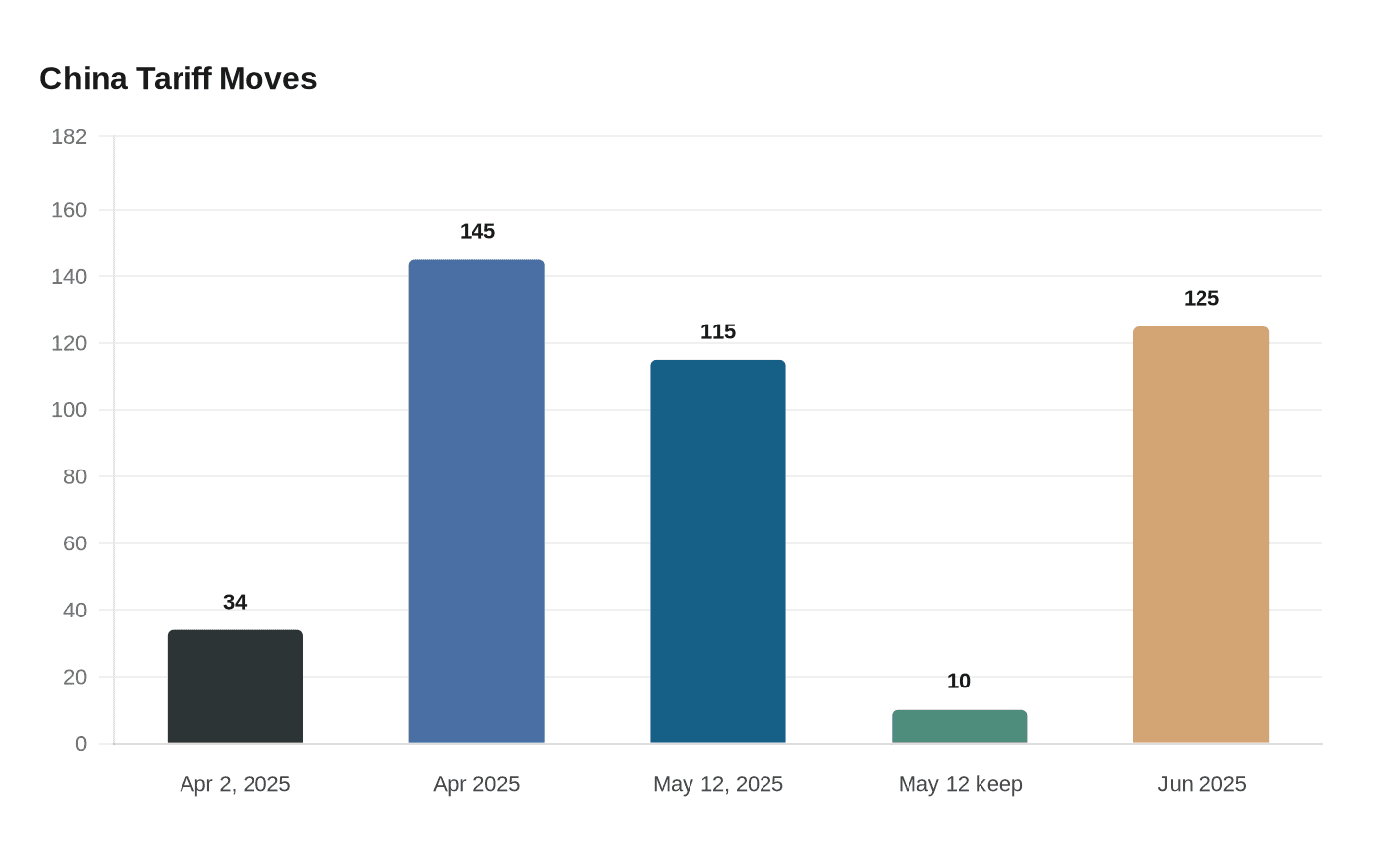
The first real climbdown came in Geneva on May 12. The White House said the United States and China agreed to lower tariffs by 115% on each side, while keeping an additional 10% tariff in place. China agreed to remove retaliatory tariffs and suspend or remove non-tariff countermeasures taken since April 2. The United States said it would remove the extra tariffs imposed on April 8 and April 9, but keep pre-existing duties, including Section 301, Section 232, fentanyl-related IEEPA tariffs and normal MFN duties. It was a truce, not a settlement.
That partial retreat reflected the wider damage. By June 2025, China had answered with 125% tariffs on American imports, and U.S. imports from China had fallen to about half their level from a year earlier. Global stock markets rose when the de-escalation was announced, but the underlying dispute remained unresolved. Businesses were already shifting sourcing toward Vietnam, Taiwan and Mexico, while critical inputs such as rare earth permanent magnets and certain semiconductors still depended on China. Chinese export restrictions on those products nearly disrupted U.S. auto production, a reminder that the most aggressive tariff threats can quickly collide with the reality of industrial dependence. By the end of 2025, China’s share of U.S. goods imports had dropped to 9%, down from 22% before Trump’s first trade war in 2018, a sign that the economic break was real even if the politics of confrontation kept widening.
Know something we missed? Have a correction or additional information?
Submit a Tip