Trump Threatened to Obliterate Iran's Power Grid; Tehran Fired Back With Missiles
Trump gave Iran 48 hours to reopen the Strait of Hormuz or face strikes on its power plants. Tehran dismissed the ultimatum and launched missiles into southern Israel.
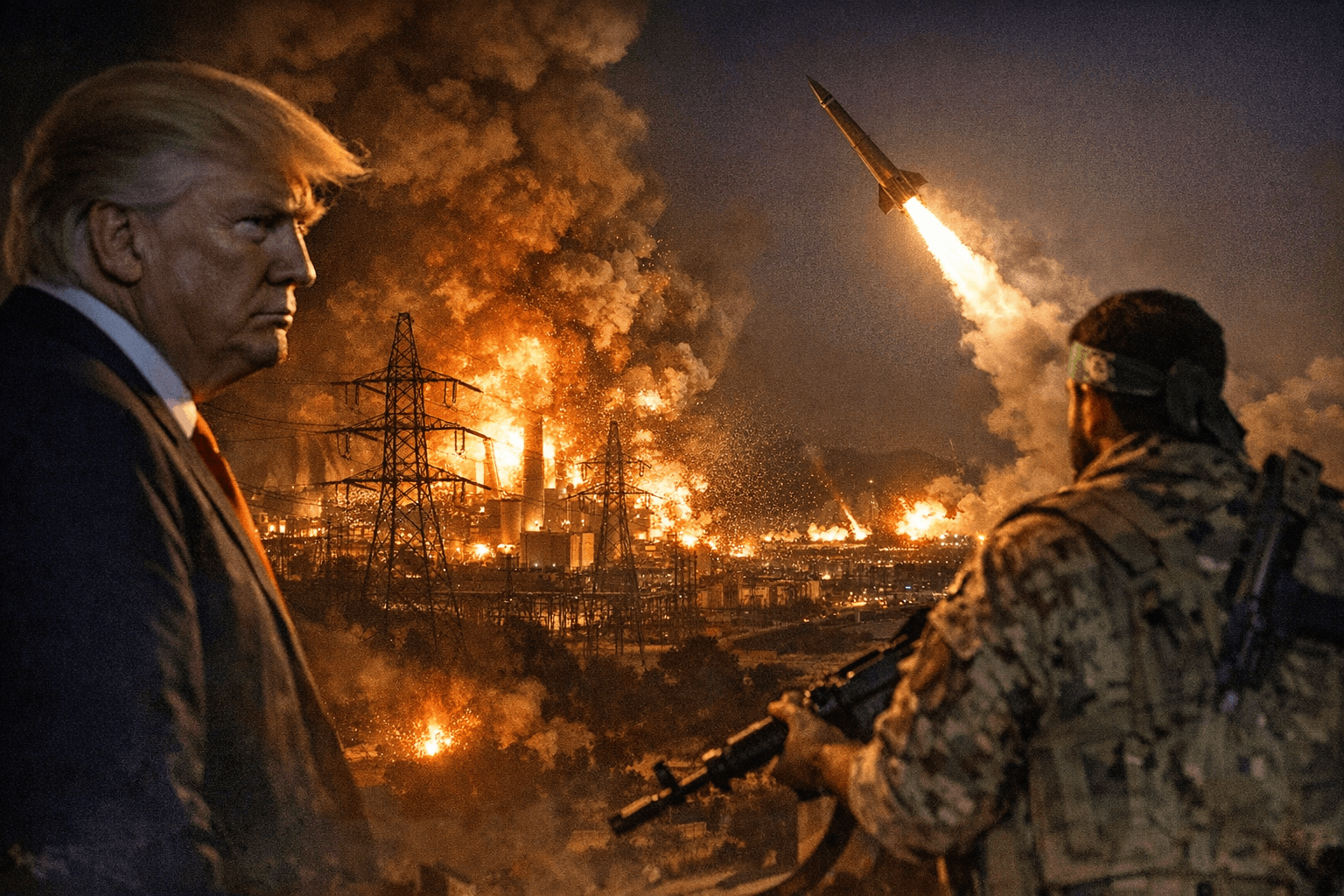
Iranian missiles struck the southern Israeli towns of Dimona and Arad on Saturday, wounding more than 100 people after missile defense systems failed to intercept them, even as President Trump issued a 48-hour ultimatum threatening to "obliterate" Iran's power plants if Tehran did not reopen the Strait of Hormuz.
The strikes landed near Israel's main nuclear research center. Iran said the attack on Dimona was direct retaliation for an earlier Israeli strike on Natanz, Iran's primary nuclear enrichment facility, according to the official Iranian news agency Mizan.
Trump, speaking to reporters aboard Air Force One, expressed surprise at Iran's refusal to comply, describing Tehran's posture as unwillingness to "cry uncle." He warned that any military response would begin "starting with the biggest one first," a reference to Iran's largest power plant.
Iran did not blink. Its military announced through state media that it would retaliate by striking U.S. infrastructure across the region. Iran's top military spokesman, Gen. Abolfazl Shekarchi, went further, warning that "parks, recreational areas and tourist destinations" worldwide would not be safe for enemies of Tehran. Iranian officials also insisted the country was continuing to build missiles.
The confrontation unfolded against a backdrop of sustained U.S. military pressure. A bombing run over Iran's three major nuclear sites last June was, by American accounts, a single evening's operation that buried the country's nuclear stockpiles and destroyed thousands of centrifuges used to enrich uranium. That campaign stripped Iran of its most advanced nuclear capabilities but has not broken its willingness to fight.
Iran also attempted a missile strike Friday on Diego Garcia, the joint U.S.-British military base in the Indian Ocean roughly 2,500 miles from Iranian territory. The strike failed. The attempted attack raised immediate questions about the operational reach of Iran's arsenal: the farther Iran fires, the less reliable its missiles and the less accurate its attacks become. Iran's weapons, for all the alarm they have generated, currently cannot reach the continental United States.
Trump had telegraphed that concern even before the current conflict began, warning in his State of the Union address that Iran was "working to build missiles that will soon reach the United States of America."
Iran's Revolutionary Guard disputed Israeli Prime Minister Benjamin Netanyahu's claim that Iran's navy had been sunk, its air force reduced to tatters, and its ballistic missile production capacity eliminated. Saturday's strikes on Israeli soil, whatever their strategic outcome, gave that denial some weight.
The strategic calculus now centers on the Strait of Hormuz, the narrow waterway through which roughly 20 percent of the world's traded oil passes. Iran's closure of the strait has already rattled energy markets. Trump's ultimatum places the economic pressure squarely back on Tehran, but a government that has absorbed the destruction of its nuclear program and continued launching missiles across a 2,500-mile arc is not one that has shown a disposition toward quick concessions.
The 48-hour clock, by all appearances, is running.
Know something we missed? Have a correction or additional information?
Submit a Tip